Updated 2 min read
In This Article:
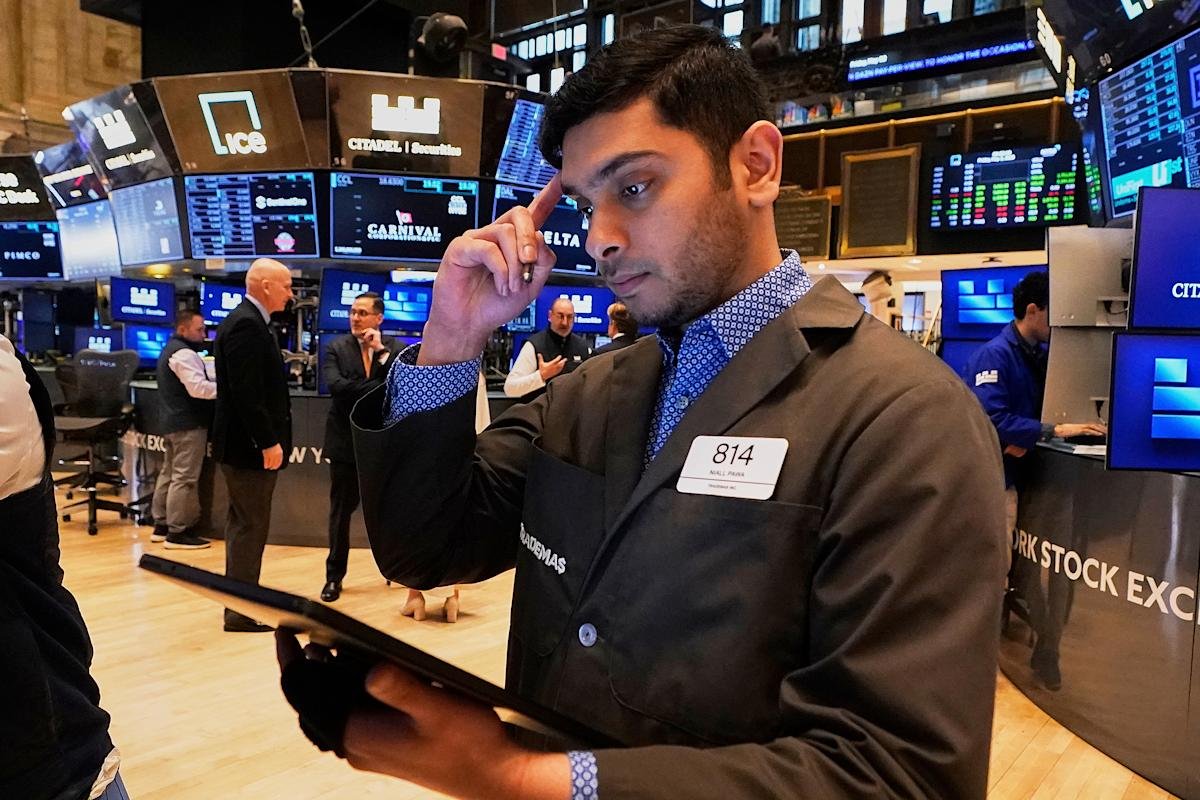
US stock futures fell on Tuesday in the wait for the Federal Reserve meeting to start, as investors gauged the impact of President Trump’s tariffs on its decision making and the path of interest rates.
S&P 500 futures (ES=F) slid 0.8%, while Dow Jones Industrial Average futures (YM=F) dropped roughly 0.6%. Contracts on the tech-heavy Nasdaq 100 (NQ=F) led the way lower, falling over 1%.
The countdown is on to the Fed’s rate decision on Wednesday as policymakers begin their two-day meeting. Although the central bank is expected to keep rates unchanged, Wall Street will listen closely to Chair Jerome Powell’s comments on how the economy is holding up. Focus is on the Fed’s evaluation of the fallout from Trump’s trade offensive, which has yet to fully show up in economic data.
Read more: The latest on Trump’s tariffs
The president’s remarks at the weekend dimmed hopes of tariff relief, helping drive a retreat by the S&P 500 (^GSPC) on Monday from its longest winning streak in 20 years. First, Trump said he plans to impose a 100% tariff on movies produced outside of the US. He also indicated he has no plans to talk trade with China’s President Xi Jinping this week.
And in another salvo, Trump signaled late Monday that he planned to announce tariffs on pharmaceuticals over the next two weeks. He made the comments after signing an executive order aimed to reduce regulatory hurdles for pharmaceutical manufacturing in the US.
Meanwhile, Ford (F) shares dropped in premarket as tariffs loomed large in its strong earnings report. The Big Three carmaker pulled its 2025 guidance and said it foresees a $1.5 billion hit from auto tariffs. Barbie maker Mattel (MAT) added to the storm clouds, withdrawing its guidance and saying it would hike prices for some products.
Highlights on the earnings docket on Tuesday include chipmaker AMD (AMD), server maker Super Micro (SMCI), and EV company Rivian (RIVN).
LIVE 6 updates
-
Mattel pulls FY forecasts, eyes price hikes due to tariff costs
Barbie maker Mattel (MAT) has joined Ford (F) and others in flagging that it’s bracing for a big impact from President Trump’s overhaul of trade policy.
Shares slipped into the red in premarket trading despite the toymaker’s earnings beat on Monday.
“Given the volatile macroeconomic environment and evolving U.S. tariff landscape, it is difficult to predict consumer spending and Mattel’s U.S. sales in the remainder of the year and holiday season,” the company said, as it withdrew its previous full-year forecasts.
Mattel warned it may need to hike US prices for some of its products as it faces $270 million in added input costs from tariffs this year. The company imports about 20% of the items it sells in the US from China, according to Reuters.
But it said it expects to offset those costs as it accelerates moves to shift manufacturing from China.
-
Stock’s recent rally is the norm for bear markets: Goldman
The steep recovery in equity markets over the past two weeks is typical of bear market rallies, and the erratic swings mean almost every investor will experience pain whichever direction the market suddenly moves.
Goldman Sachs Group (GS) strategist Peter Oppenheimer said “the asymmetry for equity investing is poor. Sharp rallies within bear markets are the norm, not the exception.”
The biggest market driver is still uncertainty, with no real long-term bullish or bearish conviction seen from investors. Price action is mainly fueled by short-term headlines and guesswork on how the quickly evolving US tariffs story will be told through corporate earnings and resetting valuations.
“If the tariff announcements are reversed quickly with little lasting economic damage, this does suggest that the downside risks are limited. Nonetheless, at current valuations, we also think the upside is limited,” Oppenheimer wrote in a note.
Investing becomes far more difficult in such a regime, when both upside and downside are seen as limited and decision making is caught in foggy headline risk. Market participants have to choose between chasing a fading rally then risk exiting too late, or missing out entirely on another squeeze higher. They want to avoid trap doors in a tricky macroeconomic environment while still being able to capture opportunities.
-
Stocks’ best winning streak since 2004 hasn’t ‘alleviated’ Wall Street’s worries
Yahoo Finance’s Josh Schafer reports:
The S&P 500 (^GSPC) has recouped all of its “Liberation Day” losses with help from the longest winning streak for the benchmark index since 2004.
But now, with the S&P 500 up about 14% from its April 8 low, Wall Street strategists aren’t confident that a smooth path higher for the index will continue.
“For now, fundamental and macro concerns are pushed out but not alleviated,” Citi equity strategist Scott Chronert wrote in a note to clients.
To Chronert’s point, there have been incremental signs that the US is nearing trade deals in recent weeks, but none have actually been announced. This leaves Trump’s tariffs as a consistent variable in the investing landscape.
Another key concern is the risk of recession. While the April jobs report released Friday showed the US labor market remains on solid footing, other indicators have continued to flash signs of a cooling jobs environment. This comes amid a wave of other worse-than-expected economic data.
-
‘Asian crisis in reverse’ as currencies soar vs. the dollar
A wave of dollar (DX=F) selling in Asia is an ominous sign for the greenback as the world’s export powerhouse starts to question a decades-long trend of investing its big trade surpluses in US assets.
Ripples from Friday and Monday’s record rally in the Taiwan dollar (TWD=X) are now spreading outward, driving surges for currencies in Singapore, South Korea, Malaysia, China and Hong Kong.
The moves sound a warning for the dollar because they suggest money is moving in to Asia at scale and that a key pillar of dollar support is wobbling.
While Tuesday brought a measure of stability, following a stunning 10% two-day leap for Taiwan’s currency, Hong Kong’s dollar (HKD=X) was testing the strong end of its peg and the Singapore dollar has soared close to its highest in more than a decade.
“To me, it has a very sort of Asian-crisis-in-reverse feel to it,” said Louis-Vincent Gave, founding partner of Gavekal Research, in a podcast, due to the speed of the currency moves.
-
China stocks rally after holiday break amid trade optimism
Chinese shares advanced on their return from a five-day holiday, aided by signs of easing trade tensions with the US and data showing resilient domestic consumption.
The onshore benchmark CSI 300 (000300.SS) Index ended 1% higher Tuesday, with telecom and technology names among the top gainers. An index of small-cap stocks rallied 3.3% to close at a one-month high.
The gains came after Treasury Secretary Scott Bessent said the US could see some “substantial progress in the coming weeks” in trade talks with China. That followed President Donald Trump‘s remarks that said he is willing to lower tariffs on China at some point, building on optimism triggered by Beijing’s statement Friday that it is assessing the possibility of trade talks with the US.
Meanwhile, latest data from strong sales at key retail and catering firms to robust holiday traffic results also came as a welcome sign for policymakers seeking to boost consumption to drive future economic expansion. Those appear to have eased concerns about slowing growth after a private gauge showed China’s services activity deteriorated more than expected in April.
-
Palantir stock plummets after the bell
Palantir Technologies Inc. stock dropped 9.2% in after-hours trading following earnings reports that did not live up to Wall Street’s sky-high expectations.
Bloomberg reports: