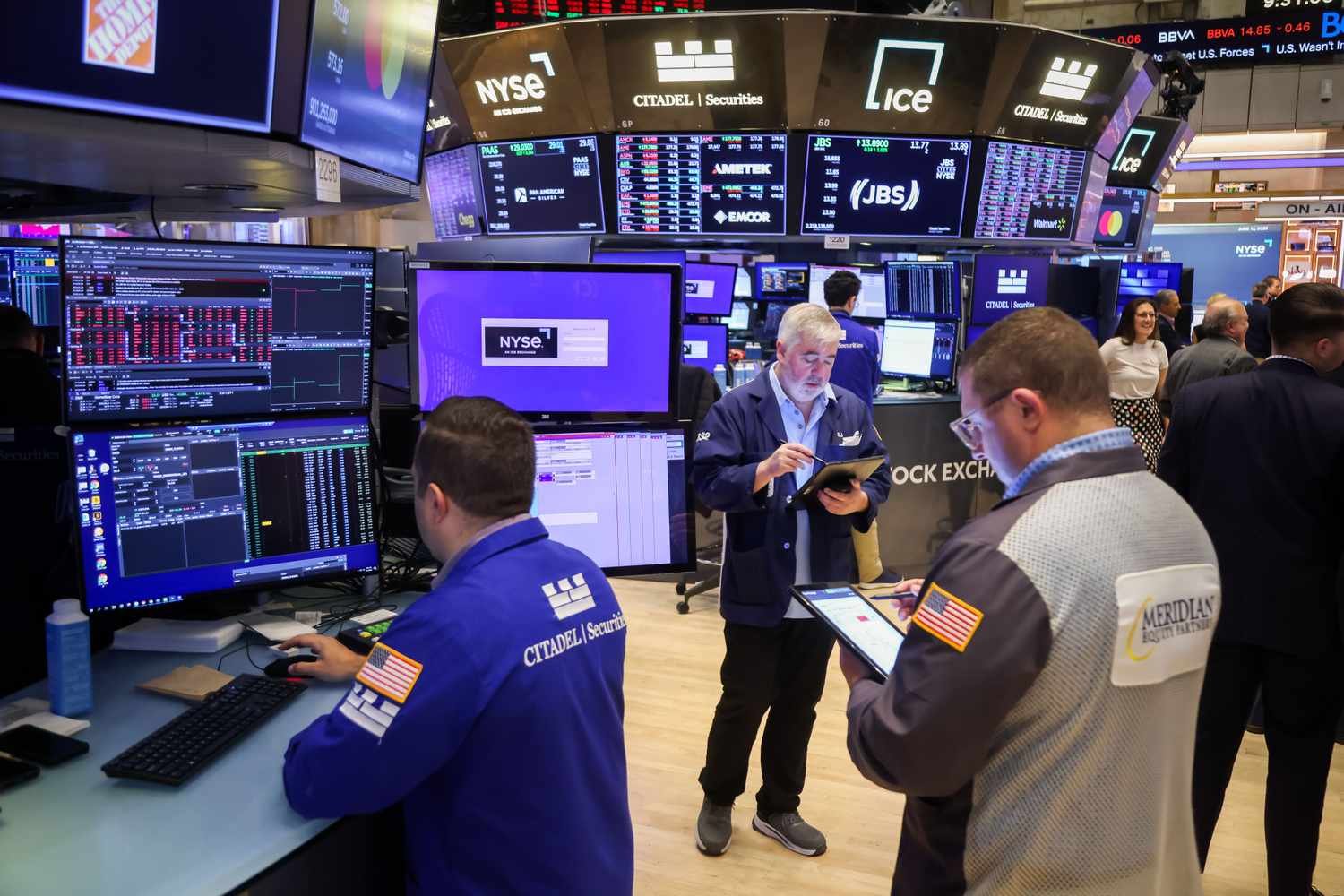
Stocks moved sharply higher Monday morning, recovering from steep losses the previous session, as investors keep close tans on the latest developments in the ongoing conflict between Israel and Iran.
The Dow Jones Industrial Average and S&P 500 were each up 1.1% recently, while the tech-heavy Nasdaq added 1.5%. Major indexes are coming off their first weekly declines in three weeks after a sharp downturn on Friday spurred by the onset of heavy fighting between Iran and Israel.
West Texas Intermediate futures, the U.S. crude oil benchmark, slid 3.9% to $70.15 per barrel this morning, after surging nearly 8% on Friday amid concerns that oil supplies could be disrupted by attacks on energy infrastructure in the Middle East. WTI futures had risen as high $77.60 on Friday, their highest level since January.
Before Friday’s sell-off, stocks had rallied—with the S&P 500 nearing a new record high—amid hopes the Trump administration will soften its stance on tariffs, as well as optimism about generally strong corporate earnings and a data that shows the economy remains on sound footing. The calendar for economic data and corporate earnings is light this week, with investor attention focused on the Federal Reserve’s decision on interest rates, scheduled for Wednesday afternoon.
Shares of the world’s largest technology companies were up across the board this morning. Chipmakers Nvidia (NVDA) and Broadcom (AVGO) rose 2% and 1%, respectively, while Meta Platforms (META) climbed 3%, and Microsoft (MSFT), Apple (AAPL), Amazon (AMZN), Alphabet (GOOG) and Tesla (TSLA) each gained about 1%.
Among other noteworthy tech sector movers, Advanced Micro Devices (AMD) soared 9% to lead S&P 500 gainers, as chip stocks moved higher. Marvell Technology (MRVL), Arm Holdings (ARM) and ON Semiconductor (ON) were each up more than 5%.
Airline stocks also advanced this morning, recovering from steep losses on Friday that were spurred by concerns about higher fuel prices. Delta (DAL), United (UAL) and Airlines (AAL) each tacked on about 5%.
Bitcoin was at $107,600 in recent trading, up from a weekend low of around $104,500. The digital currency traded above $110,000 last week, approaching its record high of just below $112,000.
The yield on the 10-year Treasury note, which affects borrowing costs on a wide range of loans, notably mortgages, was at 4.41%, down from 4.42% at Friday’s close. The U.S. dollar index, which measures the performance of the dollar against a basket of foreign currencies, fell 0.3% to 97.87, after hitting a three-year low last week of around 97.60.
Gold futures were down 1.2% at $3,410 an ounce, giving back some of the gains posted last week as investors turned to the traditional safe haven amid the geopolitical tensions. The precious metal is not far from its record high of around $3,500.
US Steel Jumps as Nippon Steel Set to Complete Acquisition
18 minutes ago
United States Steel (X) shares surged Monday, as the Pittsburgh-based company’s takeover by Japan’s Nippon Steel looks set to close following approval by President Donald Trump.
Trump issued an executive order on Friday green lighting Nippon Steel’s takeover of U.S. Steel after the companies signed a national security agreement, which included the issuance of a so-called golden share to Washington. The companies didn’t elaborate on what the golden share would entail.
In a post on X over the weekend, Commerce Secretary Howard Lutnick said the golden share “has powerful terms that directly benefit and protect America, Pennsylvania, the great steelworkers of U.S. Steel, and U.S. manufacturers that will have massively expanded access to domestically produced steel.” The golden share prevents U.S. Steel from many actions without the president’s approval—such as moving the headquarters out of Pittsburgh, transferring jobs outside the U.S., or changing its name, Lutnick wrote.
The national security agreement also provided for approximately $11 billion in new investments to be made by the companies by 2028. Former President Joe Biden blocked the $14.1 billion takeover by the Tokyo-based steelmaker in the final days of his presidency, citing national security concerns.
The companies said they have received all the needed regulatory approvals, and “the partnership is expected to be finalized promptly.”
U.S. Steel shares were up 5% in recent trading. The stock has gained about 60% since the start of 2025.
Boeing Levels to Watch After Last Week’s Slide
1 hr 11 min ago
Boeing (BA) shares inched higher Monday morning after slumping to end last week following news that one of the company’s aircraft was involved in an Air India plane crash on Thursday.
While air safety experts have said that at this time there is no reason to think a manufacturing or design problem caused the incident, it comes as the aircraft manufacturer faces heightened scrutiny over its production processes following several mishaps involving its planes, including a door plug detaching in midair on an Alaska Airlines 737 Max 9 flight in January last year.
Boeing shares fell 4.8% on Thursday and dropped another 1.7% on Friday. The stock still trades about 13% higher since the start of the year. In recent months, the shares have been boosted by optimism that the company could be a beneficiary in a long term trade deal with China and Beijing’s withdrawal of a ruling imposed in early April that barred the country’s airlines from taking delivery of Boeing planes.
Boeing shares staged a news-driven breakdown from a rising wedge pattern in Thursday’s trading session, potentially setting the stage for a deeper retracement. The selling, which occurred on the highest volume since last October, coincided with the relative strength index falling toward its neutral threshold, signaling accelerating downside momentum.
Investors should watch crucial support levels on Boeing’s chart around $187 and $163, while also monitoring vital resistance levels near $218 and $245.
The stock was up 0.7% at just under $202 in recent trading.
Read the full technical analysis piece here.
What to Expect from Fed Meeting This Week
2 hr 23 min ago
The Federal Reserve is likely to stick to its “wait-and-see” mantra, setting it on a collision course with the president.
The Federal Reserve is widely expected to hold its key interest rate steady when the central bank’s policy committee meets Wednesday, possibly provoking more wrath from President Donald Trump, who has repeatedly demand the Fed, which is not under direct control of the White House, cut its benchmark interest rate by an entire percentage point.
Financial markets are pricing in nearly a 100% chance the Fed will leave the rate unchanged this week, according to the CME Group’s FedWatch tool, which forecasts rate movements based on Fed funds futures trading data.
Al Drago / Bloomberg / Getty Images
In recent weeks, Fed officials have said they’re reluctant to lower interest rates from their current elevated levels because they’re concerned Trump’s tariffs will reignite the high inflation that has fallen to within shooting distance of the Fed’s target of a 2% annual rate, after surging in the post-pandemic era. For his part, Trump has frequently browbeaten the Fed for not having cut rates this year, going so far as to call Fed Chair Jerome Powell a “numbskull”.
A lower fed funds rate could boost the economy and encourage job creation, but it could also take some of the downward pressure off inflation.
Fed officials have been under a communications “blackout” over the past week in advance of the meeting, but before they went silent, members of the Federal Open Market Committee said they wanted to see how the economy responded to Trump’s tariffs before making any policy moves.
The tariffs pose a dual threat to the Fed’s dual mandate to keep inflation low and employment high: not only could the import taxes push up prices, but they could hurt the economy, potentially pushing up unemployment. If inflation proves the greater threat, the Fed could keep interest rates higher for longer, or alternatively, could cut rates to rescue the economy if the job market starts to crumble.
Recent economic data has showed the job market holding steady and inflation staying cool, giving the Fed more reason to bide its time, economists said.
“No FOMC official has been advocating for a change in policy, so the decision to hold should be easy,” Michael Feroli, chief U.S. economist at JPMorgan Chase, said in a commentary.
The fed funds rate is the Fed’s main tool for carrying out monetary policy and influencing the economy. The rate affects interest rates at which banks lend money to one another, which influences how much interest they charge for car loans, credit cards, and other debt.
The Fed cut the rate to near zero to support the economy with easy money during the pandemic, and cranked it up to a two-decade high starting in 2022 to counteract a surge of inflation, holding it there until late 2024. Last year, the Fed began cutting rates because inflation was cooling, but has kept the rate flat since December after Trump’s election shook up the economic outlook.