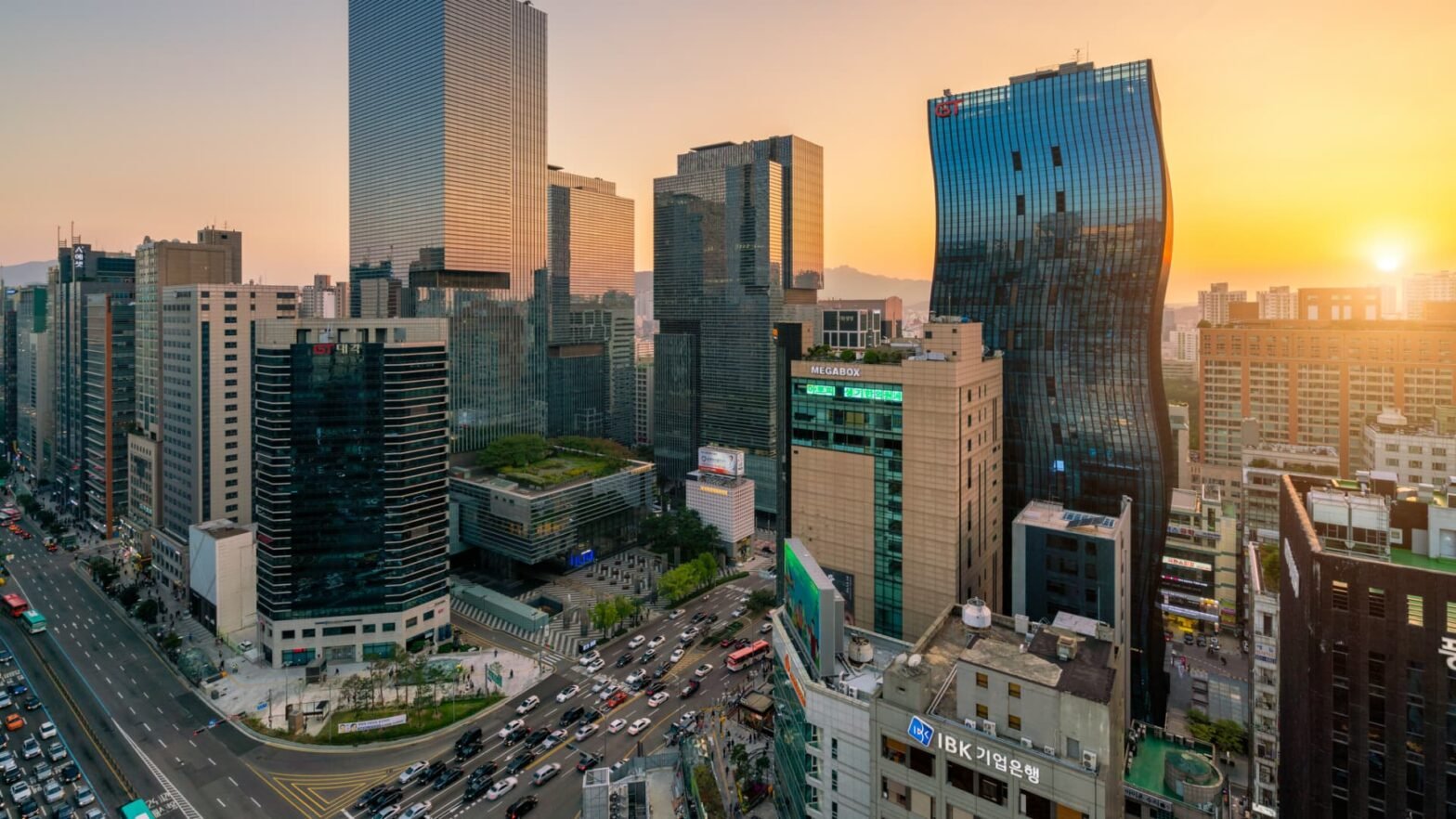
Sunset scene of light trails traffic speeds through an intersection in Gangnam center business district of Seoul at Seoul city, South Korea
Mongkol Chuewong | Moment | Getty Images
Singapore stocks hit a record high on Wednesday amid mixed trading in the Asia-Pacific region on Wednesday as investors digested the latest comments from U.S. Federal Reserve Chair Jerome Powell.
Powell said Tuesday that the central bank would have already cut interest rates if it weren’t for U.S. President Donald Trump’s tariff initiatives.
Singapore equities climbed 0.4% to a record high of 4,005.39 points Wednesday morning, data from LSEG showed.
Japan’s benchmark Nikkei 225 slid 1.32%, and the Topix lost 0.64%. South Korea’s Kospi was 0.42% lower while the Kosdaq was flat. Australia’s S&P/ASX 200 inched up 0.49%.
Hong Kong’s Hang Seng index rose 0.73% while the mainland CSI 300 was flat.
U.S. stock futures were little changed early Asian hours after investors began the second half of the year with a reduced appetite for technology stocks.
Overnight stateside, the three major averages closed mixed. The S&P 500 inched down 0.11% and closed at 6,198.01, while the Nasdaq Composite lost 0.82% to settle at 20,202.89. The blue-chip Dow was the outlier, gaining 400.17 points, or 0.91%, to end at 44,494.94.
— CNBC’s Sean Conlon and Tanaya Macheel contributed to this report.
Singapore stocks hit record high

Singapore stocks year-to-date
Singapore equities climbed 0.4% to a record high of 4,005.39 points Wednesday morning local time, beating its last record on March 28, data from LSEG showed.
UBS on Tuesday upgraded Singapore equities to Attractive. “The market offers a defensive safe haven amid ongoing geopolitical uncertainty, backed by a stable currency, generous dividend yields, and a steady earnings outlook,” said Tan Min Lan, head chief investment office in the APAC team at UBS Global Wealth Management.
“The ongoing equity market reforms provide additional catalysts in the form of a SGD 5 billion capital injection and potential value-up initiatives to unlock shareholder value,” she added.
—Lee Ying Shan
South Korea’s inflation rate hits highest since January
South Korea’s headline inflation rate in June rose at its fastest pace since January, coming in at 2.2% year over year.
The inflation figure was higher than the 2.1% expected by economists polled by Reuters, and higher than the 1.9% seen in June.
The country’s core inflation rate — which strips out food and energy costs — held steady at 2% compared to the same month of the previous year, and 0.1% higher than May.
— Lim Hui Jie
Japanese stocks lead region’s losses at the open
Performance of Japanese stocks year-on-year
Hello from Singapore, and here are the opening calls
Good morning from Singapore. It’s 7.29 a.m. local time and futures are pointing toward a mostly higher open.
Japan’s benchmark Nikkei 225 is set to open lower, with the futures contract in Chicago at 39,665 while its counterpart in Osaka last traded at 39,570, against the index’s last close of 39,986.33.
Australia’s S&P/ASX 200 is poised for a higher open with futures tied to the benchmark at 8,558 compared to its last close of 8,541.1.
Futures for Hong Kong’s Hang Seng index stood at 24,170, higher than its last close of 24,072.28.
—Lee Ying Shan
Fed could cut rates if there is ‘compelling evidence of labor market deterioration,’ Bank of America says
U.S. Federal Reserve Chair Jerome Powell walks to attend a press conference following the issuance of the Federal Open Market Committee’s statement on interest rate policy in Washington, D.C., U.S., June 18, 2025.
Kevin Mohatt | Reuters
Although Federal Reserve Chair Jerome Powell said last week that he expects policymakers to remain on hold until there’s more clarity on the impact of President Donald Trump’s tariffs on prices, the central bank may look to cut interest rates if there’s a downturn in the labor market.
“Occam’s razor suggests that inflation is already stuck above target, with risks to the upside from tariffs over the next several months,” wrote economist Aditya Bhave in a Tuesday note. “The Fed might still cut rates this year if there is compelling evidence of labor market deterioration. But the lack of progress on inflation raises the bar for cuts.”
Additionally, Bhave anticipates there could be much more impact to the U.S. economy from tariffs ahead.
“An optimistic take on the data would be that the pickup in goods inflation reflects some preemptive price hikes ahead of the tariffs,” he continued. “Still, there is most likely a lot more tariff-driven inflation in the pipeline.”
— Sean Conlon