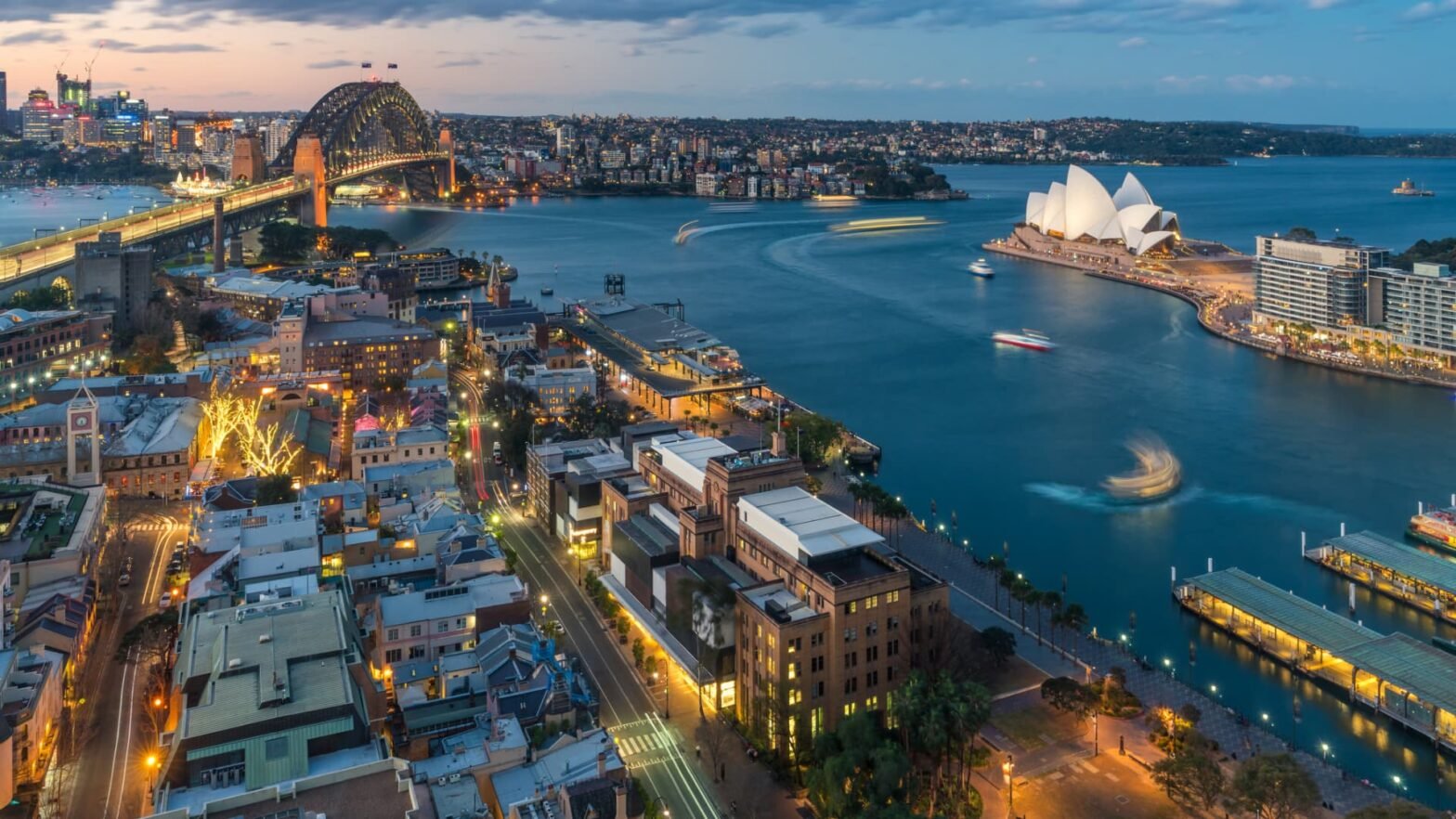
Waterfront city skyline of Sydney city downtown at night with bright illumination of modern architectural landmarks in Sydney, Australia.
Prasit Photo | Moment | Getty Images
Asia-Pacific markets traded mostly lower on Monday after U.S. President Donald Trump confirmed that tariffs, first announced in April, will take effect on August 1 for countries that haven’t struck a deal.
Treasury Secretary Scott Bessent said Sunday that tariffs introduced in April will be enforced starting August 1 for countries that haven’t finalized an agreement with the Trump administration. While Bessent dismissed the notion that August 1 represents a fresh deadline, he acknowledged that the new date could allow trading partners additional time to renegotiate tariff terms.
Japan’s benchmark Nikkei 225 slipped 0.26% while the Topix declined 0.18%. South Korea’s Kospi fell 0.48% and the small-cap Kosdaq slipped 0.5%.
Australia’s S&P/ASX 200 was flat at the open.
Futures for Hong Kong’s Hang Seng index stood at 23,899, lower than its last close of 23,916.06.
The Reserve Bank of Australia kicks start its two-day meeting, where it is widely expected to cut rates by 25 basis points to 3.60%.
U.S. stock futures fell after Trump confirmed that tariffs are set to go into effect Aug. 1, not July 9. Dow Jones Industrial Average futures slid by 146 points, or 0.32%. S&P 500 futures and Nasdaq 100 futures dipped 0.39% and 0.42%, respectively.
Last Friday stateside, the three major averages closed higher. The S&P 500 and Dow Jones Industrial Average powered to new highs and capped off a winning week as banking behemoths ushered in a promising start to the third-quarter earnings season. The Nasdaq Composite added 0.33% to finish at 18,342.94 and less than 2% below its all-time high.
— CNBC’s Samantha Subin and Brian Evans contributed to this report.
Oil prices fall after OPEC+ agrees to larger-than-expected oil production hike
Oil prices fell after eight oil-producing nations of the OPEC+ alliance agreed over the weekend to increase their collective crude production by 548,000 barrels per day, as they continued to unwind a set of voluntary supply cuts.
This subset of the alliance — comprising heavyweight producers Russia and Saudi Arabia, alongside Algeria, Iraq, Kazakhstan, Kuwait, Oman and the United Arab Emirates — met digitally. They had been expected to increase their output by a smaller 411,000 barrels per day.
The U.S. West Texas Intermediate crude fell 1.91% to $65.72 per barrel, while global benchmark Brent was down 1.17% to $67.50 per barrel as of 9.06 a.m. Singapore time.
—Ruxandra Iordache, Lee Ying Shan
Asia-Pacific markets kick off Monday trading lower
Asia-Pacific markets kicked off Monday trading lower. Japan’s benchmark Nikkei 225 slipped 0.26% while the Topix declined 0.18%. South Korea’s Kospi fell 0.48% and the small-cap Kosdaq slipped 0.5%.
Australia’s S&P/ASX 200 was flat at the open.
—Lee Ying Shan
Good morning from Singapore, here are the opening calls
Hello from Singapore!
Asia-Pacific stock markets are looking at a mixed trading Monday after U.S. President Donald Trump confirmed that higher tariffs, first announced on April 2, will take effect on Aug. 1 for countries that have not struck a trade deal.
In April, Trump also announced a 90-day pause on the steep tariffs, which is due to expire on Wednesday.
Australia’s S&P/ASX 200 is set to open lower with futures tied to the benchmark at 8,583 compared to its last close of 8,603. Futures for Hong Kong’s Hang Seng index stood at 23,899, lower than its last close of 23,916.06.
Japan’s benchmark Nikkei 225 was set to open higher, with the futures contract in Chicago at 39,915 against the index’s last close of 39,810.88.
—Lee Ying Shan
Trump confirms that tariffs will go into effect Aug. 1
U.S. President Donald Trump stands next to U.S. Secretary of Commerce Howard Lutnick, as he speaks to members of the media, upon his arrival at Morristown Airport, in Morristown, New Jersey, on July 6, 2025.
Nathan Howard | Reuters
U.S. President Donald Trump and high-ranking Cabinet officials confirmed that tariffs will go into effect Aug. 1, not July 9.
Trump and Commerce Secretary Howard Lutnick were asked in an interview with pool reporters Sunday to clarify when the new higher tariffs rates will be implemented. Lutnick responded, “Tariffs go into effect Aug. 1. But the president is setting the rates, and the deals, right now.” Trump assented with the statement.
Earlier in the day, Treasury Secretary Scott Bessent said in an interview on CNN’s “State of the Union” that tariffs announced back in April will go into effect on Aug. 1 for those countries that have yet to reach an agreement with the U.S. He said duties will “boomerang” back to higher April 2 levels if there is no progress.
As of Sunday, Trump’s April 9 executive order which established the July 9 tariff implementation date did not appear to have been formally revised. While the president has broad tariff powers, the April 9 order would typically be replaced with a new order establishing the Aug. 1 date.
The White House did not immediately reply to a question from CNBC about whether the president planned to issue a new executive order before July 9.
— Sarah Min