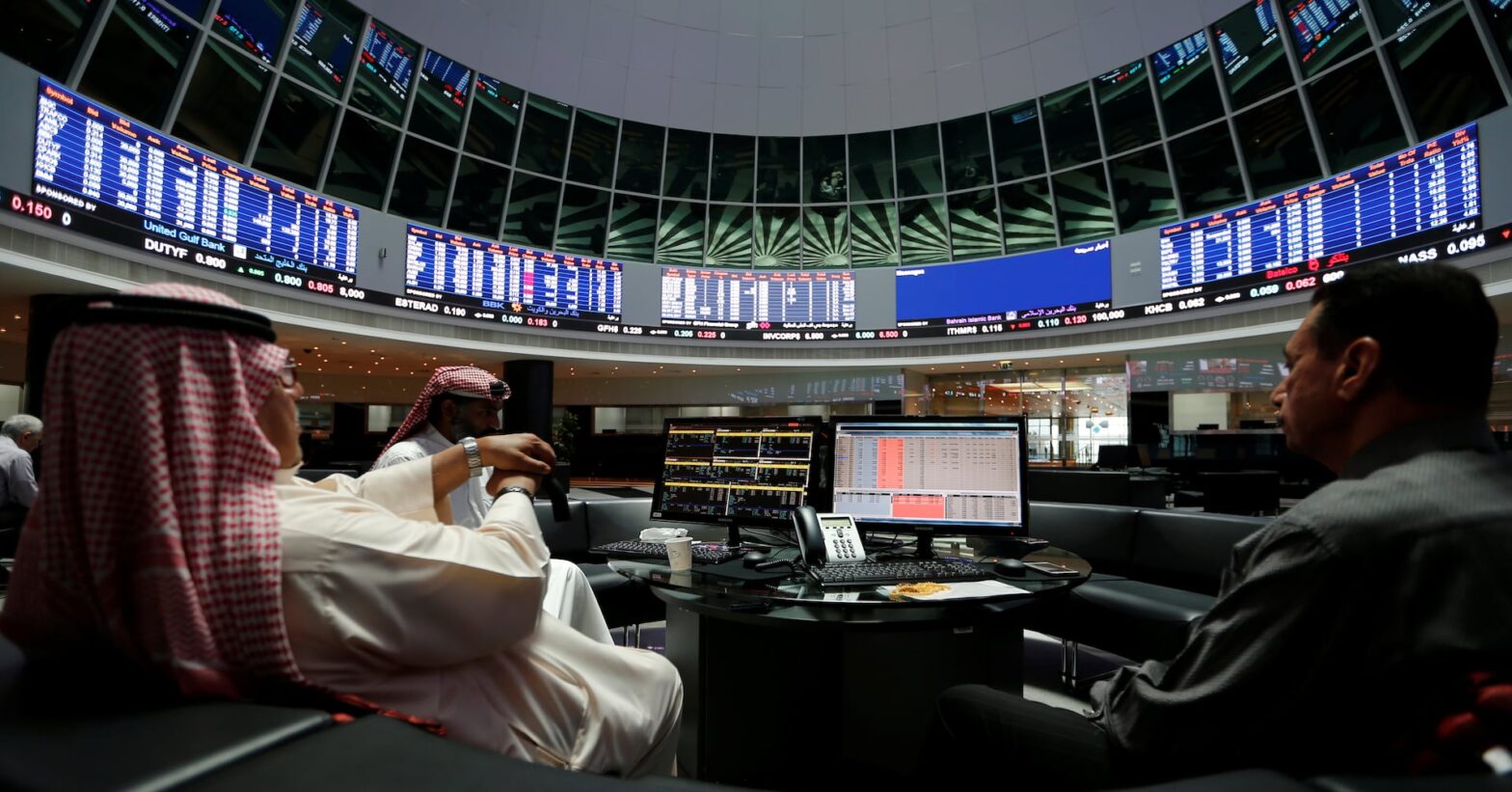

Traders chat during early hours after opening of the Bahrain stock market, in Manama, Bahrain June 26, 2016. REUTERS/Hamad I Mohammed/File Photo Purchase Licensing Rights, opens new tab
March 24 (Reuters) – Most stock markets in the Gulf ended little changed on Sunday and the Saudi index dipped, with weaker oil prices dampening sentiment after earlier gains fuelled by dovish signals from the U.S. Federal Reserve.
Oil prices , a catalyst for the Gulf’s financial markets, fell on Friday, with a possibility of a ceasefire in Gaza, the stronger dollar and lower U.S. gasoline demand all weighing.
The Qatari benchmark index
was up marginally with gains in communication services, materials, consumer staples, and energy sectors offsetting the losses in finance, industry and real estate.
Qatar Gas Transport
and Ooredoo
rose 0.7% and 1.1%, respectively, while Qatar National Bank
, the region’s largest lender, and Industries Qatar
both closed down 0.3%.
Saudi Arabia’s benchmark index
retreated 0.3%, after a previous session of gains with almost all sectors in the red.
ACWA Power
fell 1.7% and Saudi National Bank
, the kingdom’s largest lender, shed 0.9%.
Among other losers, ADES Holding
and Savola Group
fell 2.4% and 2.5%, respectively.
Earlier in the week, the Fed left rates unchanged but signaled it was still on track for three rate cuts this year, boosting stock markets around the world.
Most Gulf currencies are pegged to the dollar, and any U.S. monetary policy changes are usually followed by Saudi Arabia, the United Arab Emirates and Qatar.
Outside the Gulf, Egypt’s blue-chip index
was little changed as gains in materials, consumer staples, finance, and communication sectors offset losses in healthcare, industries and real estate.
E-Finance
and Fawry for Banking Technology
climbed 10.3% and 7.2% respectively, while Talaat Mostafa
dropped 4.2% and El Sewedy Electric
slipped 4.6%.
The Reuters Daily Briefing newsletter provides all the news you need to start your day. Sign up here.
Reporting by Md Manzer Hussain Editing by Tomasz Janowski
Our Standards: The Thomson Reuters Trust Principles., opens new tab