Market snapshot
- ASX 200: +0.6% to 8,830 points (live values below)
- Australian dollar: +0.1% to 65.94 US cents
- Wall Street (Friday): S&P500 +0.5%, Dow +0.4%, Nasdaq +0.7%
- Europe (Friday): Dax -0.2%, FTSE -0.1%, Eurostoxx flat
- Spot gold: +0.1% to $US3,688/ounce
- Brent crude: +0.2% to $US66.82/barrel
- Iron ore (Friday): +1.1% to $US106.50/tonne
- Bitcoin: -0.1% at $US115,350
Prices current around 10:20am AEST
Live updates on the major ASX indices:
Housing and business lending has inverted
A good observation from the committee’s deputy chair Simon Kennedy.
“Over the last 20 years the balance between business loans and home loans has sort of inverted.
“Twenty years ago, it was $2 for every business loan to a dollar for a home loan. That’s now switched. Is this something you discuss?”
First, a note that Kennedy has probably compressed the timeframe a bit — it’s probably taken more like thirty years for this to happen.
RBA governor Michele Bullock says it is something the bank has noted.
“We have observed that and it’s true that the Australian banks are very heavily weighted towards housing,” she responds.
“And I think part of the response, as Chris mentioned earlier, non-banks have started to step into the business loan business because the housing loan business is very competitive within the banks.
“So, yes, we do discuss it, issues to do with risk weights and so on that people might think might affect that.”
In response to a follow up question from Allegra Spender, Bullock acknowledges:
“It’s true that risk rights favour owner occupied housing, encourage lending for housing. That’s true.”
Although she says that is because home loans are much less risky than business loans, and banks have been encouraged to be safer since the global financial crisis (which, perhaps ironically, was sparked by dodgy home loans in the US).
Don’t know what a risk weight is, and want to find out? I wrote this article about it seven years ago.
Hard to measure productivity improvements in service sector, especial non-market services
A pretty good discussion from the RBA’s chief economist Sarah Hunter in response to a question from the committee’s deputy chair Simon Kennedy around productivity.
“Because they don’t have a market price, we can’t put a proper value on them,” she observes about how non-market services are captured in productivity measures.
“So that value effectively becomes the value of their inputs [which is mostly labour].
“So that sector, if you look over the last 30, 40 years, has effectively zero growth in productivity in that sector because of how we measure it.
“Now, you can imagine, actually outcomes in that sector may well have improved from our on a more holistic definition.
“The Productivity Commission put out a paper early last year that looks at the healthcare sector in particular, and called out improvements in quality outcomes and shorter hospital stays for all kinds of surgeries, for example, better cancer treatment outcomes, all these sorts of things. These have happened over the last 30 years.”
Most of these improvements in the quality of outcomes have been missed in the productivity data.
“So you do have to be a little bit careful with how you look at the numbers,” Sarah Hunter concludes.
Economy now growing again ‘per capita’
RBA assistant governor and chief economist Sarah Hunter says Australia’s economy now looks like it’s in a “cyclical upturn”, with economic activity and income per person now growing again.
“We have now moved into a period where GDP per capita has started to rise again after a number of quarters where it was contracting, or maybe flat, in a particular quarter,” she tells the committee.
“Over the last sort of three or four quarters we’ve generally seen a bit of a pick up, and that reflects a number of factors that are improving for households.
“We’ve now got wages growing in real terms, so that means that the increase annual increase in someone’s pay is now larger in percentage terms than the increase in the price level, so they able to purchase more in real terms. That’s obviously a very favourable and positive development to see.
“As the governor mentioned, we’ve got positive household wealth effects playing through as well, and we have had over the the 12 months through to the end of June.
“We also have the stage three tax cuts too, which were also helpful in terms of take home pay.
“So all of those things together mean that household income now is growing very positively in real terms, and that’s on a per capita basis or per household basis as well as in aggregate.
“And that was a, we think that has flowed through and supported consumer spending.”
‘Can’t be complacent yet’ about winning inflation battle
RBA governor Michele Bullock sounds a note of caution about the battle against inflation, noting “pockets” of high or rising inflation in many comparable economies overseas, most notably the US.
“You’re starting to see some signs that there’s tariff related inflation there but, even abstracting from that, there is some strength in services inflation there,” she tells the House of Reps economics committee.
“So I think everyone’s comfortable that they’ve got inflation back down much closer to their targets, but I think there are signs that we can’t be complacent yet about where inflation is at overseas.”
Key Event
‘Very good position in terms of inflation’: RBA
We’re into questions, and the committee chair Ed Husic starts off by asking the RBA governor what she thinks of the current state of inflation, that is the change in consumer prices.
“We have this target range of 2 to 3% — headline inflation has in fact been in target for some time in that target range, but that’s been impacted by cost of living relief, particularly in electricity, which has meant that the headline inflation we don’t think 100% reflects the underlying pulse of inflation,” Michele Bullock responds.
“So that’s why we’ve been focusing on what we call the underlying inflation rate. That’s now back also under 3%, so I think we’ve made really good progress.
“At 2.7% it’s not far from the midpoint of the range, and our forecasts, which are predicated on a further slight easing in [monetary] policy, suggests that inflation is going to settle around the middle of the band.
“So I think we’re in a very good position in terms of inflation.”
Key Event
RBA officials front House of Reps Standing Committee on Economics
So far, RBA governor Michele Bullock has been giving her prepared statement to the committee.
It was a bit of an Econ 101 lesson for new members on the committee where Ms Bullock explained that, while inflation was now coming under control, the price level wouldn’t be going back towards where it was before the post-COVID inflation breakout.
She also discussed developments in cash distribution, given the troubles in that sector, as cash use declines and costs of sending it around to banks, retailers and ATMs rise.
The meatiest stuff is usually in the Q&A, which is coming up soon, and I will bring you the highlights.
Key Event
China leaves rates unchanged
China has kept its powder dry on further economic stimulus leaving benchmark lending rates unchanged for the fourth consecutive month.
The one-year loan prime rate (LPR) was kept at 3.0% on Monday, while the five-year LPR was unchanged at 3.5%.
Most new and outstanding loans in China are based on the one-year LPR, while the five-year rate influences the pricing of mortgages.
Despite a string of recent data suggesting the Chinese economy is losing momentum, authorities appear to be not in a rush to roll out major stimulus measures amid resilient exports and a recent stock market rally.
In a Reuters of 20 market participants conducted last week, all participants predicted no change to either of the two rates despite a recent spate of weak economic data.
“While the broad-based deterioration in July-August activity data increased the urgency to introduce new stimulus, we remain cautious about the size of any new fiscal stimulus,” analysts at Barclays said in a note before the decision, adding chances of fresh fiscal stimulus could be reduced if the trade truce between Washington and Beijing holds.
Still, some analysts expect marginal monetary easing later this year will ensure the world’s second-largest economy will hit the government’s annual growth target of “around 5%.”
With Reuters
Key Event
ASX 200 up 0.5% in early trade, supported by miners
Having bounced out of the blocks gaining as much as 0.8% in the opening minutes of trade, the ASX 200 has settled back to a more muted advance.
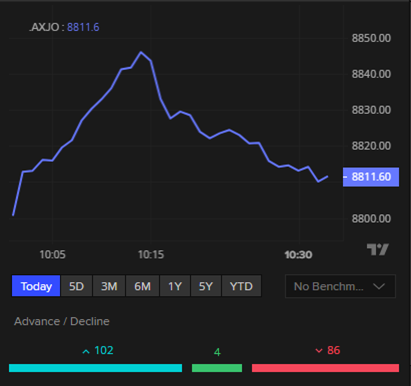
At 10:30am AEST, the ASX 200 was up 0.4% to 8,812 points, with 102 stocks making gains, 86 underwater and the rest tracking sideways.
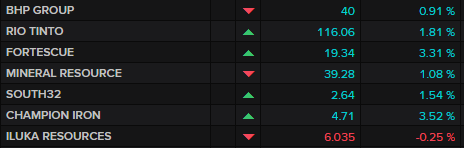
Miners in the materials sector led the gains, while energy stocks are a drag (Woodside -1.5%, Whitehaven Coal -1.1%).
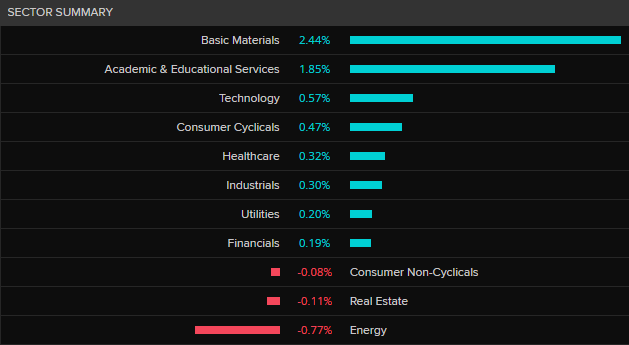
The big miners have been supported by a solid gain in iron ore prices on Friday with Fortescue up 3.5%.
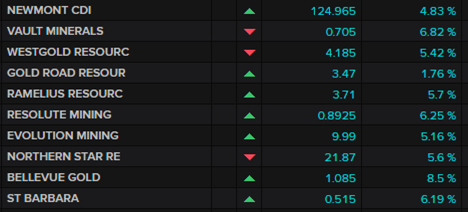
Within the miners, gold producers are having another strong day.
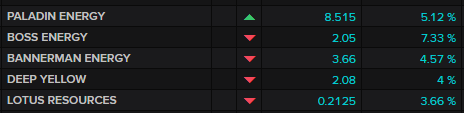
Uranium miners are also in demand.
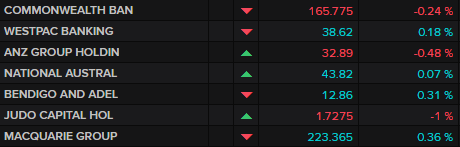
At the other end of the ASX barbell, banks are having a mixed day with Westpac (+0.2%) and NAB (+0.1%) up and CBA (-0.2%) and ANZ (-0.5%) down.
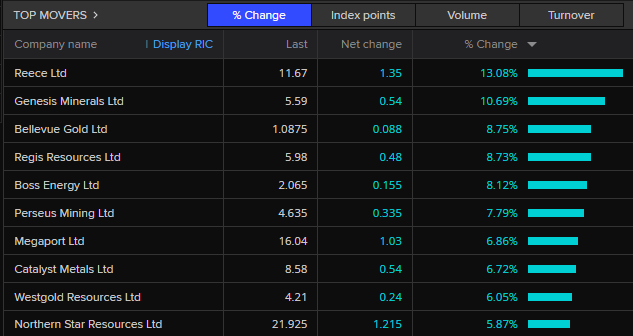
Plumbing supplier Reece (+13.1%) is having a much better day announcing a $250 million share buyback, having been badly beaten down on results last month.
The rest to the ASX top mover list is dominated by gold miners.
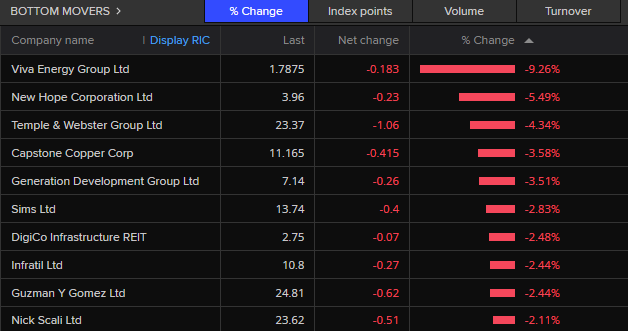
Among the bottom movers, petrol retailer and refiner Viva is down 9.3% and coal miner New Hope has shed 5.5%.
Key Event
ASX 200 opens 0.6% higher
The ASX 200 has jumped out of the blocks opening 0.6% higher at 8,830 points (10:16am AEST)
ICYMI: Kohler on the household consumption rebound – can it save us from recession?
Just a bit of food for thought before the market opens.
Our esteemed finance wiz Alan Kohler has posted another one of his regular Sunday night think pieces – this time on the green shoots of household consumption sprouting in the economy.
That’s good news given GDP growth has been propped up by government spending and population growth for some time, but will those shoots grow into something more substantial (a tree, or even a forest, perhaps) in time ward of recession?
Check out AK here, well worth 1 min 43 sec of you time:
Loading…
Santos floating LNG facility in NT receives first gas
Gas and oil producer Santos says the first gas has been delivered to its floating LNG plant off the Northern Territory coast.
In a statement to ASX this morning, Santos said the flow to the Opal floating production, storage and offloading (FPSO) vessel was “a major milestone” in delivering the Barossa LNG project.
The Barossa project, a joint venture with PRISM Energy Australia and the Japanese controlled JERA Australia, centred on a gas field 300 kilometres north-west of Darwin.
Gas from the FPSO will be piped directly to the Darwin LNG plant over the next two decades.
This week: RBA Governor’s testimony, global PMIs
Australia:
Mon: RBA Governor Michele Bullock fronts House of Reps committee
Tue: Purchasing Managers’ Indexes (PMI, Sep)
Wed: CPI indicator (Aug)
Thu: National accounts finance & wealth (Q2), Job vacancies (Aug)
International:
Mon: CN — 1 & 5 year loan rates
Tue: US — PMIs (Sep), Fed Chair Jerome Powell speaks, Current Account Balance (Q2)
Wed: US — New home sales (Aug)
Thu: US — GDP (Q2), Advanced goods trade balance (Aug), Durable goods orders/ wholesale inventories (Aug)
Fri: US — PCE inflation (Aug)
After a flurry of central banking activity over the past fortnight, things will be quieter this week.
On the home front, RBA governor Michele Bullock delivers her testimony to the House of Representatives economic committee today.
No bombshell statements are expected, just a reiteration that the RBA is taking a measured approach to lowering rates.
The most interesting subject maybe the RBA’s view on the jobs market and whether it is softening.
The monthly CPI indicator (August) is out on Wednesday.
The CBA economics team estimates the annual trimmed mean measure (the RBA’s preferred measure) will fall to 2.5%, right in the middle of the RBA’s target band … so unlikely to be a market mover.
With the labour market coming into sharper focus again, Thursday’s job vacancies numbers will be worth a look.
The jobs market has been tight for some time, but maybe that’s changing.
S&P Global rolls out Purchasing Managers’ Indexes, both manufacturing and services sectors, across major economies this week — Australia, along with the US, EU and UK get the results on Tuesday.
Australia’s manufacturing and services PMIs have reported expanding activity in recent months, and the composite PMI is now a solid 55 points, where 50 is the breakeven number between expansion and contraction.
EU and UK activity is expected to slow, while the US PMI is expected to be in line with previous months.
US Q2 GDP is forecast to come in at 3.3% growth annualised, but the key number this week is the PCE price index (Friday), the Fed’s preferred measure for inflation.
Societe Generale is tipping core US PCE will rise 0.3% over August to hit 3% year-on-year, the highest in around 18 months.
The French investment bank makes the interesting point that if personal spending comes in at +0.5% month-on-month as forecast, that would be a fair bit higher than personal income growth.
As SG notes, “in other words, private consumption growth in the US is living on borrowed time.”
The US advanced trade data (Thursday) also deserves a look.
SG says US imports held up against all odds in July, but they are likely to have fallen in July, while exports may jump as US businesses try to ship as much as possible out before expected retaliatory tariffs hit.
All up, that means a smaller trade deficit and solid support for Q3 US GDP.
Key Event
Trump nominates the Murdochs and tech billionaires in TikTok deal
President Trump has nominated Fox CEO Lachlan Murdoch and tech billionaires Larry Ellison and Michael Dell as the key US investors in a proposed deal to keep the Chinese-owned social media platform TikTok operating in the United States.
Speaking on the Murdoch-owned Fox News’ “The Sunday Briefing” program, Mr Trump said that the United States and China had made progress on a deal requiring TikTok’s American assets to be transferred to US owners from China’s ByteDance.
“I hate to tell you this, but a man named Lachlan is involved, Lachan is, that’s a very unusual name, Lachlan Murdoch,” Mr Trump said.
“And Rupert is probably going to be in the group. I think they’re going to be in the group.”
The proposed investors would give Trump allies in corporate America influence over a widely popular social media app, which counts 170 million US users and helps shape public discourse on politics and culture.
Mr Trump praised his group of preferred investors, calling them prominent people and “American patriots.”
“You know they love this country, I think they’re going to do a really good job,” Mr Trump said.
Mr Trump also said he was “a little prejudiced” about TikTok, crediting the app with helping build his support among young voters in the 2024 presidential election.
Under the expected deal, TikTok’s US assets would be majority owned by American investors and operated in the United States by a board of directors with national security and cybersecurity credentials.
ByteDance’s current shareholders include Susquehanna International Group, General Atlantic, and KKR.
ByteDance would hold less than 20% of the stock of a joint venture controlling TikTok’s US operations, according to a Reuters’ report.
Any investment in TikTok US would come through Fox Corp, two people familiar with the matter told Reuters.
The Murdochs would not invest as individuals, nor would News Corp, parent company of the Wall Street Journal and the New York Post, the Reuters’ sources said.
Mr Ellison, the co-founder of Oracle, a major Republican donor and recently he held the titular title as the “world’s richest person”, has long been linked to a potential TikTok deal.
Michael Dell is the CEO of Dell Technologies.
The Trump administration has declined to enforce a 2024 US law enacted during the Biden administration requiring TikTok’s divestiture by January 2025 over fears its US user data could be accessed by the Chinese government.
Mr Trump has included negotiations over the app as part of wide-ranging economic talks with China.
The Trump administration has made a series of unusual interventions in US business, including taking a 10% stake in Intel and allowing AI chip giant Nvidia to sell its H20 chips to China in exchange for receiving 15% of those sales.
With Reuters
Key Event
Wall St continues record-breaking run, ASX poised to rise
Wall Street’s three key indices all hit new record highs for the second successive session, buoyed by last week’s rate cut from the Fed and the prospect of more to come.
The blue-chip Dow, the S&P 500 and tech-centric Nasdaq rose 0.4%, 0.5% and 0.7% respectively.
Apple was a standout, gaining 3.2% after bullish commentary on demand for its latest iPhone and broker upgrade from J.P. Morgan.
Over the week, the S&P 500 gained a solid 1.2% and the Nasdaq did even better, up 2.2%.
ASX 200 futures closed on Friday pointing to a 0.3% gain this morning — a positive start after two consecutive weeks of losing ground.
Much of the action in the US centred on the thoughts of the Fed’s newest governor, Stephen Miran, the White House economic adviser parachuted into the Federal Open Market Committee by President Donald Trump.
Mr Miran pushed for a larger cut at last week’s meeting that delivered the expected 25bps reduction.
He is likely to be pushing that barrow for some time, given his cunning plan is for an overall 150bps reduction, or seven more cuts, even if inflation continues to edge higher.
“Certainly, if the idea is the Fed is moving in a direction to relax the inflation target, that is definitely a recipe for running hot, and that’s good for stocks,” chief investment officer at Horizon Investments Scott Ladner told Reuters.
European markets were little changed on Friday and over the week, although defence sector stocks continue to be in solid demand.
Despite the rate cut, the US dollar continued its recent rally as traders were coming around to the idea that the Fed (with the exception of Mr Miran) wasn’t in any urgency in the easing cycle.
The US dollar gained around 0.3% against its six major trading peers. The Australian dollar slipped 0.3% back just under 66 US cents.
Spot gold eased back from its record high above $US3,700/ounce, but was still up around 0.8% over the week.
While oil tends to bubble up after rate cuts, both global and US benchmarks slipped (Brent -1.1% and West Texas Intermediate Crude -1.4%) as traders bet any increase in demand would not outweigh more supply in the pipeline.
Market snapshot
- ASX 200 futures: +0.3% to 8,852 points
- Australian dollar: -0.3% to 65.89 US cents
- Wall Street (Friday): S&P500 +0.5%, Dow +0.4%, Nasdaq +0.7%
- Europe (Friday): Dax -0.2%, FTSE -0.1%, Eurostoxx flat
- Spot gold (Friday): +1.1% to $US3,684/ounce
- Brent crude (Friday): -1.1% to $US66.68/barrel
- Iron ore (Friday): +1.1% to $US106.50/tonne
- Bitcoin: -0.3% at $US115,485
Prices current around 7:00am AEST
Good morning
Good morning and welcome to another week on the ABC markets and finance blog.
Stephen Letts from ABC business team limbering up for a blow-by-blow coverage of the day’s events, where every post is hopefully a winner, but none should be construed as financial advice.
In short, it looks like the ASX looks like starting the week on a positive note.
Futures trading points to the ASX 200 gaining 0.3% on opening.
We’ll be keeping an eye on RBA governor Michele Bullock’s appearance before the House of Representatives Standing Committee on Economics, among many other things today.
As always, the game’s afoot, so let’s get blogging.
Loading