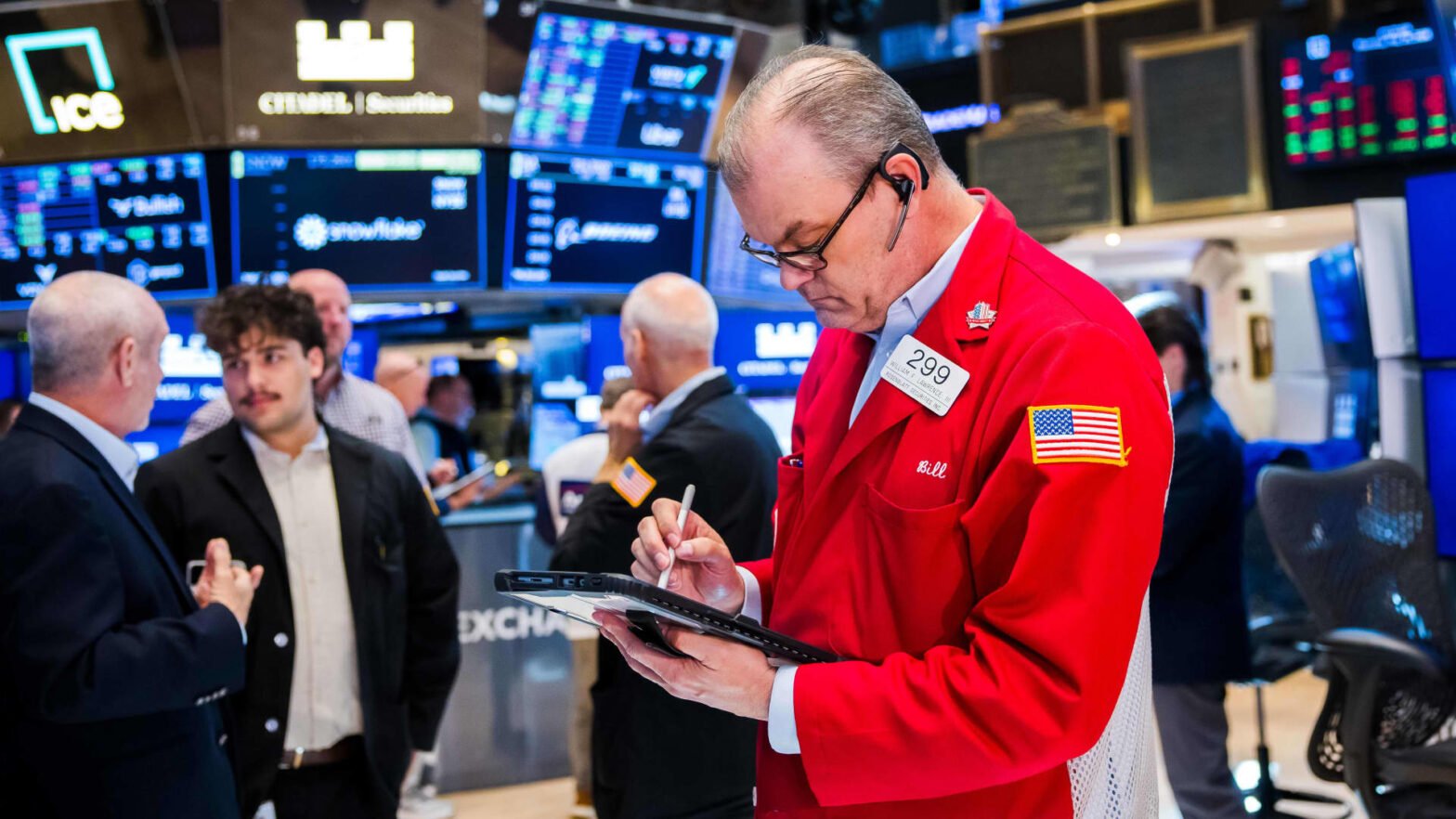
Traders work on the floor of the New York Stock Exchange.
NYSE
Stock futures were hovering near the flatline night ahead of crucial inflation data.
Futures tied to the Dow Jones Industrial Average added 18 points, or 0.04%. S&P futures rose 0.06%, while the Nasdaq 100 futures ticked up 0.05%.
Investors are awaiting the release of August’s personal consumption expenditures price index out Friday, as the release is widely known to be the Federal Reserve’s preferred inflation measure. Economists expect the print to reflect an uptick in inflation and markets continue to price in two quarter-point rate cuts at the Fed’s upcoming meetings, in line with what the central bank has projected.
The outcome could sway market reaction, however, after solid jobs data released earlier Thursday and a strong upward revision in second-quarter gross domestic product to 3.8% slightly dampened bullish sentiment. Investors fear fewer jobless claims could mean that the economy is in decent shape and therefore give the Fed less reason to cut interest rates.
The three major U.S. indexes fell again on Thursday while the 10-year Treasury yield rose to 4.2% at one point during the session on the back the latest economic data.
Major players in artificial intelligence, namely Oracle, Meta and Tesla, also pulled back. Oracle lost 5.6%, reflecting growing concerns among a pocket of investors that tech valuations have run far too high and that the interconnected AI industry could be risky.
Week to date, the S&P 500 is down nearly 0.9%. The tech-heavy Nasdaq Composite has lost about 1.1% while the Dow Jones Industrial Average has shed 0.8%.
After this week’s losses, some market participants remain wary while still seeking longer-term buying opportunities. Andrew Slimmon, head of Applied Equity Advisors at Morgan Stanley Investment Management, said he would use any weakness to add to positions in tech.
“The market was vulnerable to a pullback and because tech has been a leader, it’s the most vulnerable,” Slimmon told CNBC. “I would not panic on this action. Any pullback or worse for the euphoria stocks is healthy for the market. I don’t think it’s a good long-term sign when speculation gets rampant.”
Shares of Costco, Concentrix move after market close on the back of earnings results
Costco and Concentrix were among the companies moving after Thursday’s close.
- Shares of Costco dipped about 0.9% after the warehouse retailer reported fiscal fourth-quarter earnings and revenue that beat analysts’ estimates, supported by double-digit gains in both membership income and its e-commerce business. Costco earned $5.87 per share on revenue of $86.16 billion, while analysts polled by LSEG expected earnings of $5.80 per share on revenue of $86.06 billion.
- Shares of Concentrix plunged nearly 22% in after-hours trading. The technology and services company missed earnings expectations and lowered its forecast. The company earned $2.78 per share after adjustments, while analysts polled by LSEG expected $2.87 per share. Revenue of $2.48 billion exceeded the consensus view of $2.46 billion. Concentrix boosted its quarterly dividend by 8.2% to 36 cents per share.
— Pia Singh
Fundstrat’s Tom Lee: Markets will stay strong in the case of just one more Fed rate cut this year
Markets are still pricing in two more rate cuts this year, but the possibility of just one more rate cut isn’t necessarily bad news, according to Fundstrat head of research Tom Lee.
If the Federal Reserve decides to only implement one rate cut by the end of 2025, Lee told CNBC on Thursday that he thinks “markets would interpret that in a good way, in the sense that they’d rather see the fed cutting into strong economy rather than weak.”
Lee’s comments come after market participants slightly dialed back their expectations of a quarter-point rate cut from the Fed after seeing fewer-than-expected initial jobless claims on Thursday.
“We know that the Fed was lagging in it’s easing because of that imputed shelter inflation, but the reality is they should have been easing sooner … and so I think that we have to be careful,” Lee said. When the Feds talking about that imputed effect, it doesn’t mean we have to start a new hiking cycle just because it takes a while to show up. And I think that’s why markets are going to see through that.”
— Pia Singh