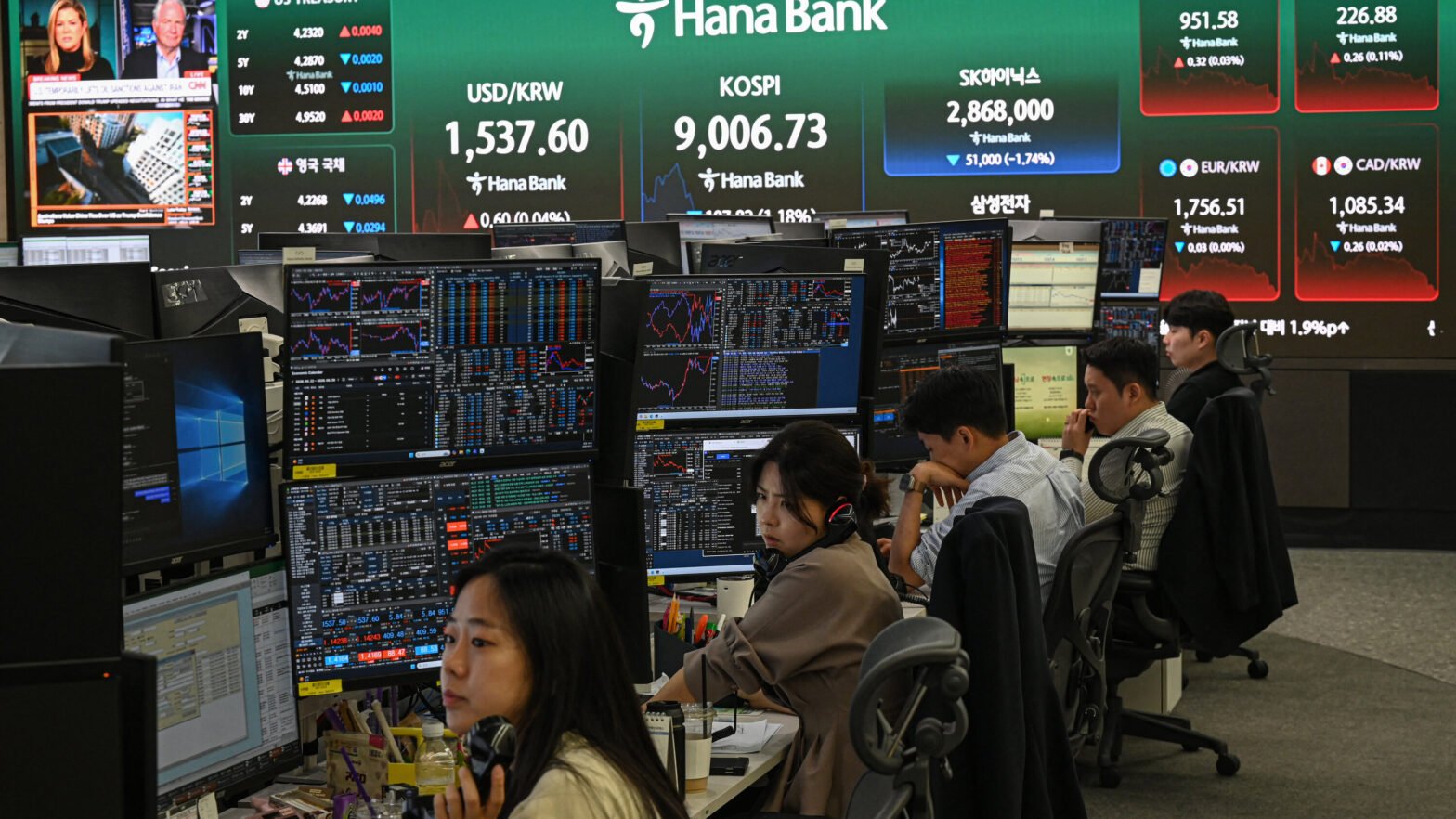
The seesaw effect in the Asia-Pacific market has become evident!
Today (October 6th), on the occasion of the Mid-Autumn Festival, the Asia-Pacific markets opened for trading. The Nikkei Index surged over 4%, while the previously strong Hong Kong market suddenly weakened. The Hang Seng Index opened 0.5% lower. The Hang Seng Tech Index opened 1.12% lower, and its decline subsequently widened, followed by repeated fluctuations at a low position.
On the trading front, three major variables are influencing the pattern of Hong Kong’s stock market.
 Firstly, S&P Global announced that, after seasonal adjustment, Hong Kong’s S&P Purchasing Managers’ Index (PMI) for September fell from 50.7 in August to 50.4, reflecting a continued improvement in Hong Kong’s business environment but with a slight pullback in economic activity.
Secondly, Goldman Sachs raised the target price for SMIC and Huahong Semiconductor’s Hong Kong stocks, whereas JPMorgan downgraded CATL’s H-share rating to neutral.
Thirdly, Barclays predicted that the likelihood of another interest rate hike by the Bank of Japan within the year has decreased following the victory of Koichi Takemoto. This development has brought about significant changes in the global foreign exchange market, with the US Dollar Index strengthening significantly, while non-US currencies, including the Renminbi, have weakened.
Sudden Change in Hong Kong Stocks
Compared to the strength of Japan’s market, the performance of Hong Kong stocks at the opening today showed noticeable changes compared to the previous few trading sessions.
At the morning opening, the Hang Seng Tech Index fell by more than 1%. Among well-known Hong Kong stocks, CATL once plummeted nearly 4%, Alibaba dropped almost 3%, Meitu fell over 3%, and SMIC also dropped nearly 4%. On the other hand, Huahong Semiconductor surged over 6%, while Zijin Mining and Country Garden saw notable gains. Digital currency and non-ferrous metals rose significantly, whereas artificial intelligence, big data, and cloud computing lagged behind noticeably.
From a macro perspective, S&P Global announced that, after seasonal adjustments, Hong Kong’s S&P Purchasing Managers’ Index (PMI) for September fell from 50.7 in August to 50.4, reflecting a continued improvement in Hong Kong’s business environment but with a slight decline in momentum. Overall business activities expanded for two consecutive months, with the expansion rate being the highest since December of last year, driven primarily by the service sector, while the remaining three major sectors experienced negative growth. Additionally, the China Federation of Logistics and Purchasing released the global manufacturing PMI for September today: the index slightly dropped by 0.2 percentage points month-on-month, with limited volatility, indicating a relatively stable recovery in the global economy. Regional analysis shows that Asian manufacturing continues to expand steadily. The global manufacturing PMI for September stood at 49.7%, down 0.2 percentage points from the previous month, marking the seventh consecutive month it has stayed within the 49%-50% range. For the third quarter, the average global manufacturing PMI was 49.6%, up 0.3 percentage points from the second quarter. The Asian manufacturing PMI remained unchanged from the previous month and has been above 50% for five consecutive months.
From an industry stock perspective, Goldman Sachs raised the target prices for SMIC and Huahong Semiconductor’s Hong Kong-listed shares, citing opportunities in semiconductors driven by China’s expanding AI ecosystem. Goldman Sachs increased the target price for both companies to HKD 117, up from previous targets of HKD 95 for SMIC and HKD 87 for Huahong Semiconductor. However, JPMorgan analysts downgraded CATL’s Hong Kong-listed shares from Overweight to Neutral, stating that the current valuation is relatively reasonable, while raising the target price by 13% to HKD 600. Analyst Rebecca Wen and her team noted in the report that the lock-up period for cornerstone investors, who hold nearly 50% of the issued Hong Kong shares, will expire on November 19, potentially leading to selling pressure and forming technical upward pricing resistance. The new target price is based on a 30x price-to-earnings ratio applied to earnings forecasts for 2026. This may be the main reason for today’s significant adjustment in CATL shares.
Regarding external variables, Naohiko Baba, an economist in Barclays’ Fixed Income, Currencies, and Commodities Research division, stated that the likelihood of another interest rate hike by the Bank of Japan (BOJ) in 2025 has decreased following Sanae Takaichi’s victory in the Liberal Democratic Party leadership election. Takaichi’s stance expressed at the press conference suggests that her dovish tone could further strengthen compared to her campaign period. Additionally, “considering Takaichi’s view that policy tightening should only occur after demand-pull inflation driven by wage growth takes hold, the most reasonable timing for a rate hike would currently be the January meeting, which would allow for a comprehensive assessment of the progress in next spring’s labor-management negotiations.”
The variable represented by Sanae Takaichi has brought significant changes to the market. In early trading today, the yen fell sharply, dropping 1.5% against the US dollar and nearing the 150-yen level. Meanwhile, the US Dollar Index surged above 98, while offshore yuan weakened below 7.14. This may also be one of the key reasons for the adjustment in Hong Kong stocks.
Will this disrupt the trend?
However, some analysis suggests that stronger variables may be needed to interrupt the upward trend in Hong Kong stocks, with the impact of the aforementioned factors likely limited to the short term.
First, Chinese capital’s pricing power in the Hong Kong stock market continues to grow. According to data from Bocom International, southbound capital inflows accelerated in September, with net inflows exceeding HKD 1.1 trillion year-to-date, setting a new historical record. At the same time, China’s macroeconomic policies have maintained continuity and stability, with ample “pro-growth” policy tools providing fundamental support for Hong Kong stocks. The restart of overseas interest rate cuts has eased liquidity pressures in Hong Kong, and southbound capital continues to flow in at an accelerating pace.
Second, the external environment has continued to improve marginally, steadily boosting market risk appetite. In September, Hong Kong stocks maintained a volatile upward trend, supported by the dual tailwinds of resumed US-China trade talks and expectations of overseas interest rate cuts, coupled with rotational gains in the technology sector, providing important support to the broader market. The external environment remains favorable, as US-China trade negotiations have resumed, with both sides engaging in discussions on key issues such as tariff reductions and export controls, raising market expectations for progress in bilateral relations.
Third, driven by the narrative around technology, domestic and overseas investments in computing power continue to grow, and demand from mainland Chinese investors for quality Hong Kong-listed AI-related stocks is expected to remain strong.
Fourth, following Sanae Takaichi’s election, the market perceives her as having a clear preference for loose monetary policy. On September 24, Takaichi explicitly stated during a panel discussion that “the government bears responsibility for determining the direction of fiscal and monetary policy, but the specific instruments of monetary policy should be decided by the Bank of Japan.” CICC believes that the BOJ’s monetary policy may be influenced to some extent by political factors. If Takaichi becomes Japan’s Prime Minister, the BOJ may adopt a more dovish stance, potentially slowing the pace of interest rate hikes. Regarding exchange rates, Takaichi may favor a weaker yen.
A weaker yen has two effects: first, it pushes up the US Dollar Index, and second, it increases the scale of yen funding costs. Typically, the former may hinder the performance of equity markets (especially cyclical stocks), while the latter could push up the valuation levels of risk assets.
 Futubull AI: Your Portfolio Manager! Your Stock Selection Advisor!Come and experience it now >>

Editor/Lambor