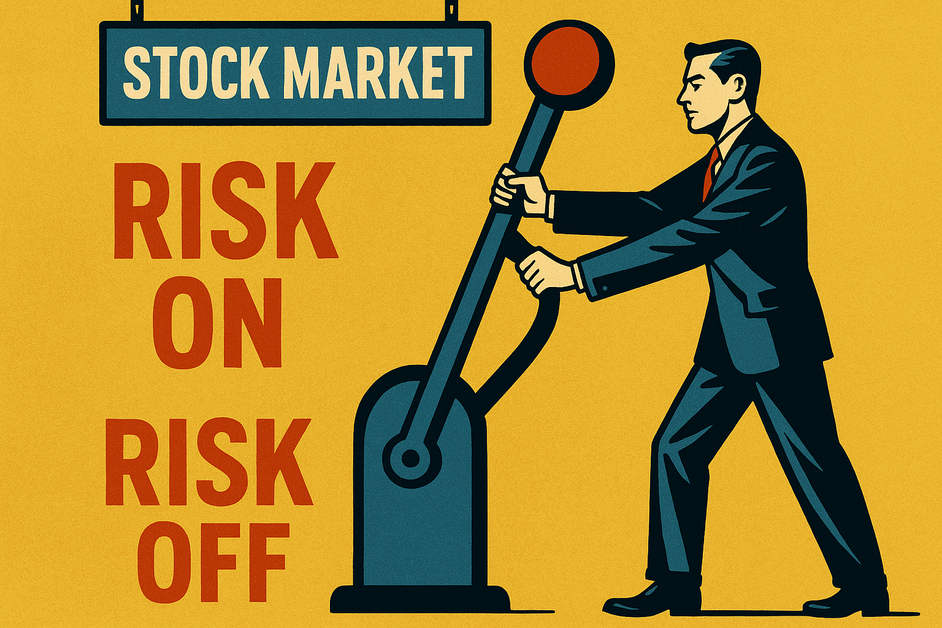
Stocks ran out of steam on the way back from another painful selloff. What’s holding them back?
- Wall Street is struggling to sustain a recovery after last week’s selloff
- US-China trade war fears may mask a deeper “risk off” regime change
- Round one of Q3 earnings, Fed Chair Powell speech pass without issue
Wall Street continues to whipsaw in the aftermath of the dramatic selloff capping last week’s trade. Stocks started the week with a heroic attempt at a recovery, only to crumble toward last week’s lows once more. That push ran out of steam in turn, sending shares back higher.
In all, the bellwether S&P 500 stock index finished the session with a loss of just 0.12%, having been down as much 1.5% intraday. The tech-tilted Nasdaq 100 fared a bit worse, trimming an intraday downswing of as much 2% to a loss of 0.64%. The small-cap Russell 2000 outperformed, ending up 1.45%. At one point, it was facing a loss of 1.68%.
Are stocks really being driven by the US-China trade war?
That is a curious arrangement, considering the bout of unpleasantness kicked off last week was apparently linked to signs of escalation in the US-China trade war. One might have expected cyclically sensitive small-cap names to be more vulnerable to such an economic threat than the cash-rich, big-tech cohort driving Nasdaq to record highs.

Nevertheless, the Russell has erased all of last week’s losses and is now trading up about 1.1% on net. By contrast, Nasdaq is down about 0.8% over the same time frame. It is as though the markets reacted to trade war headlines not on the basis of their substance, but as a trigger to lighten up risk exposure where it has been concentrated most.
If so, the markets may be in the midst of regime change. Having appeared bulletproof on the run-up from April’s lows – where every minor setback was readily bought up in short order – stocks may have flipped to the opposite dynamic. If risk appetite has truly peaked, then traders are in search of an excuse to sell, and every rally faces stiff resistance.
Will “risk-off” be the new default setting for financial markets?
Tellingly, this week’s latest wipeout did not seem to be linked to anything novel on the trade war front, nor some adverse event risk. Top tier economic data remains on pause amid the US government shutdown, while the first round of big-splash earnings reports for the third quarter came and went largely without incident.
A speech from Federal Reserve Chair Jerome Powell did not stray far from familiar territory and left monetary policy expectations broadly unchanged. The markets are fully priced for 25-basis-point (bps) rate cuts in October and December. The gap between the Fed’s forecast of 25bps more next year and the markets’ bet on 69bps remains unresolved.

Ilya Spivak, tastylive head of global macro, has 15 years of experience in trading strategy, and he specializes in identifying thematic moves in currencies, commodities, interest rates and equities. He hosts Macro Money and co-hosts Overtime, Monday-Thursday. @Ilyaspivak
For live daily programming, market news and commentary, visit tastylive or the YouTube channels tastylive (for options traders), and tastyliveTrending for stocks, futures, forex & macro.
Trade with a better broker, open a tastytrade account today. tastylive, Inc. and tastytrade, Inc. are separate but affiliated companies.