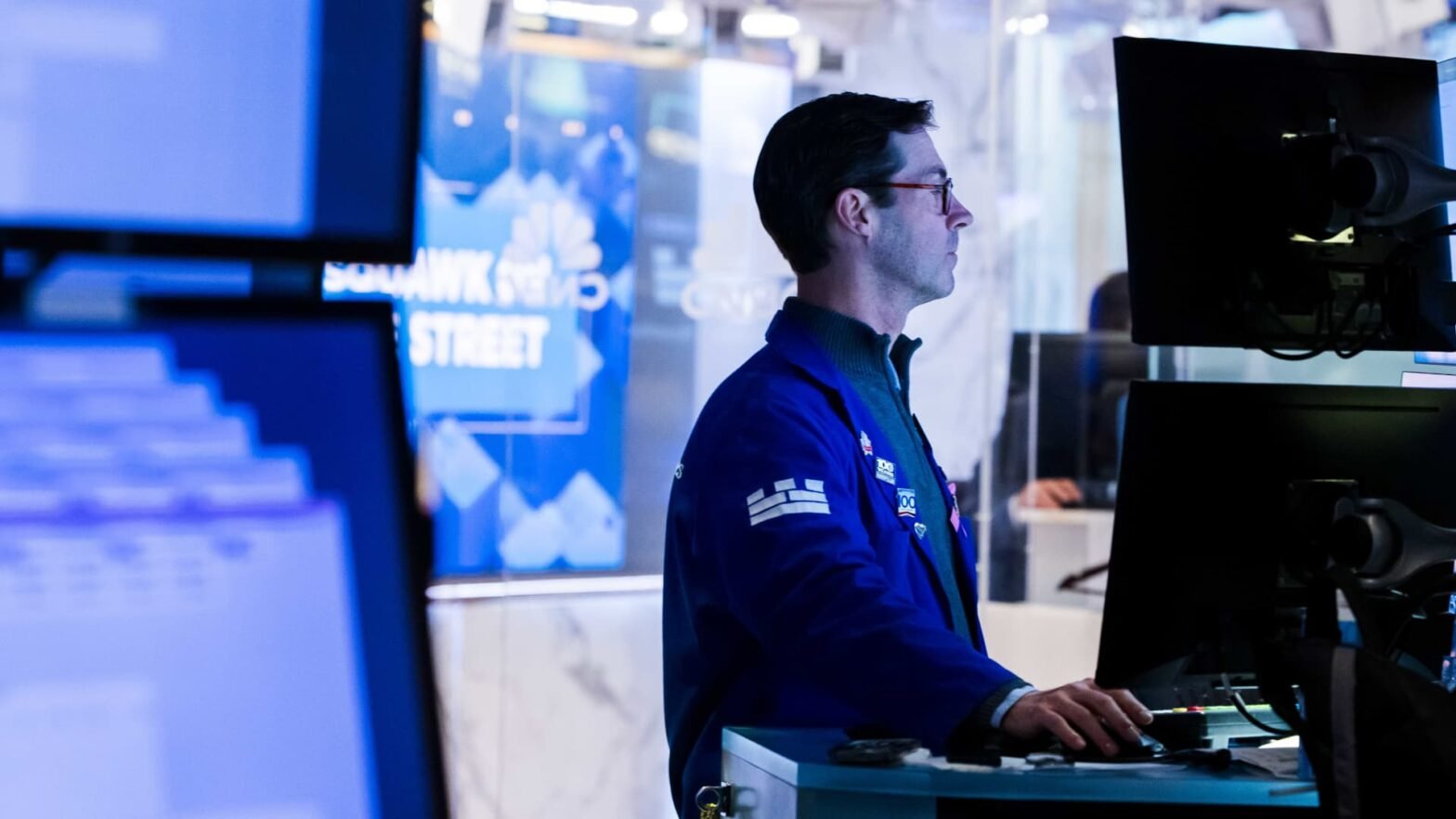
A trader works on the floor of the New York Stock Exchange.
NYSE
Stock futures were relatively flat Tuesday night following a session where investors sold off technology names and drove a rally in more risk-off parts of the market.
Futures tied to the Dow Jones Industrial Average added 3 points points, or 0.01%. S&P futures and Nasdaq 100 futures both inched up less than 0.1%.
Tuesday saw a tale of two markets emerge — the Dow Jones Industrial Average rallied more than 550 points to close at a record high, while the Nasdaq Composite slipped. The S&P 500 closed up higher, notching its third positive session in a row.
Consumer stocks such as Walmart, Home Depot and McDonald’s propped up the 30-stock Dow on Tuesday as traders moved into parts of the market with lower valuations and less exposure to the artificial intelligence trade. The health care sector was the top-performing sector, driven by moves higher in names such as Eli Lilly and Johnson & Johnson.
Darling AI stocks such as Nvidia swung lower on Tuesday, reflecting the uneasy sentiment among investors that tech valuations could be stretched after their recent surge. Talks of a stock market bubble have not dissipated either, but investors are showing more discernment between which tech giants appear to have a leg-up in the AI race.
“When you have very few groups making new highs, very few stocks remaining above their 200-day moving average or 40-day moving average … it’s a very interesting rotation,” Craig Johnson, chief market technician at Piper Sandler, said Tuesday on CNBC’s “Power Lunch.” “What hasn’t been working is a place to go hide right now.”
Investors also digested a new ADP report that showed private employers cut payrolls in October, adding to worries about labor market weakness. The report received greater focus since the record-setting U.S. government stoppage has halted many crucial economic releases. The U.S. government could reopen as soon as the end of this week. The Senate on Monday evening passed a spending bill that has since moved to the House of Representatives for a final vote.
Nuclear power startup Oklo shares down after third-quarter loss widens
Oklo shares fell slightly on Tuesday night after its third-quarter loss widened from a year ago, as the nuclear power startup works toward getting regulatory approval for its technology.
The company reported a loss of 20 cents per share, wider than analysts’ expectations of a 13 cents per share loss, according to LSEG. Shares of Oklo, which has not generated revenue, have rallied about 390% this year.
The company expects its first commercial Aurora advanced fission plant to be deployed in 2027, and is working on developing clean energy to be used at AI infrastructure facilities.
“We’re focused on producing one of the most important and valuable commodities that exist today that is also pretty significantly undersupplied in the country, which is power. And I think that’s a huge opportunity space for us to be building into … abundant large scale energy supplies are going to be worth a lot for enabling all the things that we’re wanting to do as a country,” Oklo co-founder and Chief Executive Jacob DeWitte told CNBC’s “Closing Bell: Overtime” on Tuesday evening.
— Pia Singh