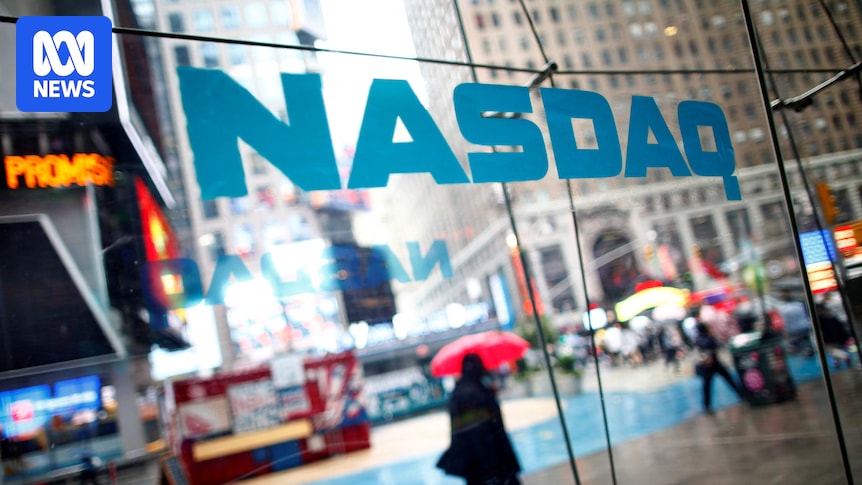
The ASX has fallen steeply in response to a sharp drop on Wall Street overnight.
Tech stocks led losses on Wall Street, with the Nasdaq down well over 2 per cent, while the S&P 500 closed 1.7 per cent lower.
Follow the day’s financial news and insights from our specialist business reporters on our live blog.
Disclaimer: this blog is not intended as investment advice.
Key Events
Market snapshot
- ASX 200: -1.6% to 8,616 points
- Australian dollar: flat to 65.27 US cents
- S&P 500: -1.7% to 6,737 points
- Nasdaq: -2.3% to 22,870 points
- FTSE: -1.1% to 9,807 points
- EuroStoxx: -0.6% to 580 points
- Spot gold: +0.2% to $US4,178/ounce
- Brent crude: +0.6% at $US63.11/barrel
- Iron ore: -0.1% to $US103.55/tonne
- Bitcoin: +1.5% to $US100,312
Prices current around 10:32am AEDT
Live updates on the major ASX indices:
ING changes some interest rates on its products
ING has today cut the rate on its key savings account by 0.05 percentage points.
This information is from interest rate comparison website, Canstar.
It’s also commented that it comes “despite the fact the cash rate has remained on hold since August”.
The bank has cut the maximum rate on its Savings Maximiser from 4.80% to 4.75% for customers who meet the monthly bonus conditions.
For those who don’t qualify, the base rate has been cut from 0.05% to just 0.01%.
ING has also increased the introductory rate on its Savings Accelerator account to 5.00%, but only for new customers for the first four months.
The ongoing rate on this account remains unchanged at 3.95%.
Wall Street slide reaction
Trading and investment house MooMoo Australia has penned a note on overnight developments on Wall Street.
Here’s an excerpt:
“[The] backdrop is changing, with Wall Street traders bracing for a data deluge now the US government is reopening.”
“They’re questioning whether the incoming reports will lead the Federal Reserve to call a rate cut.
“That’s not looking certain for December and we’re seeing investors reposition accordingly.
“The key volatility indicator, the VIX, spiked sharply to 20, depicting the heightened uncertainty.”
Key Event
TPG Telecom shares nosedive as trade ex-dividend
What’s happened to TPG telecom – down by 30% this morning?
– Craig
Why is TPG dropping so sharply?
– Bush
A few reader questions about TPG Telecom shares, which are down by around 30% this morning.
That’s because it’s trading “ex-dividend” following a major capital return.
At an extraordinary general meeting last week, shareholders approved a $3 billion capital return — that was equal to $1.61 per share, made up of $1.52 capital reduction and a 9 cent unfranked special dividend.
At the meeting, TPG’s chief executive described the capital return as a “significant milestone” in the move to simplify the telco.
Small shareholders will have the option to reinvest their payout into new TPG shares.
Here’s a plain English explanation from CommSec chief economist Ryan Felsman:
“The rights to the upcoming payout have now been settled and new buyers of the shares will not be entitled to receive it on pay day.
“Therefore, TPG’s share price is dropping in-line with the value of the dividend on the ex-dividend date.”
That means, if you buy TPG shares from today, you won’t receive that $1.61 per share special payout on Monday.
The near 30% drop in TPG shares is about $1.66 in dollar terms — so most of that fall can be attributed to the capital return on a down day for the broader market.
Key Event
Market correction ‘has already started’
The ASX 200 is down sharply today.
Is this selling the start of a broader trend?
ABC News posed that question to several market participants earlier today.
“It has already started,” Marcus Today senior portfolio manager Henry Jennings said.
“Suspect downside to continue.”
VanEck’s Anna Wu said, “Short term, we could see some weakness, especially if Nvidia’s [earnings results] disappoint next week.”
DT taking over the blog
Hello,
I’m on the blog.
I’ll take you through the afternoon.
DT
Wall St decides to travel south, analyst warns of more volatility ahead
Fitting with a lot of the other analysis I’ve seen so far, last night’s Wall Street sell-off had no particular catalyst, just a wall of worries that investors have decided to stop ignoring.
“Wall Street was scratching around for a direction and last night it decided to head south,” notes Capital.com’s Kyle Rodda.
“Essentially, it’s a story of interest rate expectations, complicated by what looms as a deluge of critical data, some of it probably lacking substantial information, that could either help or hinder the pricing-in of those expectations.”
Rodda says it’s not surprising that other markets, like the ASX, are seeing selling pressure too.
“The moves set up global markets for a bearish end to the week, where thoroughly risk off sentiment is likely to see risk assets everywhere come under pressure,” he argues.
“With volatility heightened, there is still the risk of two way price movements to round out the week. Last Friday’s intraday swing on Wall Street to round out the trading week, which could conceivably be replicated today with the right newsflow, bore out the maxim that the biggest rallies can happen in bearish markets.”
He’s referring to an early session sell-off that took the S&P 500 to a low of 6,631 points last Friday, before an afternoon rebound sent it to a positive close of 6,729 — a trading range of almost 100 points.
Alan Kohler took a look at AI valuations last Sunday — there’s a few pretty scary numbers and graphs.
Loading…
Key Event
Best and worst performing stocks
Among the best performing individual stocks on the ASX 200 at open were Infratil Ltd and Sonic Healthcare, both up 1% followed by Amcor PLC, up 0.8%.
Looking at the worst performing stocks, Life360 Inc and Deep Yellow were down 7.4% and 6.5% respectively, and Megaport was also down 6.4%.
Key Event
Falls across the board as ASX drops more than 1.5%
There are falls for all sectors on the Australian share market, as the benchmark ASX 200 index trades 1.6% lower in the first half hour since the market opened.
The ASX 200 is down 137 points at 8,616 points, with 170 out of the top 200 firms on the market in the red.
The mining sector (-2.4%) is faring worst, with some smaller uranium and gold operators whacked hardest.
Australia’s relatively small tech sector (-2.1%) is also being battered, after US big tech led the Wall Street sell-off overnight.
Industrials, financials and real estate are also performing particularly poorly as investors shift their views on the outlook for interest rates, expecting fewer cuts in the US and none locally.
QBE announces new chair
QBE Insurance has appointed Yasmin Allen as its new chair, succeeding Mike Wilkins.
Ms Allen will start in the role as Mr Wilkins retires from the board at the AGM in May, QBE said in an ASX statement.
Ms Allen joined the QBE board in July 2022 as an independent non-executive director, bringing deep commercial and strategic experience, the company said.
She is a non-executive director of Santos, chair of the Digital Skills Organisation and has held various director and chair roles at regulated entities, including Insurance Australia and Macquarie Global Infrastructure Funds, according to the statement.
Regional councils call for government intervention to prevent future airline debts
Regional councils are urging the federal government to enforce bonds on carriers if they want to use their airports.
Albury City Council said it was owed $996,000 from Rex, Virgin Australia, Bonza and Jetgo, which have either gone into administration or liquidation in the past decade.
Mayor Kevin Mack says the vast majority of regional airports face financial strain from multiple airline collapses.
“It is really disappointing that we continually have foregone income because of failures of the carriers,” Cr Mack said.
You can read more on this from Philippe Perez and Wade Stephens.
Key Event
ASX 200 and All ORD down at open
The ASX 200 is sharply lower today, down 1.5% to 8,622 points, setting a 50-day low.
All Ordinaries also slips 1.6% to 8,893 points.
Key Event
Bitcoin again falls below $US100,000
Bitcoin is currently trading below the $US100,000 mark at $US99,689, its lowest since June.
Westpac signs enforceable undertaking after underpaying $50 million
Westpac Banking Corporation has paid almost 47,000 staff more than $50 million in backpay and signed an enforceable undertaking (EU), according to the Fair Work Ombudsman (FWO).
In breach of multiple Westpac Group enterprise agreements, employees were underpaid their casual loading and minimum wages for ordinary hours, allowances such as higher duties and weekend penalties, termination payments, leave payments and more, the Fair Work said in a statement.
To date, Westpac has back paid more than $50.26 million, plus almost $9 million in interest and applicable superannuation, to nearly 47,000 current and former staff who were underpaid between January 2014 and February 2025, it said.
Fair Work Ombudsman Anna Booth said an EU was an appropriate outcome as Westpac had fully cooperated with the FWO’s investigation and demonstrated a strong commitment to rectifying its non-compliance issues.
According to the EU, Westpac is required to:
- ensure its board is appropriately informed of compliance matters;
- establish a dedicated channel for employees to raise concerns about their entitlements;
- consult regularly with employees and the Finance Sector Union;
- give mandatory training on monetary worker entitlements to relevant staff;
- tell its staff about the EU through its website, intranet, and social media;
- pay further unclaimed monies to the Commonwealth.
Warner Bros Discovery initiates strategic review, including sale of company
Warner Bros Discovery said on Thursday, local time, it had initiated a review of strategic alternatives in response to unsolicited interest from multiple parties.
The company is looking to evaluate a range of options, including a deal for the entire company and separate transactions for Warner Bros and Discovery Global, it said in a filing.
Shares of the company were up 3 per cent after the bell.
Reporting with Reuters
Big Short investor closes fund amid out-of-sync stock valuations
Not helping investor sentiment overnight was news that Michael Burry, the investor of “Big Short” global financial crisis fame, has decided to close his investment fund.
The Financial Times is reporting that Burry told investors he would “liquidate the funds and return capital — but for a small audit/tax holdback — by year’s end”, according to two people with direct knowledge of a letter he sent to investors.
“My estimation of value in securities is not now, and has not been for some time, in sync with the markets,” said the letter, dated October 27.
Burry made his name by taking a short position, effectively betting on large price falls, in the US housing market in the run up to what became the global financial crisis (GFC), or Great Recession as it is known in the US.
That was a crisis caused by poor home lending standards and mis-rated mortgage-backed securities leading to a surge in US home prices to bubble levels — a bubble that eventually burst when mortgage rates reset higher and millions of borrowers couldn’t afford their repayments.
This time, Burry’s Scion Asset Management has been taking bets against some of the most frothy AI names, such as Palantir.
It’s been a tough time for short sellers though, as the AI boom/bubble has proved more durable than many had expected.
Short positions have an end date, and if the price of the stock you’re targeting has risen rather than fallen by that date, then the investment loses money.
Banks warn shoppers of ‘dodgy deals’ as Black Friday sales ramp up
The Australian Banking Association is warning shoppers to watch out for scams as the November sales season ramps up, after Australians lost nearly $40 million to buying and selling scams in the past year.
The ABA says shoppers should look out for:
- Fake websites and ads, often AI generated and designed to mimic legitimate brands
- Social media marketplace scams including fake listings or sellers who vanish once paid
- Fake parcel delivery notification scams via text or email about missed deliveries
The ABA says banks are working “around the clock” to stop scammers but consumers need to stay vigilant.
As Australians continue to lose money to scams, questions over who should foot the bill (for example, banks that allow transactions to go through, or people who fall for scams) remain — the banks have rolled out a system called ‘confirmation of payee’ in an effort to reduce incorrect transfers.
While the official sales weekend for Black Friday and Cyber Monday isn’t until Friday November 28, many retailers have already kicked off promotions.
Key Event
‘A whiff of sell America back in the air’
We’re back in the historically unusual situation where US Treasury bonds are being sold off at the same time as Wall Street stocks.
“There’s a whiff of ‘sell America’ back in the air this morning, last detected back in April, with US equities smartly lower led by the technology sector, Treasury yields higher and the US dollar lower,” notes NAB’s head of FX strategy Ray Attrill.
“The proximate cause of the equity and bond market sell offs appears to be further diminishing hopes of a December Fed rate cut, with market pricing falling below 50% for the first time (47%) and in from 59% the day before.”
Four Fed officials spoke overnight and, while not ruling out a December rate cut, there was a lot of discussion about stubborn inflation and not too much panic about a softening jobs market.
Given where valuations have been at, that was all the signal traders needed to take some money off the table.
Key Event
Biggest fall in a month for Wall Street
The US market has closed, with the biggest percentage falls for major indices in about a month.
- Dow Jones -1.7%
- S&P 500 -1.7%
- Nasdaq -2.3%
ASX SPI 200 futures are down 1.5%, so similar falls expected at the open here.
🎥 Dumping net zero will spook investors says economist
The Liberal party decision to dump its net zero by 2050 commitment will create “dismay” among business, an economist says, as it reopens uncertainty.
Director of Green Energy Markets, Tristan Edis, says the announcement would make some international investors nervous.
Mr Edis told Alicia Barry on The Business the Coalition’s energy policies as they stand wouldn’t do anything to bring down power prices, which are likely to come down anyway.
He says prices are elevated due to high gas prices, so they will fall over time due to the shift to renewables, no matter what party is in power.
Loading…