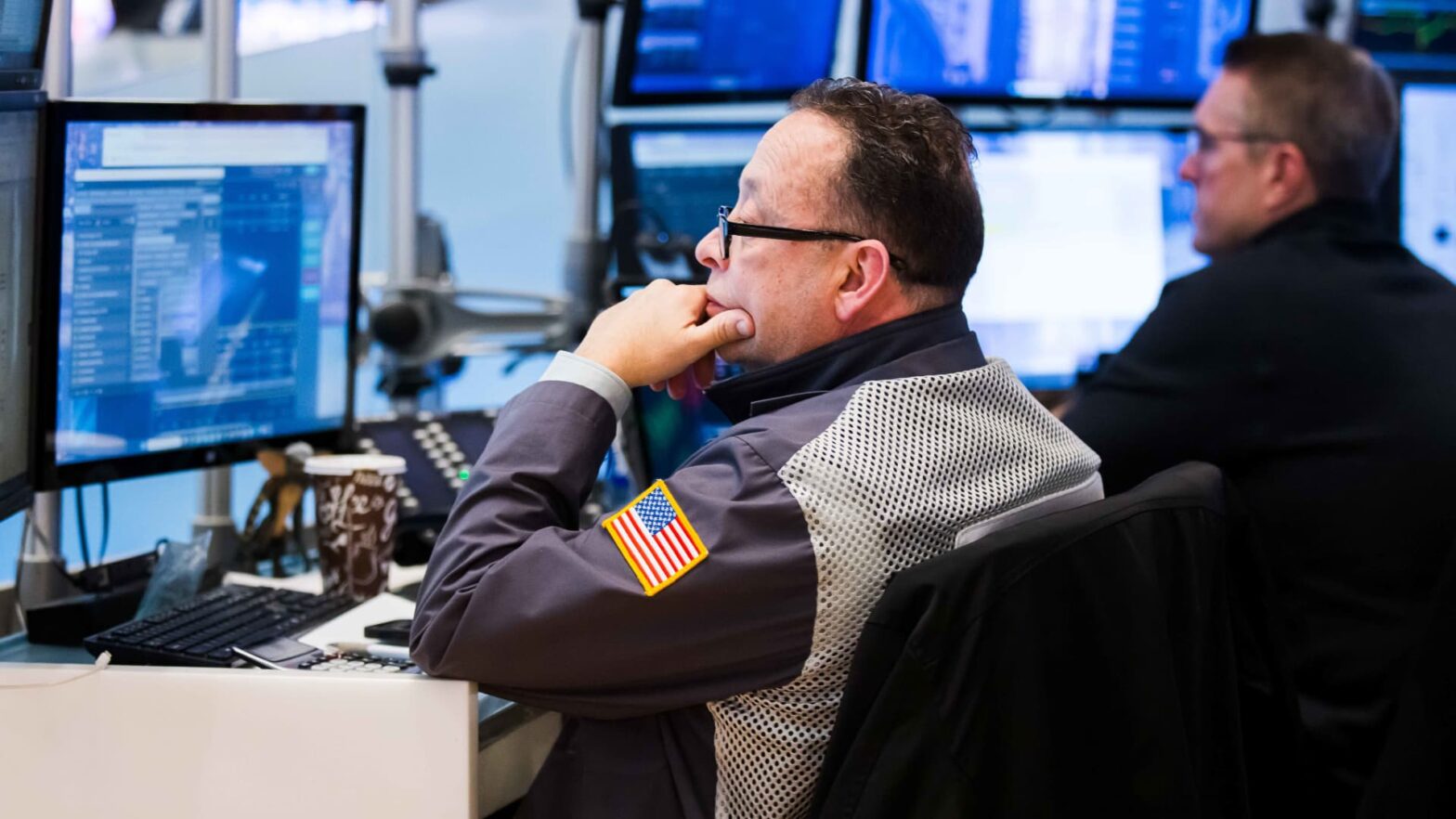
Traders work on the floor of the New York Stock Exchange.
NYSE
Stock futures are little changed on Monday night after tech losses dragged the broader market lower as investors await Nvidia‘s earnings report and delayed jobs data this week.
Futures tied to the Dow Jones Industrial Average rose 52 points, or 0.1%. S&P futures added about 0.1%, while Nasdaq 100 futures were up about 0.2%.
The three major U.S. indexes closed in the red in the previous trading session. The 30-stock Dow Jones Industrial Average plunged more than 550 points, or 1.2%, while the S&P 500 and Nasdaq Composite each lost around 0.9%.
Nvidia notably declined about 2% ahead of the chipmaker’s third-quarter results due after Wednesday’s close. The company, which is reporting toward the end of a strong earnings season, has been at the center of a debate about the strength of the artificial intelligence-powered market rally this year. Concerns have grown about weak market breadth, pricey tech valuations and the soundness of AI fundamentals due to a boom in Big Tech debt offerings and the pace of AI chip depreciation.
The tech-heavy Nasdaq is on pace to snap its seven-month win streak, while the S&P 500 is down 2.5% in November after rallying for six months in a row.
“The market narrative has certainly shifted dramatically over the past few weeks, as the market’s reaction function with respect to AI has taken a sharp left turn from rewarding ever-growing capex spend to rapidly growing skepticism of further investment and future returns,” said Garrett Melson, portfolio strategist at Natixis Investment Managers Solutions. “Pair that with crowded positioning across real money and systematic accounts and you’ve got all the ingredients for a sharp de-risking and an accompanying narrative reset.”
To be sure, Melson remains bullish that a cooling labor market and an overall improving inflation picture will power a year-end rally. “Despite the fears, the AI cycle remains alive and well, something we expect NVDA will confirm on Wednesday. That certainly isn’t a bearish backdrop,” he said.
Aside from Nvidia’s report, investors this week will monitor data points that can inform the trajectory of upcoming interest rate decisions, which have scaled back in recent weeks. Fed funds futures traders are pricing in roughly 40% chance of a cut, significantly lower than the more than 90% chance priced in a month ago, according to the CME FedWatch tool. The Federal Reserve’s October meeting minutes and September nonfarm payrolls release, which will be the first piece of economic data released following the U.S. government shutdown, are on deck for Wednesday and Thursday releases, respectively.
This week will also see results from heavyweight consumer names such as Walmart, Home Depot and Target. The market is watching for clues on consumer spending activity, especially as holiday shopping season gears up.
Stocks moving in after-hours trading Monday
Monday evening saw just a couple names move on the back of earnings.
Shares of drilling rig company Helmerich and Payne lost more than 8% in extended trading on the back of its disappointing earnings results. Helmerich and Payne reported a fourth-quarter loss of 1 cent per share, excluding items, while analysts polled by FactSet expected the company to earn 23 cents per share. Revenue beat analysts’ expectations, per FactSet.
James Hardie Industries added 5% in extended trading, meanwhile, after the cement and gypsum maker company beat on top and bottom lines, and raised its annual forecast.
Earnings are expected to heat up this week with companies such as Nvidia, Walmart, Home Depot, Target and TJX Companies on deck to report quarterly results.
— Pia Singh
Most-shorted stocks are returning from orbit, S3 Partners says
The October high in a basket of the most highly-shorted stocks “now looks like the blow-off top,” according to S3 Partners, a researcher specializing in monitoring short interest for professional investors. Although the basket is still crushing the S&P 500 in 2025, soaring 52% year-to-date, “a historic run is finally cooling,” since Oct. 15, when the index has climbed by more than 70%.
“The defining feature of 2025 has been the persistence of high-short-interest factor outperformance,” S3 wrote Monday. “Short-interest-heavy names led returns for most of the year, with squeezes and positioning stress repeatedly overshadowing fundamentals,” not the gap with the average U.S. stock is narrowing, the firm said.
“The largest moves occurred where long and short capital were most directly opposing each other,” said the researchers. “Short-Biased names, where short interest exceeds active long interest, saw the most pronounced squeezes and liquidity-driven spikes.”
Looking ahead, with more crowding and “contested positioning” since 2020, “the market has become more sensitive to abrupt sentiment and liquidity shifts,” S3 said.
— Scott Schnipper