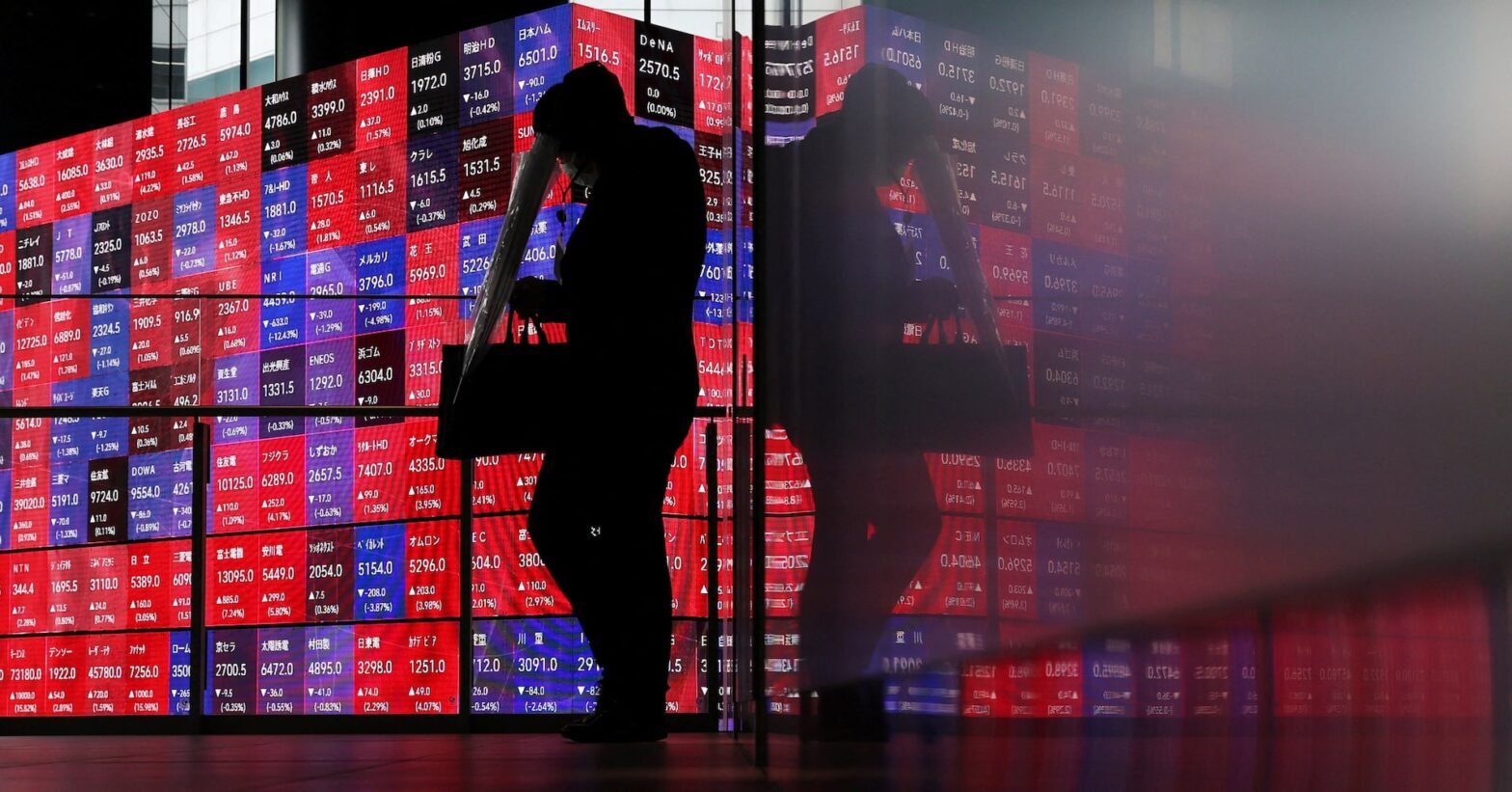
Wall Street advanced on Thursday, helped by gains in megacap technology stocks and economic data that pointed to some cooling in the labor market.
Market participants will also receive remarks from a slew of Federal Reserve speakers a day ahead of the closely-watched nonfarm payrolls report.
Approaching mid-day, the Nasdaq Composite (COMP:IND) led gains among the three major averages, rising 0.92% to 16,427.68 points. The tech-heavy index got a bump from a +3% gain in Meta Platforms (META), after Jefferies predicted that the Facebook-parent could see its best year ever in 2024 partly due to generative artificial intelligence.
Nvidia (NVDA) ticked slightly higher after the chip giant said it did not see any disruptions to chip supply following the biggest earthquake to hit Taiwan in over two decades.
The S&P 500 (SP500) added 0.70% to 5,248.02 points. The benchmark index snapped a two-day losing streak in the previous session, having started the fledgling second quarter on a negative note after a stellar Q1. The blue-chip Dow (DJI) climbed 0.48% to 39,315.73 points.
All 11 S&P sectors were in the green.
Before the opening bell, data from Challenger, Gray & Christmas showed that U.S.-based employers announced 90,309 job cuts in March, a 7% acceleration from February. Meanwhile, the number of Americans filing for initial jobless claims in the past week increased to 221K, compared to a consensus of 213K.
The economic indicators pointed to some signs of cooling in what has been a highly stubborn labor market. Recent data has only reinforced that resilience, and coupled with sticky inflation has complicated the Federal Reserve’s plans for interest rate cuts.
Still, Fed chair Jerome Powell on Wednesday reassured investors at an event in Stanford, Calif. by saying that recent hotter-than-anticipated data on the labor market and inflation did not “materially change” an overall scenario of deceleration inflation and anticipated rate cuts.
“As we think about the rest of the year, the biggest known market risks appear to stem around the potential of sticky inflation, a higher and more volatile interest rate environment that could pressure stocks, and a bar for positive surprises that has risen,” Keith Lerner, co-chief investment officer at Truist, said in a note on Wednesday.
“Market valuations, even outside of the tech heavy weights, have also expanded alongside the rally this year, and concentration risks in tech remain a concern. As we move deeper into the year, the election will come closer into view, likely injecting periodic bouts of volatility. And, of course, there will be unexpected events,” Lerner said.
“Still, until the weight of the evidence shifts, our view is bull market rules apply. That is, investors should stick with the primary market uptrend, and look to pullbacks as opportunities,” Lerner added.
Turning to the fixed-income markets, Treasury yields made small moves on Thursday. The 30-year (US30Y) and 10-year yields (US10Y) were both little changed at 4.50% and 4.35%, respectively. The shorter-end more rate-sensitive 2-year yield (US2Y) was up 2 basis points to 4.70%.
See live data on how Treasury yields are doing across the curve at the Seeking Alpha bond page.
Turning to active stocks, Conagra Brands (CAG) was among the top percentage gainers on the S&P 500 (SP500). The company, which owns brands such as Slim Jim, Duncan Hines and Swiss Miss, delivered a quarterly profit beat on the back of a growing trend among U.S. consumers to eat at home.
Conversely, Lamb Weston (LW) tumbled and was the top S&P percentage loser. The frozen potato giant reported a quarterly top and bottom line miss due to a greater-than-expected impact of a transition to a new enterprise resource planning system in North America.
Ford (F) climbed after announcing plans to delay the launch of its three-row electric vehicles to 2027 and instead focusing on its hybrid vehicles.