The local share market is trading lower, despite the value of US stocks, gold and silver climbing to their most expensive levels ever.
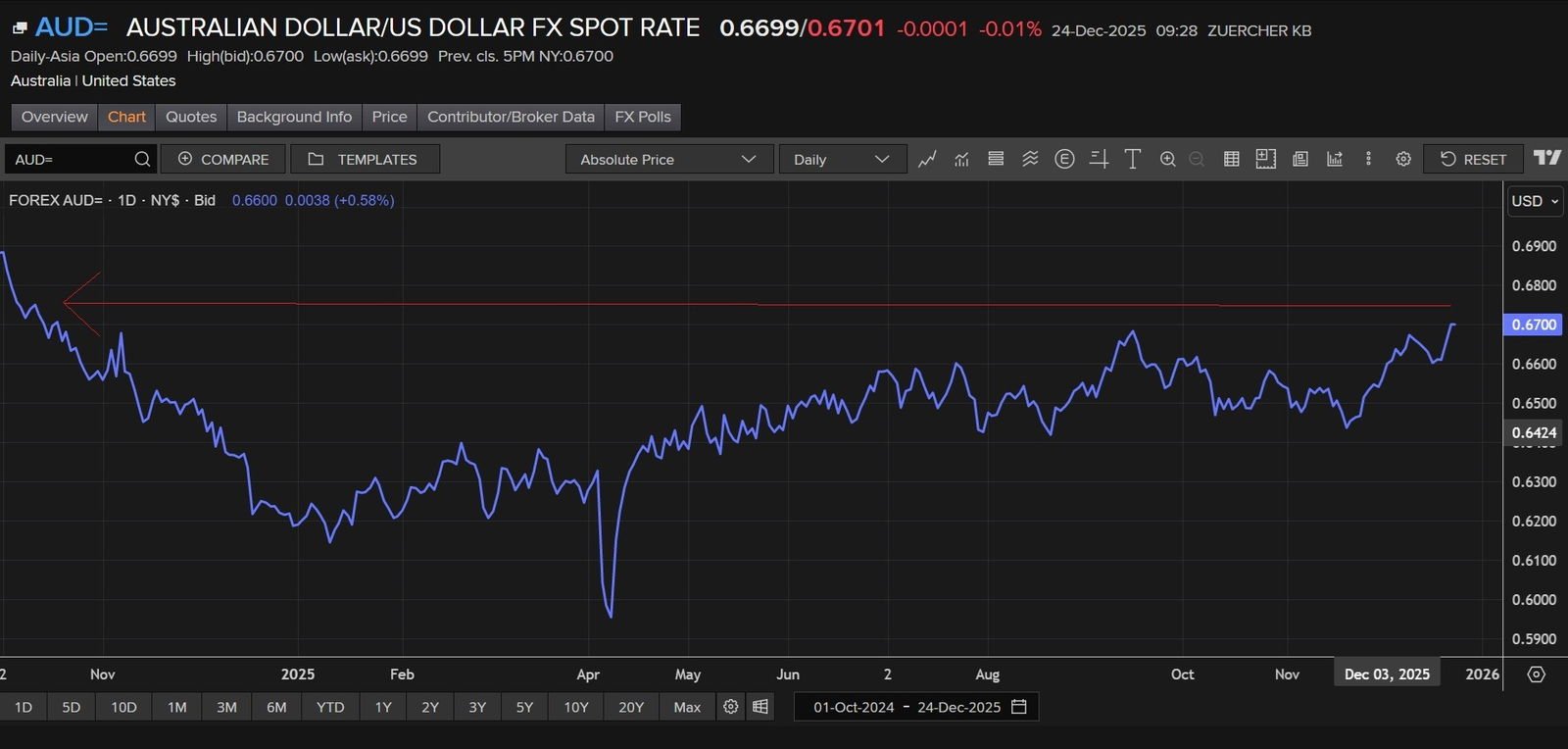
The Australian dollar has jumped to 67 US cents, its highest level since October 2024.
See how the trading day unfolds on our blog.
Disclaimer: this blog is not intended as investment advice.
Key Events
Market snapshot
- ASX 200: -0.5% to 8,753 points
- Australian dollar: +0.7% to 67 US cents
- Wall Street: Dow Jones (+0.2%), S&P 500 (+0.5%), Nasdaq (+0.6%)
- Europe: DAX (+0.2%), FTSE (+0.2%), Stoxx 600 (+0.3%)
- Asia: Nikkei (+0.4%), Shanghai (flat)
- Spot gold: +1.1% to $US4,492/ounce
- Oil (Brent crude): +0.6% to $US62.45/barrel
- Iron ore: -0.5% to $US104.20/tonne
- Bitcoin: -0.5% at $US87,254
Prices current around 12:25pm AEDT
Live updates on the major ASX indices:
Key Event
Aussie dollar at a 17-month high against Japanese yen
The Australian dollar is trading at a 14-month high, partly due to the prospect of higher interest rates next year.
Continued gains across commodities also supported the resource-heavy currency with gold and copper hitting records, both of which are major export earners for Australia.
The Aussie dollar is sitting around 67 US cents, having climbed 1.2% in just two sessions.
It’s doing particularly well against Japan’s currency, having jumped to a 17-month high of 104.6 yen (a gain of almost 7% in the past quarter).
The rally has been driven by rising bond yields as markets swung to price in the risk of a 2026 tightening from the Reserve Bank (RBA).
Minutes from the RBA’s last meeting showed the board preparing the ground for a hike should inflation not recede as hoped, highlighting the importance of the December-quarter inflation numbers (which will be published on January 28).
The RBA holds its first meeting of the year on February 3 and markets are pricing in a 28% chance of the cash rate rising by a quarter-point to 3.85%.
– with Reuters
Key Event
Major banks drag ASX down, despite record commodity prices driving miners higher
Losses for the Australian share market have worsened in midday trade.
The ASX 200 index was down 0.6% to 8,745 points.
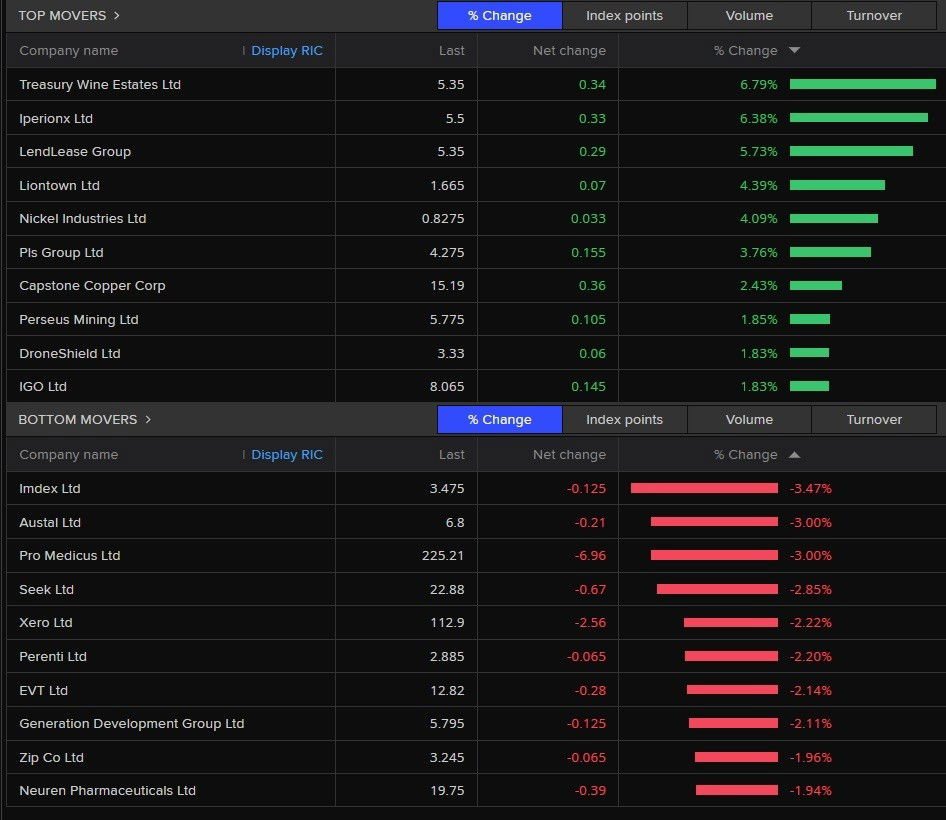
Now that the market has been open for a couple of hours, let’s take a look at today’s best and worst performing stocks.
The companies seeing the strongest demand for their shares are DroneShield, Treasury Wine Estates, LendLease, lithium stocks Liontown and PLS, along with miners IGO, Perseus Mining and Capstone Copper — thanks to gold and copper prices hitting new record highs.
On the flip side, Austal, Seek, Pro Medicus, Xero and Zip Co are seeing the biggest falls to their share price.
But the biggest drags on the market are the heavyweight financial stocks, with the ‘big four’ banks Commonwealth Bank, Westpac, NAB and ANZ dropping between 0.3% and 0.8%.
The major banks are facing “stretched valuations”, which are among the most expensive compared to banks in developed economies.
It’s a technical way of saying they’re “too pricey” (when you compare their share price with the profits they’re earning).
Key Event
Copper also hits new record high, boosting shares of Rio Tinto and other miners
These record highs just keep on coming!
The price of copper has surged above $US12,000 per tonne.
This has led to shares of mining giant Rio Tinto climbing as high as $148 (a new record), for its seventh consecutive day.
Capstone Copper and IGO shares have jumped by around 2% each.
“Copper is currently commanding investor attention, driven by surging AI data centre demand and the metal’s essential role in the development of electrification infrastructure,” said Betashares investment strategist Tom Wickenden.
“But rewind a few months and the narrative was different.
“Earlier this year, lithium dominated discussions as EV demand fluctuations drove significant price volatility.
“Silver also surged mid-year on expanding industrial and solar applications, while rare earths captured headlines amid supply chain concerns and growing defence technology requirements.”
Key Event
Australia’s gold mining stocks jump to highest levels ever
It’s not just physical gold prices hitting a new record high — but also Australia’s gold mining stocks.
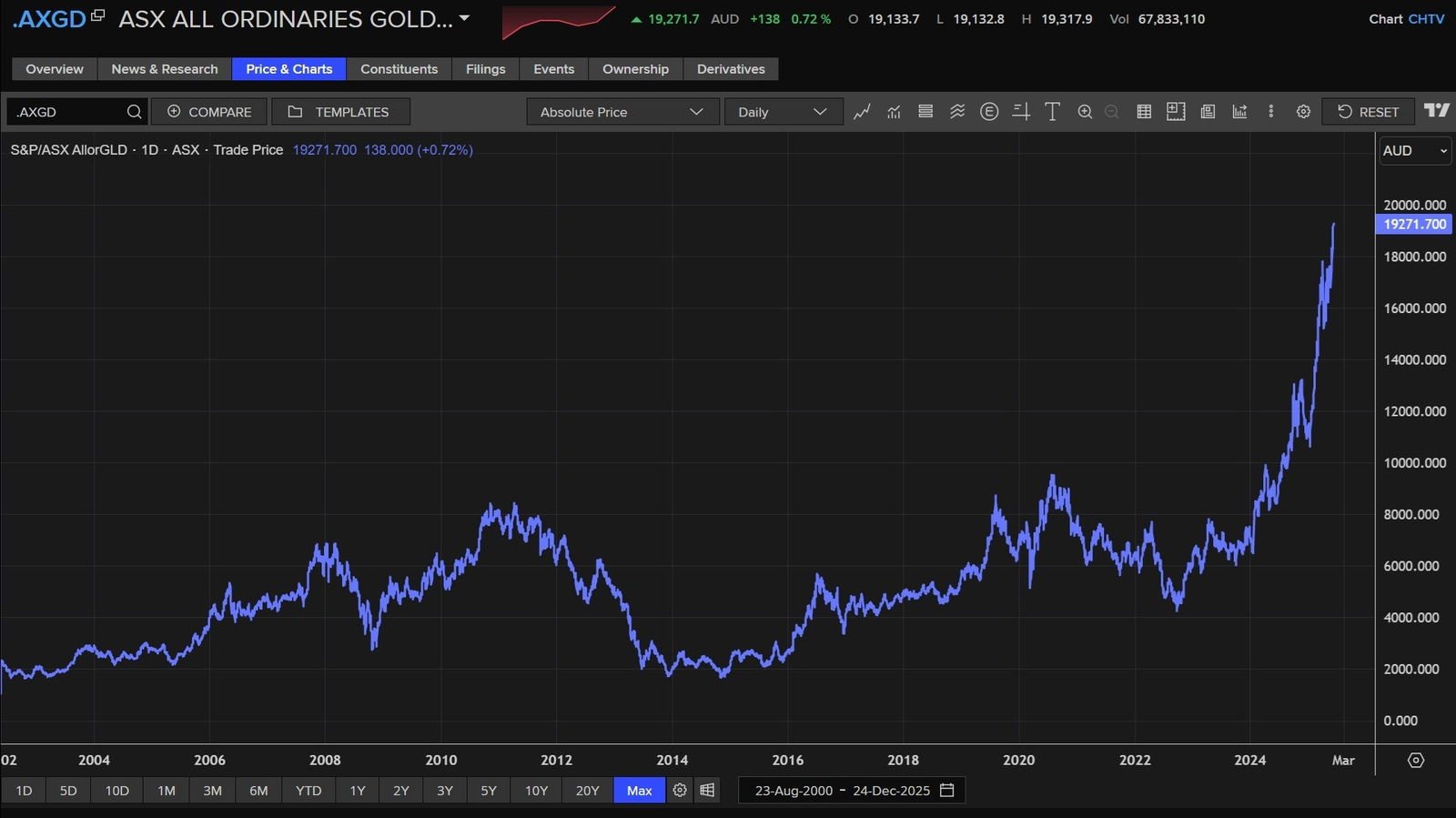
The All Ords Gold sub-index climbed almost 1% to its highest levels ever.
Shares of large gold miners like Evolution Mining and Northern Star Resources gained as much as 1.5% each.
Since the beginning of the year, the gold sub-index has surged by around 129%.
In other words, its value has more than doubled on expectations the gold price will continue rising, along with the profits of those miners.
Key Event
What’s driving gold to record high … after record high?
With geopolitical tensions (particularly Russia-Ukraine, Israel-Gaza and US-Venezuela) continuing to makes investors nervous, safe haven demand is causing gold prices to surge.
Central banks have also been building up their supplies of physical gold bars, which is seen as an attempt to diversify their reserves to be less reliant on the US dollar and US Treasury bonds.
Meanwhile, the Federal Reserve is expected to cut interest rates further next year, which would generally weaken the US currency.
On top of that, an increasing number of fund managers (including those at investment bank Morgan Stanley) are now recommending investors boost their holdings of gold.
They’ve even gone as as far as recommending an asset allocation of 60% to shares, 20% to bonds and 20% to gold.
Historically, Wall Street gurus recommended investing 60% in shares and 40% to bonds to maximise risk, while managing risk.
So it means fund managers are buying more gold than ever before, and they plan to keep doing so!
And given the price of commodities (like gold) are quoted in US dollars, a weaker greenback makes it cheaper to buy those metals.
That leads to more people buying gold, with the increased demand drive up prices further!
Key Event
Gold skyrockets above $US4,500 to another record high
Gold has surged above the psychological milestone of $US4,500 for the first time ever.
In the past couple of hours, the precious metal’s spot price rose 0.4% to $US4,509 per troy ounce.
In Australian currency, you’d have to pay $6,725 for just 31 grams of gold!
It’s incredible when you consider an ounce of gold was fetching $US2,657 at the start of the year (or $3,964 in Australian dollars).
So its value has jumped by around 70% in just 12 months!
Key Event
When Australia could get 6G after Trump launches ‘race’ to next generation of mobile connectivity
Donald Trump says he wants the United States to lead the world in the “6G race” and has given his government one year to find out how to begin making it happen.
The US president has authorised national radio frequencies used by federal agencies to be vacated so private companies can start planning and testing a future rollout of 6G wireless networks.
“The next generation of mobile communications networks (6G) will be foundational to the national security, foreign policy, and economic prosperity of the United States,” Mr Trump said in a statement released on Friday, local time.
There is currently no 6G network connection anywhere in Australia (5G is as fast as it gets).
Some experts believe Australia will not have 6G coverage at least until 2030.
Key Event
Consumer and financial sectors drag ASX lower
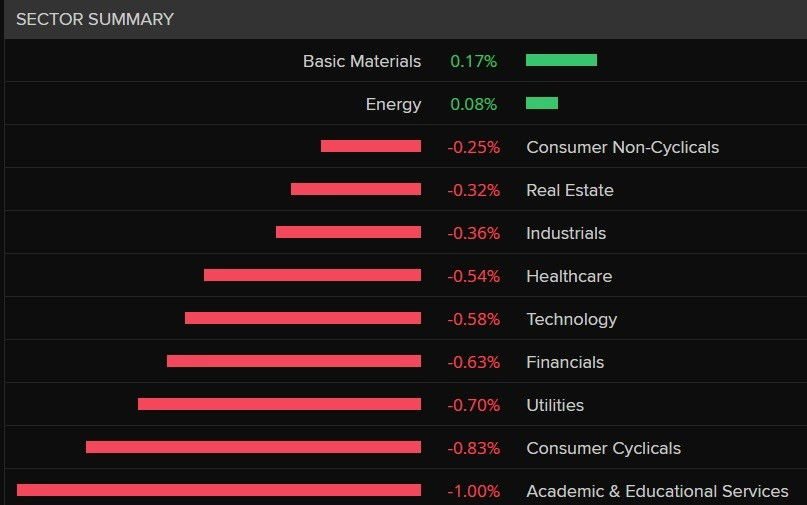
Almost every sector on the ASX 200 is trading lower this morning.
The worst performing sectors include consumer discretionary (-0.8%), utilities (-0.7%) and financials (-0.6%).
On the flip side, the only sectors doing well are materials (+0.2%) and energy (+0.1%).
Key Event
ASX falls 0.3 per cent in early trade
Australia’s share market is off to a slightly worse-than-expected start.
The ASX 200 is down 0.3% to 8,767 points.
The broader All Ordinaries index is down by a similar percentage to 9,067 points.
I’ll have more details on today’s best and worst performing stocks shortly.
Market snapshot
- ASX 200: -0.4% to 8,757 points
- Australian dollar: +0.7% to 67 US cents
- Wall Street: Dow Jones (+0.2%), S&P 500 (+0.5%), Nasdaq (+0.6%)
- Europe: DAX (+0.2%), FTSE (+0.2%), Stoxx 600 (+0.3%)
- Spot gold: +1.1% to $US4,492/ounce
- Oil (Brent crude): +0.6% to $US62.45/barrel
- Iron ore: -0.5% to $US104.20/tonne
- Bitcoin: -0.5% at $US87,254
Prices current around 10:12am AEDT
Key Event
US consumers turn pessimistic as inflation, tariffs and interest rates weigh on mood
While America is experiencing stronger-than-expected economic growth, consumers are not feeling so optimistic.
In fact, US consumer confidence deteriorated in December, for a fifth straight month, amid deepening anxiety over jobs and income.
The Conference Board said its consumer confidence index fell 3.8 points to 89.1 points this month.
Economists polled by Reuters had forecast the index at 91 points.
Any number less than 100 points means the number of pessimists outweigh the optimists, and it could be an ominous sign for future consumer spending.
“Consumers’ write-in responses on factors affecting the economy continued to be led by references to prices and inflation, tariffs and trade, and politics,” said Dana Peterson, chief economist at the Conference Board.
“However, December saw increases in mentions of immigration, war, and topics related to personal finances—including interest rates, taxes and income, banks and insurance.”
– with Reuters
Key Event
Strongest level for Aussie dollar since October 2024 as US dollar weakens
Here’s what the Australian dollar being at a 14-month high looks like.
The last time it traded at 67 US cents was back on October 18, 2024.
So that’s good news if you’re currently travelling in the United States or buying goods from a US shopping website.
The local currency has also jumped 8.3% since the year began.
Conversely, the US dollar index (which tracks the greenback against a basket of major currencies) has dropped more than 10% in the year to date.
It’s largely because of the widening interest rate differentials between the US and Australian currencies.
While the Federal Reserve is likely to cut rates next year, Australia’s Reserve Bank is widely expected to announce at least one interest rate hike in 2026.
In general, rate cuts lead to a weaker dollar, while rate hikes boost a currency’s strength.
The US dollar is also being sold off as a result of the “sell America‘ trade — as Trump tariff unpredictability, worries about the future independence of the Fed and ballooning US debt (partly used to fund tax cuts which predominantly benefit the wealthy) have led to investors putting their money in less risky places.
Key Event
Aussie dollar rises to 14-month high after strong US economic data
The Australian dollar is trading at 67 US cents, after jumping 1% overnight.
That’s the highest level it has been all year.
To be more precise, the local currency hasn’t been this strong since October 2024 (around 14 months ago).
It’s partly because the US dollar weakened overnight as the odds of a Federal Reserve interest rate cut decreased.
That was in response economic figures, showing the US economy growing at a much faster than expected 4.3% in the September quarter.
The data bolstered views that the Fed will hold off on cutting rates at its meeting in late January, with the odds currently at 87%, according to LSEG estimates.
US rate futures now expect the US central bank’s next interest rate cut may occur in June, with two rate reductions priced in for 2026.
– with Reuters
Key Event
Consumer spending drives surprisingly strong US economic growth in September quarter
Wall Street recorded another strong day after the United States released official figures showing the economy growing at its fastest pace in two years.
The figures showed gross domestic product (GDP) increasing at a 4.3% annualised rate in the September quarter, well above the 3.3% estimate of economists polled by Reuters.
America’s economic growth was fuelled by robust consumer spending and a sharp rebound in exports, though momentum appears to have faded amid the rising cost of living and recent government shutdown.
The stronger-than-expected increase in GDP last quarter also reflected continued investment by businesses in equipment and artificial intelligence (AI).
Government spending, mostly on defense, also provided a lift, according to the new data from the US Commerce Department.
While the data was delayed due to the 43-day government shutdown (and many analysts expected the December quarter would show a slower pace of economic growth), markets are now pricing in a smaller chance of a January rate cut from the Federal Reserve, according to CME’s FedWatch Tool.
– with Reuters
Key Event
House prices and AI investment boom define economy in 2025
Australians are finishing this year the same way they started it: with rising house prices and inflation pressures on the household budget.
Lower interest rates and migration helped push up Australia’s economic growth (as measured by GDP).
But the GDP per capita number was flat, which means there was no economic growth on a per person basis.
In this report, Alan Kohler also ponders whether the artificial intelligence (AI) investment boom mirrors the Dot Com Bubble.
Loading…
Market recap — Daniel Ziffer’s finance report
In case you need a refresher before the ASX opens (in less than three hours), I can certainly recommend Daniel Ziffer’s finance report.
Daniel decodes the Reserve Bank’s latest meeting minutes, summarising the discussions which RBA governor Michele Bullock had with her colleagues on what might trigger an interest rate hike in the months ahead.
Loading…
Key Event
S&P 500 closes at record high as Wall Street’s tech stocks jump
Traders on Wall Street are certainly feeling the festive cheer in the lead-up to Christmas.
Its benchmark stock index, the S&P 500, posted a record closing high after it rose 0.5% to 6,910 points.
The Nasdaq Composite rose 0.6% to 23,562 points, thanks to strong gains from tech stocks like Nvidia (+3%) and Broadcom (+2%).
The Dow Jones Industrial Average went up by a much smaller 0.2% to 48,442 points.
Despite the solid performance on Wall Street, the Australian share market is expected to open with a slight fall.
ASX futures are down 0.1% to 8,768 points.
Key Event
Boxing Day sales set to be biggest on record as interest rate relief drives retail rebound
Australians are expected to spend a record $1.6 billion on Boxing Day, supported by higher demand from population growth and revived household spending after three interest rate cuts from the Reserve Bank.
That’s a 4.3 per cent increase on last year, according to research from the Australian Retailers Association in partnership with Roy Morgan.
The retail sector has experienced a rebound this year; however, the prospect of interest rate hikes could dampen sales in 2026.
For more, here’s the story by Samuel Yang:
Key Event
Australian businessman Ranjit Thambyrajah languishes in Vietnam jail after failed loan deals
A high-flying Australian businessman has been languishing in a Ho Chi Minh City jail for two months, accused of swindling a struggling Vietnamese petrol trading company.
Ranjit Thambyrajah, 65, has spent decades building a business promising to connect borrowers everywhere — from New York to Kuala Lumpur — with lenders in the high-stakes world of global finance.
Over the years, the business, Acuity Funding, has been involved in legal stoushes over the fees it charges, including an allegation of fraud made against it in a civil lawsuit in American courts.
But in October, the stakes escalated dramatically when Vietnam’s powerful and politically connected Ministry of Public Safety imprisoned Mr Thambyrajah without charge after accusing him of swindling companies there.
For more, here’s the story by Ben Butler: