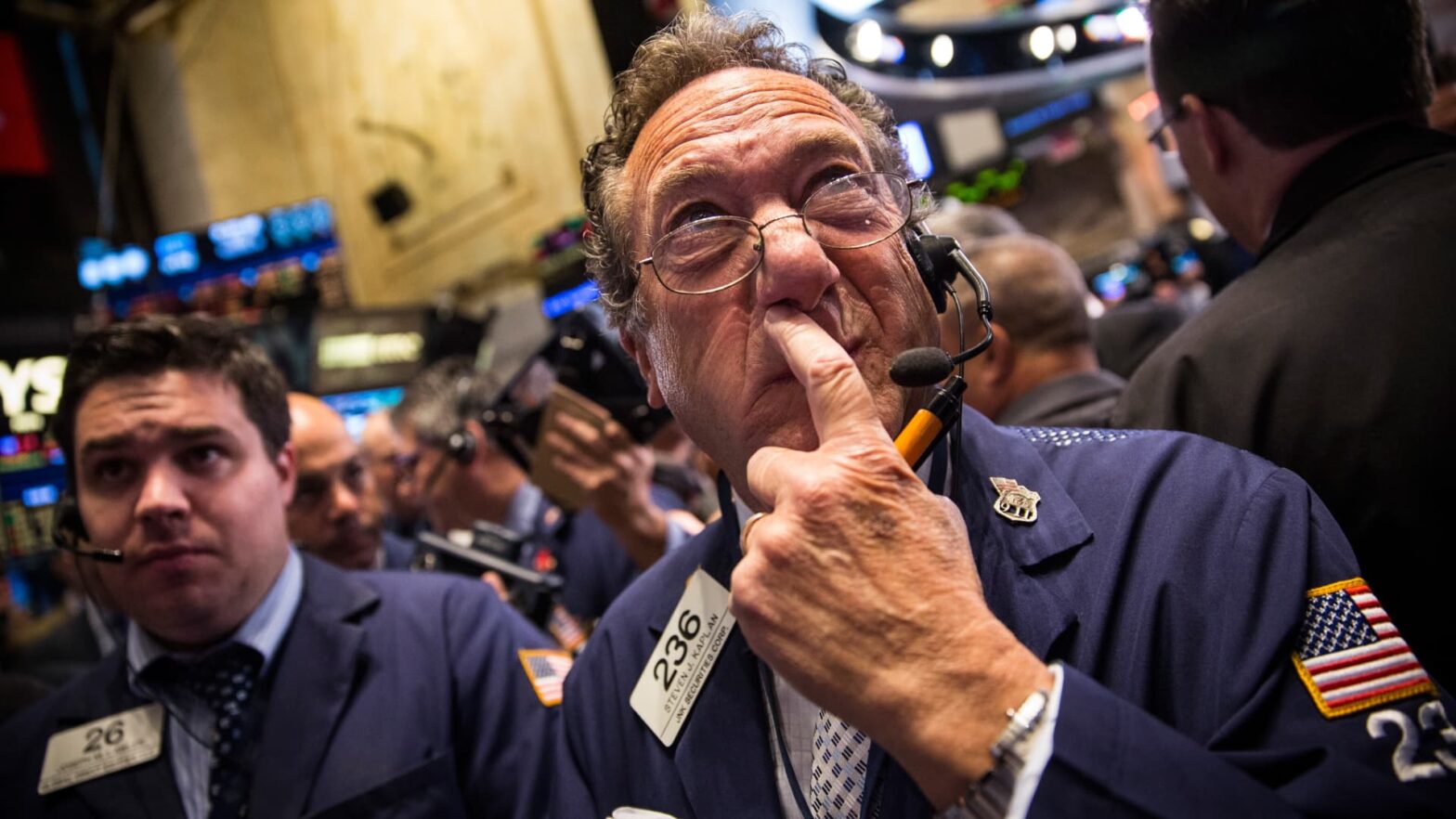
Traders work on the floor of the New York Stock Exchange during morning trading on February 29, 2024 in New York City.
Michael M. Santiago | Getty Images
Futures tied to the Dow Jones Industrial Average sat near flat Thursday night following the index’s worst session in over a year. Investors also awaited key labor data due Friday morning.
Dow futures added just 8 points, trading slightly above flat. S&P 500 futures and Nasdaq 100 futures each rose about 0.1%.
Those moves follow a selloff on Wall Street during Thursday’s session. The Dow tumbled about 530 points, or 1.35%, marking its biggest daily drop since March 2023 and its fourth consecutive losing session.
The S&P 500 and Nasdaq Composite tumbled 1.23% and 1.4%, respectively. The three major averages swung into the red in the afternoon as crude oil jumped and Minneapolis Federal Reserve President Neel Kashkari questioned if interest rates should come down amid sticky inflation.
The Dow has led the three major indexes down this week, pacing for a loss of 3% and its worst weekly performance since March 2023. The S&P 500 and Nasdaq have each slid around 2% through Thursday’s close. Those moves mark a retreat after the strong first quarter concluded last week, leading some market participants to wonder if a correction is warranted following big gains.
“Near term, equities are likely subject to some consolidation following robust first-quarter returns,” said Terry Sandven, chief equity strategist at U.S. Bank Wealth Management. “A modest pullback would be within the normal ebb and flow of an upward-trending market.”
Investors will watch for the all-important jobs data coming Friday morning. Economists polled by Dow Jones anticipate nonfarm payrolls growing by 200,000 jobs and the unemployment rate ticking down to 3.8% in March.
Average hourly wages, another closely followed metric, are expected to rise by 0.3% on the month and 4.1% from a year prior.
“The market remains highly sensitive to any indication that the data-dependent Fed may need to curtail a rate-easing cycle this year,” said Quincy Krosby, LPL Financial’s global chief strategist, citing Kashkari’s Thursday comments. “Accordingly, the payroll report will provide important inflation-related data particularly with regard to the pace of wages.”
Consumer spending will get a boost from the five-month-long stock market rally, Capital Economics says
Consumer spending in the U.S. is likely to see at least a modest bump as a result of a resurgence in household wealth thanks to the stock market rally and higher house prices, according to London-based Capital Economics.
“The continued surge in the stock market that we forecast is likely to drive household net wealth to a record high as a share of incomes and provide a tailwind to consumption growth,” Andrew Hunter, deputy chief U.S. economist wrote Thursday.
American household stock holdings jumped $7 trillion in the first quarter, while total household net wealth climbed $8.5 trillion, including the value of homes, Hunter said. The research firm sees household wealth advancing an additional $20 trillion by the end of 2025, “as an AI-fueled bubble inflates” and house prices gain another 6% by the end of next year.
Any added spending resulting from households feeling more wealthy is likely to bolster consumer spending rather than lead to a big upswing, the firm said. “We suspect rising household wealth is likely to underpin a gradual acceleration in consumption growth in 2025-26 rather than driving a sudden boom,” wrote Hunter.
— Scott Schnipper
Here’s what investors should look for in Friday’s big jobs report
Expect a strong March jobs report as the Labor Department rolls out its payrolls data on Friday morning.
Economists polled by Dow Jones expect that employers added 200,000 jobs last month, which would indicate a slowdown from February’s addition of 275,000.
While job gains are a key area of focus for Wall Street, traders will be looking through the Labor Department’s report for revisions to previous payrolls reports. In its February results, the federal agency announced sharp downward revisions to December and January’s payroll data.
Investors – and the Federal Reserve – will also have an eye on wage growth. Economists anticipate average hourly earnings gained 0.3% in March. That would be an increase from February’s 0.1% jump.
Read more from CNBC’s Jeff Cox on the details in the upcoming jobs report.
–Darla Mercado
Investor bullishness stays above average for 22nd week in latest AAII poll
Investor optimism over the outlook dipped in the latest weekly poll from the American Association of Indivodual Investors, while still remaining above its historical average for a 22nd consecutive week, coinciding with the start of the current bull market.
Bullishness fell to 47.3% from 50.0% last week, against an historical average of 37.5%.
Bearishness about the outlook for stock prices stayed below its historical average for a 22nd week, easing to 22.24% from 22.4% last week versus an historical average of 31%. Neutral sentiment climbed to 30.5% from 27.6%, the eighth time in 10 weeks it was below its historical average of 31.5%.
Sentiment indicators are used as a contrarian signal. When bullish readings get too extreme, it’s regarded as a sign that optimists have finished most of their buying and little money remains on the sidelines to come into the market. Conversely, extreme bearish readings can signal that most selling is done and plenty of cash is on the sidelines ready to buy stocks.
— Scott Schnipper
Stocks head for losing week
With just Friday’s session left in the trading week, the three major indexes are on track for notable drops.
The Dow has lost about 3% so far, putting it on pace for its worst week since March 2023. The S&P 500 and Nasdaq Composite have each slipped around 2%.
— Alex Harring
Dow futures little changed
Dow futures traded slightly above flat shortly after 6 p.m. ET. Futures tied to the S&P 500 and Nasdaq 100 each added around 0.1%.
— Alex Harring