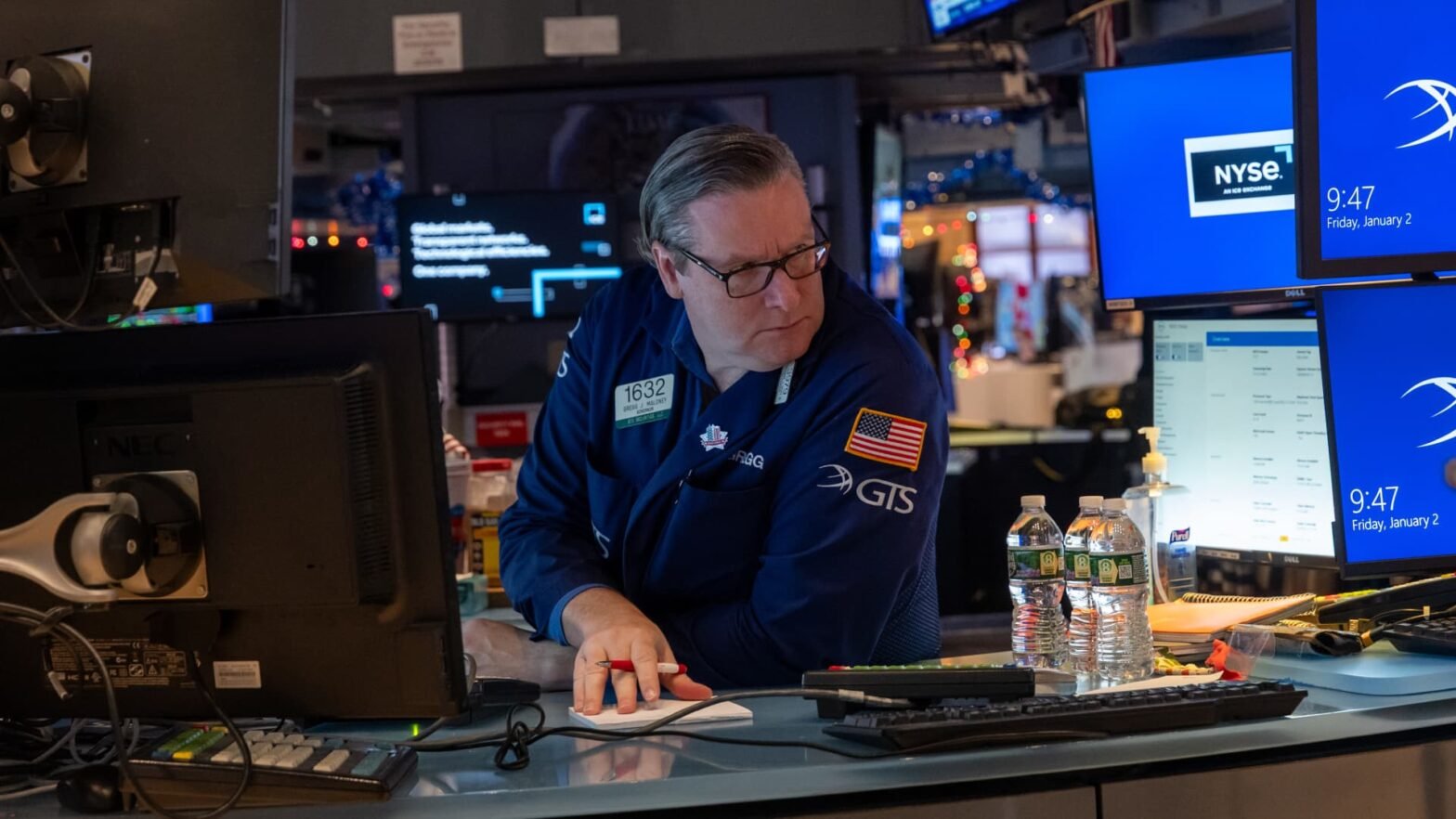
Traders work on the floor of the New York Stock Exchange on the first day of trading for the year on Jan. 2, 2026 in New York City.
Spencer Platt | Getty Images
Stock futures were steady on Sunday night, as global markets reacted to the U.S.’ attack on Venezuela and capture of leader Nicolas Maduro.
Dow Jones Industrial Average futures traded 15 points higher. S&P 500 futures rose 0.1%, and Nasdaq-100 futures advanced 0.2%.
Following the attack, Maduro and his wife, Cilia Flores, were flown to New York — where they were charged with narco-terrorism conspiracy and other crimes. Drug trafficking, according to the indictment, “has enriched and entrenched Venezuela’s political and military elite.”
Maduro’s ouster comes more than a decade after he came to power, succeeding longtime dictator Hugo Chavez in April 2013. It also raises questions about what’s next for the country with the largest proven oil reserves in the world.
President Donald Trump said Saturday in a news conference that the U.S. would “run” Venezuela “until such time as we can do a safe, proper and judicious transition.” Secretary of State Marco Rubio appeared to walk back those remarks on Sunday, however, noting the U.S. would use leverage to meet policy goals. He also did not say the U.S. would govern Venezuela directly.
To be sure, some on Wall Street think the impact on markets from the U.S. intervention will be limited. Despite Venezuela’s massive reserves, the country produces less than 1 million barrels per day. That’s less than 1% of global production.
BCA Research chief strategist Marko Papic also noted that the Venezuelan government is “stabilized” by the country’s military.
“President Trump’s assertion that the US will ‘run the country’ and that he is not afraid of ‘troops on the ground’ should be faded as signals. The US will likely negotiate with the military and the opposition in the transitional phase,” Papic wrote to clients.
Wall Street is coming off a mixed session. The S&P 500 and Dow closed higher on Friday — the first trading day of the year — while the Nasdaq ended just below the flatline.
This week, traders will look out for the release of the December jobs report on Friday. Economists polled by Dow Jones expect the economy added 54,000 jobs last month.
Crude slips after Venezuela attack
Crude prices were slightly lower Sunday after the U.S. attack on Venezuela and the ouster of leader Nicolas Maduro.
U.S. crude oil fell 31 cents, or 0.54%, to $57.01 per barrel. Global benchmark Brent fell 22 cents, or 0.36%, to $60.53 per barrel.
Read more here.
— Spencer Kimball
Rubio appears to backtrack on Trump remarks about U.S. running Venezuela
President Donald Trump said Saturday in a news conference that the U.S. would “run” Venezuela “until such time as we can do a safe, proper and judicious transition.” Secretary of State Marco Rubio appeared to walk back those remarks on Sunday, however, noting the U.S. would use leverage to meet policy goals. He also did not say the U.S. would govern Venezuela directly.
“What’s going to happen here is we have a quarantine on their oil, that means their economy will not be able to move forward until the conditions that are in the national interest of the United States and the interests of the Venezuelan people are met, and that’s what we intend to do,” Rubio said on ABC’s “This Week with George Stephanopoulos.”
— Fred Imbert
Stock futures open little changed
Trump issues warning to Venezuelan leader Rodriguez
President Donald Trump issued a warning on Sunday to Venezuelan leader Delcy Rodriguez, saying: “If she doesn’t do what’s right, she is going to pay a very big price, probably bigger than Maduro.”
Trump, speaking to The Atlantic, also defended his decision to attack Venezuela. “You know, rebuilding there and regime change, anything you want to call it, is better than what you have right now. Can’t get any worse.”
— Fred Imbert