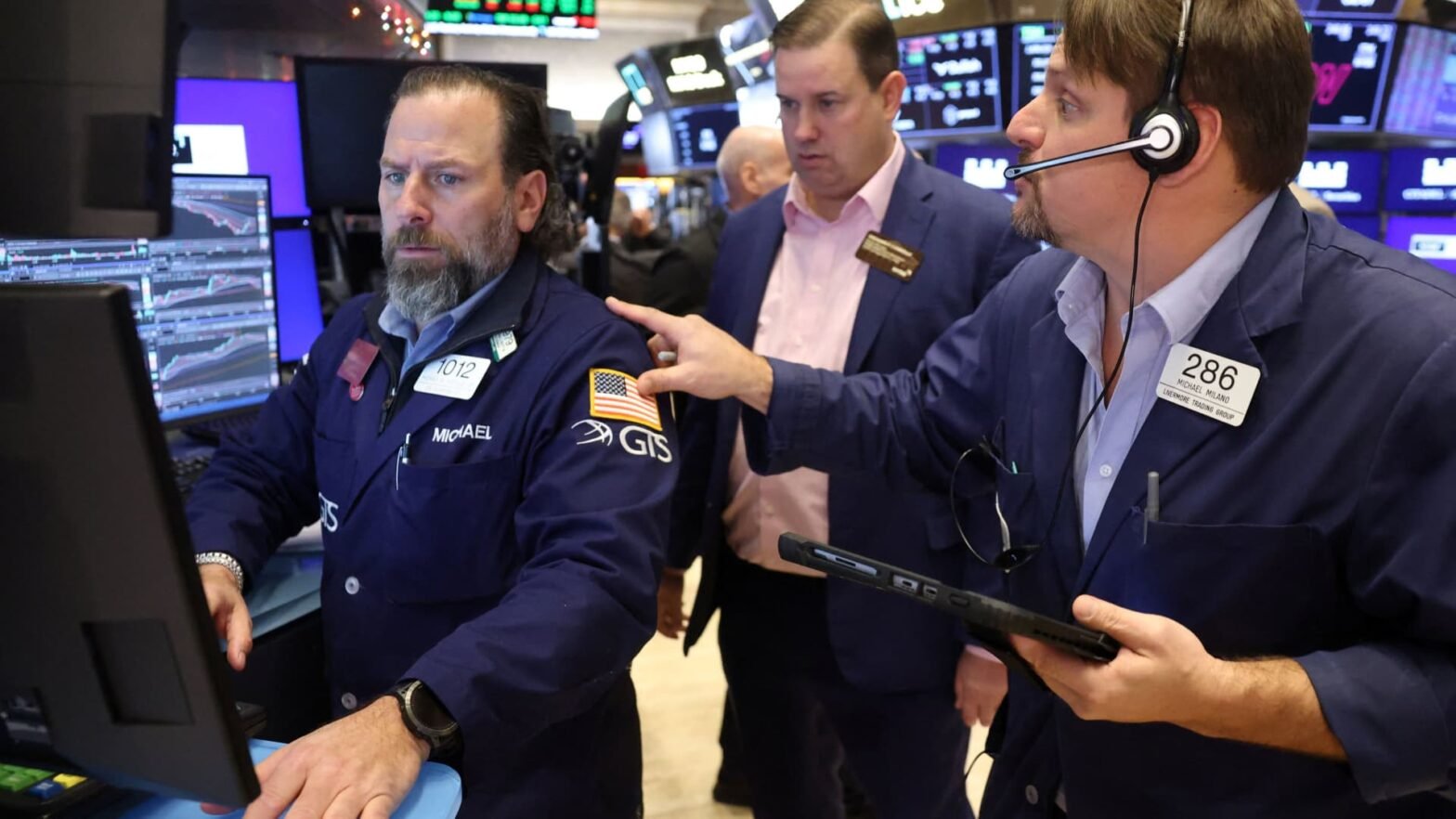
Traders work on the floor at the New York Stock Exchange in New York City, U.S., Jan. 6, 2026.
Brendan McDermid | Reuters
Stock futures traded near the flatline overnight after the S&P 500 and the Dow Jones Industrial Average notched fresh records.
Futures tied to the 30-stock Dow added 24 points, or 0.07%. S&P 500 futures gained 0.04%, while Nasdaq 100 futures rose 0.07%.
Stocks climbed in Tuesday’s regular session as investors seemed to shrug off worries about the U.S. attack on Venezuela over the weekend. The blue-chip Dow jumped nearly 485 points, or 0.99%, to close above 49,000 for the first time. The S&P 500 also posted a record close after gaining about 0.6%, and the tech-heavy Nasdaq Composite ended the day higher by roughly 0.7%
“The market’s reaction to the Venezuela news underscores the gap between headline risk and actual price action. While [Venezuelan President Nicolás] Maduro’s arrest is a notable geopolitical event, it carries no immediate implications for oil supply — the factor markets truly care about,” said Angelo Kourkafas, senior global investment strategist at Edward Jones.
“Meanwhile, the pro-cyclical rally that has unfolded since the start of the week reflects supportive fundamentals, including an expected broadening of earnings momentum both within and beyond mega-cap tech,” he added.
Nine out of 11 S&P 500 sectors ended the session higher, with gains in health care and tech boosting the index.
“Magnificent Seven” member Amazon and retail investor favorite Palantir each closed higher by more than 3%. Data storage plays SanDisk, Western Digital and Seagate were among the S&P 500’s top performers on Tuesday.
Looking ahead, Wells Fargo Investment Institute’s head of global investment strategy Paul Christopher said that “social calm” will be key for the direction of the U.S. stock market.
“If the current government does not cooperate with the U.S., or if the military or opposition lose patience awaiting elections, we could see a new round of the country’s long-simmering social chaos – a likely negative for U.S. equities,” Christopher said.
“If the U.S. can help the Venezuelan people to take better opportunity from their oil resources, and promote open and honest elections, then there is potential for the U.S. to help Venezuela and develop stronger economic ties between the U.S. and Latin America – a potential positive for U.S. markets,” he said.
Prediction markets show rising odds Trump seizes Panama Canal, moves on Greenland
Prediction market traders are ramping up bets that U.S. President Donald Trump will lead more international shake-ups after the U.S. attack on Venezuela over the weekend.
Odds that Trump will “take back the Panama Canal” before early 2029 jumped above 35% on the Kalshi prediction market, from less than 30% late last week. Trump said last year that he wouldn’t rule out using military force to gain control of the maritime route linking the Pacific to the Atlantic.
The likelihood that the U.S. will “take control of any part of Greenland” rose to 38% midday Tuesday — an increase of roughly 8 percentage points since the middle of last week. Trump and his team are considering “a range of options” in order to acquire Greenland, including using the U.S. military, White House press secretary Karoline Leavitt told CNBC on Tuesday.
“The big takeaway for investors is Trump is growing much more comfortable with, and confident in, the use of military force,” Piper Sandler analyst Andy Laperriere wrote to clients on Monday. “His first year in his second term was characterized by boundless energy and risk-taking, and that has been extended to the use of the military.”
— Alex Harring, Pia Singh
Huang at CES: Nvidia is seeing ‘very high’ Chinese customer demand for H200 chips
President and CEO of NVIDIA Jensen Huang speaks during a Siemens news conference at the annual Consumer Electronics Show in Las Vegas, Nevada, on January 6, 2026.
Caroline Brehman | Afp | Getty Images
Nvidia chief executive officer Jensen Huang said Tuesday that the company is seeing “very high” customer demand in China for its H200 AI chips, which the U.S. government recently signaled that it would approve for export.
Huang added that Nvidia has started producing the chips again and is working out the final details about export licenses with the U.S. government. Nvidia’s chips are critical for companies developing artificial intelligence models.
″We’ve fired up our supply chain, and H200s are flowing through the line,” Huang said at a press conference at the CES conference in Las Vegas.
— Kif Leswing