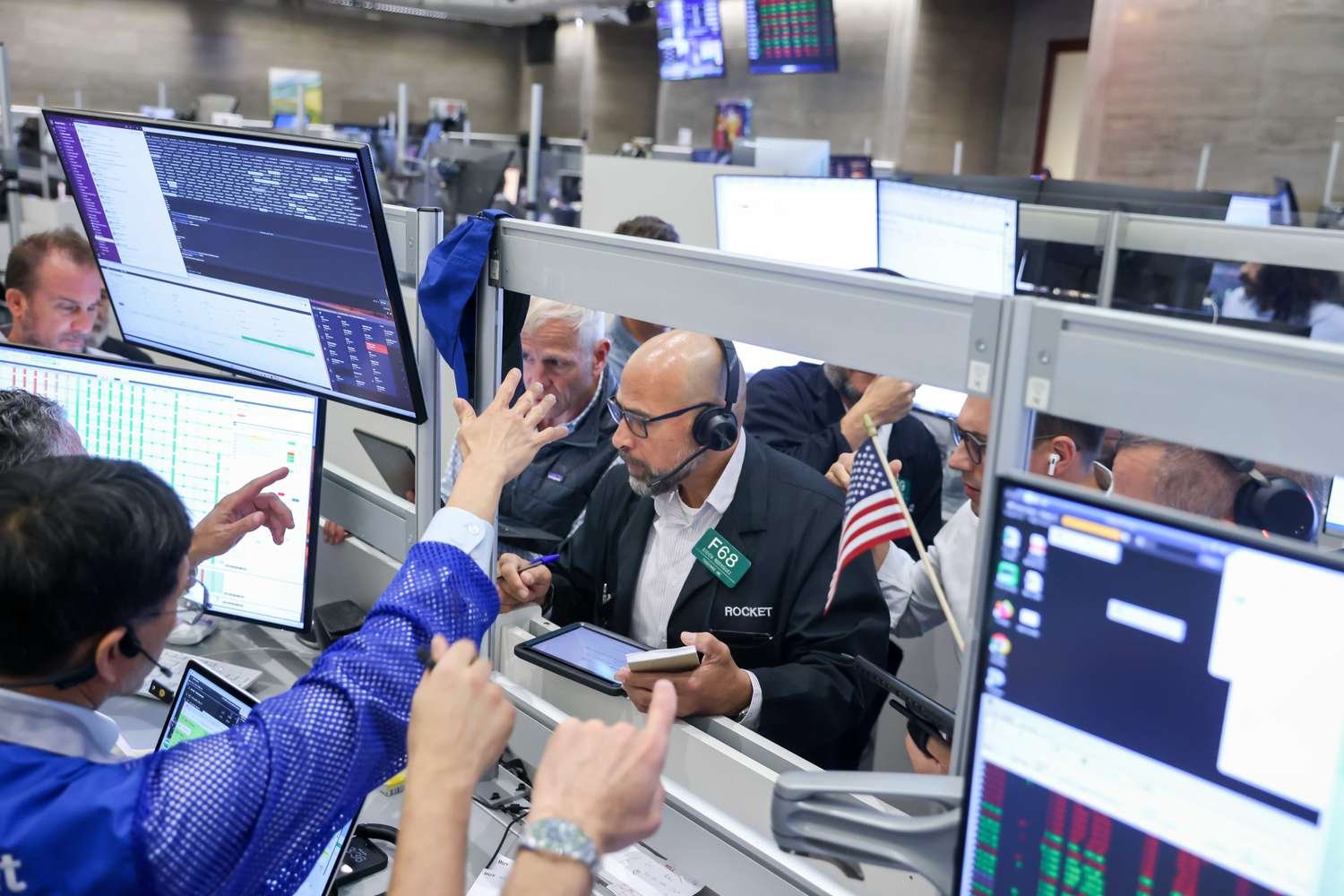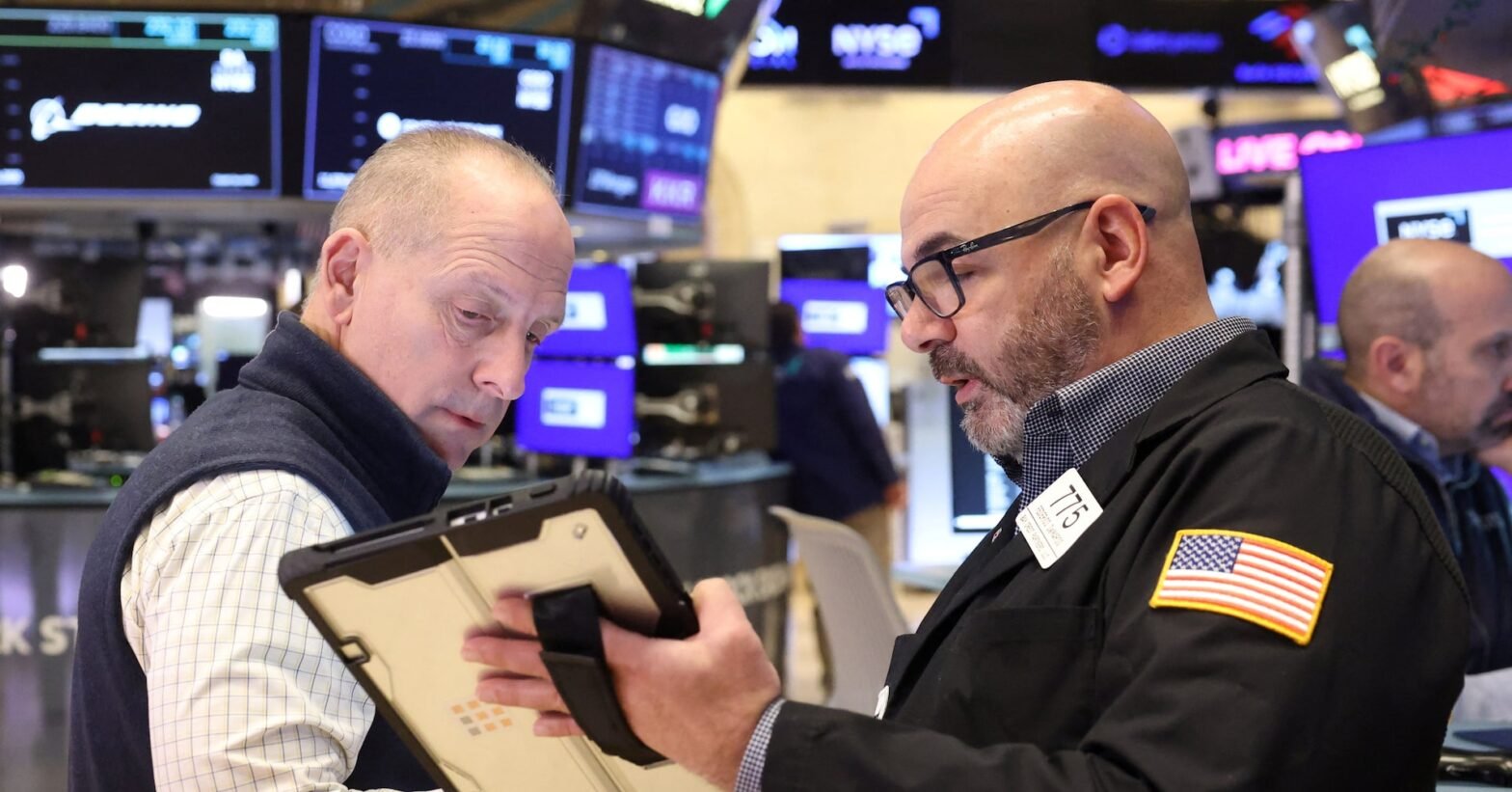

Traders work on the floor at the New York Stock Exchange (NYSE) in New York City, U.S., January 7, 2026. REUTERS/Brendan McDermid Purchase Licensing Rights, opens new tab
- Defense stocks climb as Trump proposes bigger military budget
- Ford rises after Piper Sandler upgrades rating, raises PT
- Weekly jobless claims rise less than expected
- S&P 500 -0.09%, Nasdaq -0.65%, Dow +0.54%
Jan 8 (Reuters) – Wall Street was mixed on Thursday, as Nvidia and other technology stocks dipped, while defense companies advanced after President Donald Trump called for an enlarged $1.5 trillion military budget.
Nvidia
slid 2.3%, Broadcom
declined 3% and Microsoft
dipped 1.2%. The S&P 500 technology index
lost 1.7%, leaving it down about 1% so far in 2026, as investors grew more finicky about AI-related stocks whose valuations have been inflated by outsized gains in recent years.
Sign up here.
Alphabet
gained 1.2% the day after the Google parent surpassed Apple
in market capitalization for the first time since 2019, becoming the second-most valuable U.S. company. The iPhone maker was last down 1.2%.
“While AI is still hot, there are going to be winners and losers,” said Art Hogan, chief market strategist at B. Riley Wealth. “It’s become a ‘show me’ sector. Show me how you monetize this. Show me if there’s going to be a return on the capex you’re putting into your development.”
Defense stocks gained after Trump said the 2027 U.S. military budget should be $1.5 trillion, much higher than the $901 billion approved by Congress for 2026.
Lockheed Martin
rallied 4.3%, Northrop Grumman
rose 2.6% and Kratos Defense
jumped 14%.
Some defense stocks fell in the prior session, after Trump threatened to block defense contractors from paying dividends or buying back shares until they speed up weapons production.
The S&P 500 and Dow Jones Industrial Average briefly hit intra-day record highs on Wednesday, and valuations remained relatively high ahead of fourth-quarter earnings season.
The S&P 500 is trading at about 22 times expected earnings, down from 23 in November, but above its five-year average of 19, according to LSEG data.
The S&P 500 was down 0.09% at 6,914.57 points.
The Nasdaq declined 0.65% to 23,430.74 points, while the Dow Jones Industrial Average was up 0.54% at 49,260.20 points.
The number of Americans filing new applications for unemployment benefits rose moderately last week, though demand for labor remained sluggish, supporting Wednesday’s ADP employment and JOLTS figures.
Traders were focused on Friday’s crucial nonfarm payrolls report for December, which would be among the first reliable datasets after the longest U.S. government shutdown in history.
Fitch raised its U.S. growth outlook, estimating GDP expanded 2.1% in 2025 and forecasting 2.0% growth in 2026 after incorporating economic data delayed by last year’s government shutdown.
AI-related memory chipmakers lost ground after a stellar rally. SanDisk
, Western Digital
and Seagate
fell between 7% and 9% each.
Ford
jumped 5.3% after Piper Sandler upgraded the automaker to “overweight” from “neutral”.
Advancing issues outnumbered falling ones within the S&P 500
by a 2.7-to-one ratio.
The S&P 500 posted 42 new highs and 13 new lows; the Nasdaq recorded 123 new highs and 44 new lows.
Reporting by Purvi Agarwal in Bengaluru and by Noel Randewich in San Francisco; Editing by Shinjini Ganguli, Maju Samuel and David Gregorio
Our Standards: The Thomson Reuters Trust Principles., opens new tab
San Francisco correspondent covering the stock market with a focus on Big Tech, semiconductors and other Silicon Valley companies