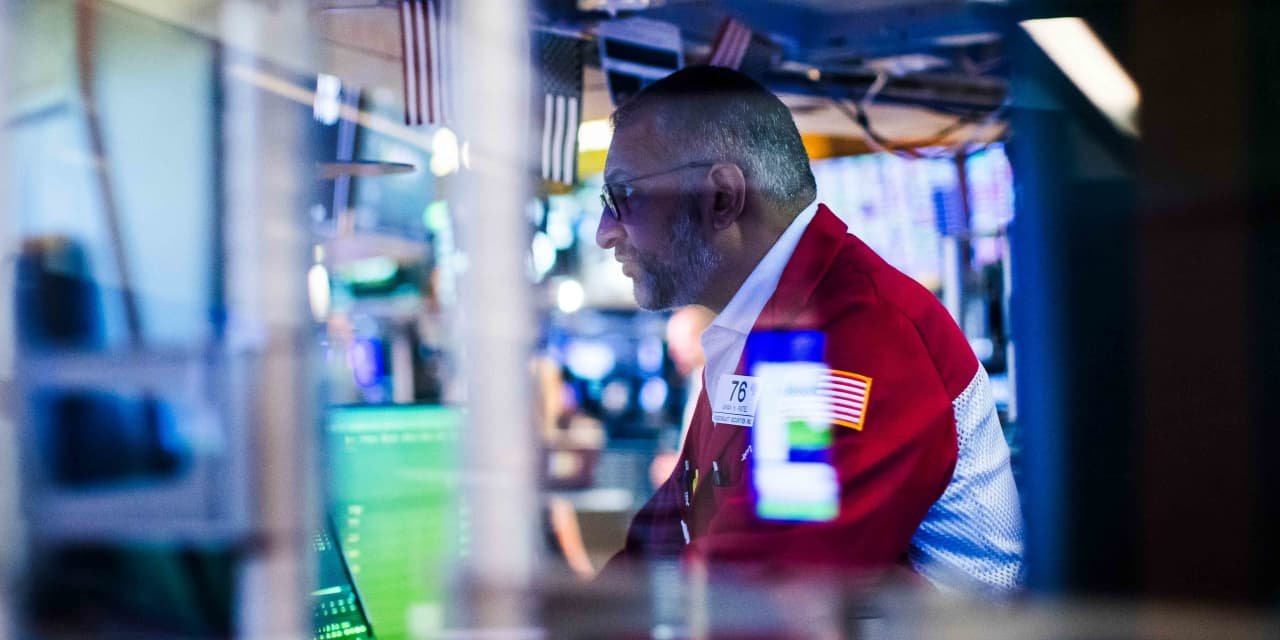
Traders work on the floor of the New York Stock Exchange during morning trading on January 14, 2026 in New York City.
Michael M. Santiago | Getty Images
Stock futures were near flat Wednesday night as the S&P 500 comes off of two consecutive days of losses.
Futures tied to the Dow Jones Industrial Average fell 67 points, or 0.1%. S&P 500 futures and Nasdaq 100 futures each declined roughly 0.1%.
Late Wednesday, President Donald Trump signed a proclamation that imposes a 25% tariff on certain semiconductors. The levy won’t apply to chips that are imported to contribute to the buildout of the U.S.’s technology supply chain, however.
In regular trading Wednesday, tech stocks slid and kept the major averages under pressure. The broad-market index closed the session down 0.5%, while the 30-stock Dow shed about 42 points, or nearly 0.1%. The Nasdaq Composite fell 1%. All three indexes posted a second straight losing day.
Microsoft, Meta and Amazon each lost more than 2%. Oracle and Broadcom each slid 4%, while Nvidia dipped 1.4%. Reuters reported earlier in the day, citing individuals briefed on the matter, that Chinese customs authorities advised customs agents this week that Nvidia’s H200 chips are not allowed to enter the country.
Banks were among the day’s biggest laggards. Wells Fargo lost 4.6% on Wednesday, weighing on the broader market, after the company posted weaker-than-expected revenue for the fourth quarter. Citigroup and Bank of America both fell more than 3%.
“The economy remains relatively stable … underlying all of this, corporate earnings remain relatively strong, and we continue to believe that 2026 is going to be really powered by earnings versus any sort of multiple expansion from here,” said Ayako Yoshioka, portfolio consulting director at Wealth Enhancement Group, on CNBC’s “Closing Bell.”
“At least at these levels, the bar is relatively high, and we can see some short-term disappointments just relative to expectations, but we think that these are all buying opportunities because the economic backdrop remains relatively stable,” Yoshioka added.
Trump edicts weigh on stocks this week
Geopolitical risks continued to weigh on investor sentiment Wednesday.
Fears over oil supply disruptions caused by mounting tensions between the U.S. and top OPEC member Iran lifted oil prices. West Texas Intermediate crude futures settled up more than 1%, but slid after Trump signaled he might not attack Iran.
Trump administration officials also met with Danish and Greenlandic foreign ministers on Wednesday as Trump continues to push for U.S. control of Greenland. Denmark and Trump have a “fundamental disagreement” over the kingdom’s ownership of Greenland, which wasn’t resolved during the meeting, a Danish official said.
Trump in recent days has also ramped up attacks on Federal Reserve Chair Jerome Powell to lower interest rates. Concerns about the central bank’s independence flared this week after Powell confirmed Sunday that the Justice Department launched a criminal investigation into the Fed leader.
On Thursday, several market catalysts await. Traders will watch for earnings reports from Goldman Sachs, Morgan Stanley and BlackRock. On the economic front, weekly jobless claims are also due.
Small cap benchmark Russell 2000 posts record, bucking Wednesday’s trend
While the three major averages posted a second consecutive losing session on Wednesday, small caps emerged as a bright spot in the market.

The small-cap Russell 2000 over the past five days
The Russell 2000 climbed 0.7%, posting its fourth positive session in the past five. The index also touched a fresh all-time high during the day and closed at a record.
Wednesday’s gains put the small-cap index on pace for its second straight positive week. The Russell is up 1% week to date.
—Darla Mercado, Chris Hayes
Trump clears way for Nvidia H200 chip sales, says government will take 25% cut
President Donald Trump on Wednesday said that his administration will approve China sales of Nvidia‘s H200 chip for artificial intelligence, but the U.S. government will take 25% of sales, one day after formal regulations were published by the U.S. government.
Unlike Nvidia’s previous China-targeted chip, the H20, the H200 is a version of the company’s Hopper generation that is also sold in the U.S. and in other markets. The H200 was not specifically designed and slowed down for export. Trump pointed out in remarks on Wednesday that the H200′s performance has been exceeded by two generations of Nvidia chips currently in production, naming Nvidia’s Blackwell and Rubin AI chips.
“It’s not the highest level, but it’s a pretty good level, and China wants them and other people want them and we’re going to be making 25% on the sale of those chips, basically,” Trump said.
Trump initially announced the approval of H200 chips and the 25% government cut a month ago.
— Kif Leswing