The Australian share market is slightly higher today after a rally on Wall Street.
Investors showed signs of relief a day after US President Donald Trump dropped tariff threats against eight European countries and ruled out seizing Greenland by force.
The Australian dollar is continuing to rise, pushing towards 68.5 cents to the US dollar.
We’ll bring you the latest on what’s happening on the markets throughout the day in our live blog.
Disclaimer: this blog is not intended as investment advice.
Key Events
Market snapshot
- ASX 200: Flat at 8,846 points
- Australian dollar: Flat at 68.38 US cents
- S&P 500: +0.5% to 6,913 points
- Nasdaq: +0.9% to 23,436 points
- FTSE: +0.1% to 10,150 points
- EuroStoxx: +1% to 608 points
- Spot gold: +0.4% to $US4,955/ounce
- Brent crude: -1.3% to $US64.4/barrel
- Iron ore: +0.5% to $US103.65/tonne
- Bitcoin: +0.3% to $US89,477
Price current around 11:00am AEDT
Live updates on the major ASX indices:
Extension of Eraring Power Station ‘reduces risks’
This week, the exit of the Eraring Power Station in New South Wales was pushed back for the second time.
The planned closure of Australia’s largest coal-fired power station on the shores of Lake Macquarie, south of Newcastle will be delayed by two years, until 2029.
It was due to shut down in August next year.
In its commodity daily press release, the Commonwealth Bank said the move by Origin Energy is important in “reducing risks to system security”.
“Eraring’s exit is a key watch point for the market as it highlights the complexity of not only replacing fossil fuel power with renewable energy, but also adding enough renewable energy to meet an anticipated step shift increase in electricity demand in coming years,” John Oh, Sustainable and Energy Economist, said.
“The two driving factors for the extension as stated by Origin Energy was (i) reducing risks to system security (i.e ability to prevent cascading failures in a power system after a disturbance), and (ii) supporting reliable power to NSW households and businesses.”
There had been growing pressure for that timeline to be extended after a warning from the Australian Energy Market Operator (AEMO) that the grid was not ready, raising the threat of widespread blackouts.
In a statement on Tuesday, Origin said it had advised AEMO that it would extend the operation of the power plant until April 30, 2029, to “support energy supply in New South Wales through the energy transition”.
“Reliability is related to security in that reliability can only be guaranteed if the power system is secure,” Mr Oh said.
“The delay in exit dates of key coal and gas plants in the last 6 months means that the next major test of the grid from the next round of fossil fuel plant retirements has shifted from 2027 to 2028 with the planned exit of Torrens Island B and Yallourn Power Station.”
‘Premature to be talking about rate hikes’ in New Zealand
Inflationary pressures in New Zealand are more benign than they seem, according to Capital Economics, with core inflation remaining “well behaved”, even if numbers have crept up.
A 0.6 per cent rise in New Zealand consumer prices last quarter was higher than the expected 0.5 per cent.
But Abhijit Surya, senior APAC economist for Capital Economics, believes that Reserve Bank of New Zealand (RBNZ) will keep interest rates on hold.
“Although headline inflation picked up further in Q4, underlying inflation remains well behaved,” Mr Surya wrote.
“That being the case, we still think the RBNZ will keep rates on hold for a prolonged period, whereas markets expect it to start tightening policy later this year.”
Mr Surya said that New Zealand prices remained “in check” and that the RBNZ may not raise rates until next year.
New Zealand’s headline inflation edged up from 3 per cent to 3.1 per cent last year, the first time in six quarters that inflation came in above the RBA’s 2-3 per cent target band, contrasting strongly with the Bank’s projection for a fall to 2.7 per cent.
“We still think it’s a little premature to be talking about rate hikes given that core inflation remains well behaved,” Mr Surya said.
“As things stand, there’s nothing in the recent slate of data that would prompt the RBNZ to change its view that the economy is operating with substantial excess capacity.
“Accordingly, we still think the Bank will wait until H2 2027 to raise rates.”
But in a separate media statement, ANZ predicted that New Zealand rates would be hiked in December this year, adjusting its original forecast of February 2027.
“Today’s release tips the balance towards hikes this year being likelier than not,” ANX said in its Q4 CPI Review,
“We are now forecasting the first 25bp hike in December, with two follow-up hikes at the February and April 2027 meetings taking the OCR back to an assumed neutral level of 3 per cent as before.”
Key Event
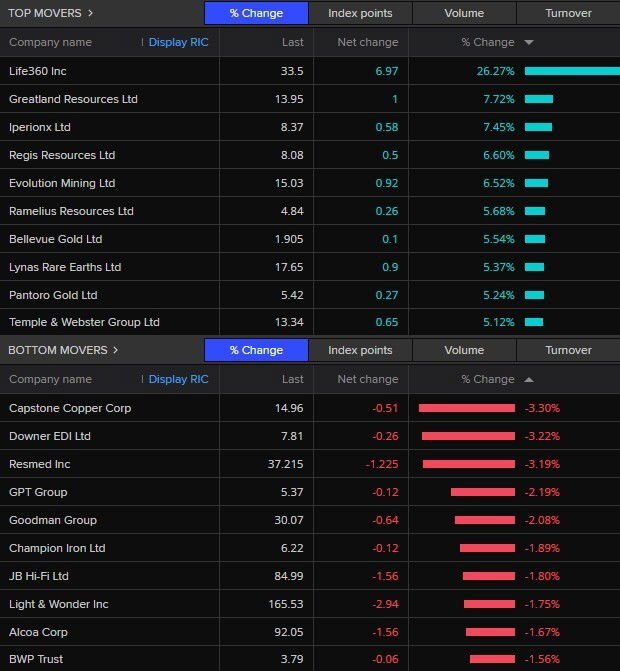
Life360 rises on upbeat annual forecast, record fourth quarter
Shares of Life360 have risen as much as 27.9% to $33.90, hitting their highest level since December 15.
The family-tracking app provider logged its biggest intraday pct gain since March 1, 2024.
The tech firm said it expected full-year revenue of $US486 million-$US489 million, about 31%-32% higher than last year.
It reported 95.8 million monthly active users for the fourth quarter, which was a record fourth-quarter performance.
Shares of Life360 were flat YTD, but up 15% this week.
Reporting with Reuters
Key Event
‘Upswing in consumer spending underway’: Westpac
Westpac Group chief economist Luci Ellis says Australia’s December quarter spending was “particularly strong”, with increased household income allowing people to spend more.
Ms Ellis called it “a genuine cyclical upswing in consumer spending” in an article entitled ‘Consumers at a crossroads’.
“A genuine cyclical upswing in consumer spending is underway, and has been for most of the past year,” Ms Ellis wrote.
“December quarter looks to have been particularly strong, and not just a blip related to shifting patterns of pre-Christmas shopping.”
Ms Ellis added there were several possible scenarios for the outlook for consumption, “some more benign than others”.
“[But] the key driver will be household income, which has (finally) recovered enough to allow people to spend more,” Ms Ellis wrote.
“A genuine cyclical upswing in consumer spending is underway. It has been building since early last year, and the final quarter of 2025 looks to have been particularly strong, if the timely indicators are a guide.”
The upswing should not be interpreted as necessarily signalling a problematic inflationary boom, Ms Ellis assured.
Top and bottom movers in first 15 minutes of trade
Key Event
ASX opens flat
The Australian share market is off to a muted start on Friday as gains in mining and tech offset losses in real estate and banks.
The ASX 200 index was flat at 8,848, by 10:15am AEDT.
Key Event
Why is the Aussie dollar soaring?
The Australian dollar has continued to strengthen against the greenback after stronger that expected jobs figures, reaching its highest level since October 2024.
The Aussie dollar surged to about 68.40 US cents, which is at a 15-month high.
CBA said growing expectations of an interest rate hike from the RBA and rising global equities supported AUD/USD overnight.
“Next week’s Q4 25 CPI will be the last piece of important Australian economic data before the RBA meets in February,” CBA’s economists said in a note.
“Our Aussie economics team expect a solid result for the Q4 25 CPI, which will encourage the RBA to raise interest rates.”
On the other hand, the expectations of the US Fed lowering interest rates, geopolitical uncertainty caused by Trump’s tariff policies, and surging US government debt levels have weakened the US dollar.
Key Event
Perth financial advisor jailed for taking more than $1m from clients
Financial advisor Anthony Paul Torre, who took more than $1 million from clients between 2010 and 2015, was yesterday sentenced to six years in prison.
Judge John Prior said Torre had stolen from people who considered him a friend, in a “gross breach of trust”.
Gary and Sue Sheehan, a couple Torre took money from, had to redraw from their mortgage for living expenses, and felt his sentence was too lenient.
Read more from David Weber.
Key Event
Airwallex responds to Austrac investigation
Yesterday afternoon, we brought you the news that Australia’s financial intelligence agency, Austrac, is investigating payments unicorn Airwallex over concerns of “serious non-compliance” with anti-money laundering and counter-terrorism finance.
Austrac has ordered an audit of Airwallex’s compliance.
Airwallex has responded. In a statement, it says it will be “cooperating fully” and expects a clean bill of health:
“Airwallex is committed to the highest standards of regulatory compliance and we welcome this audit as a transparent opportunity to independently validate our AML/CTF program,” the statement reads.
“We are confident that our AML/CTF compliance program is fit for purpose and necessary controls are in place that adequately address all areas of risks facing our business.”
It also said:
“We have zero tolerance for financial crime or illicit activity of any kind on our network. We maintain robust compliance requirements and any customer unable to comply is promptly terminated from our platform.
“We expect that this upcoming external audit will validate that our framework is robust, comprehensive, and market-leading.”
The company, which was valued at US$8bn, was readying itself for an IPO, which is now very much in doubt.
ICYMI: David Chau’s finance report
Key Event
Anger and confusion after courier Sendle collapses
The collapse of Australian shipping company Sendle has left its customers and staff feeling like they have been “ghosted”, while investors are angry and confused about what happens next.
Sendle launched more than a decade ago and came to prominence during the COVID-19 pandemic, when it marketed itself as a cheaper shipping option for smaller online retailers, including Shopify and Etsy sellers.
To fund its business connecting customers with couriers, it had raised at least $US70 million ($100 million) in private equity investment over the years, Reuters data shows.
Sendle did not publicly disclose customer numbers, but claimed to be facilitating billions of dollars in sales for retailers. Its abrupt shipping halt left many scrambling and voicing frustration on social media.
Read more from business reporter Emilia Terzon.
Key Event
Wall Street targets record highs on tariff relief, upbeat data
Wall Street’s main indexes climbed on Thursday, heading back toward record highs on buying tied to the rescinding of tariff threats on European allies by US President Donald Trump and data highlighting the resilience of the American economy.
The gains came the day after the S&P 500‘s biggest one-day percentage gain in two months, when Trump stepped back from imposing tariffs as leverage to seize Greenland and said the framework of a deal to end a dispute over the Danish territory was in sight.
On Tuesday, Trump’s tariff threats sent shivers through global markets, with all three US stock benchmarks posting their largest daily drops in three months. Investors quickly returned to stock markets after Trump’s Wednesday U-turn.
“It’s very weird to wake up every day as a money manager and you do not know whether it is Christmas morning or Friday the 13th,” said Gregg Abella, CEO at Investment Partners Asset Management.
Abella said the geopolitical issues are creating additional focus on managing client portfolios through volatility, and emphasizing the importance of diversification away from certain names, sectors and asset classes.
Reflecting such diversity, and increased risk appetite among investors on Thursday, the small-cap Russell 2000 index gained 1.2% to a record high.
The CBOE Volatility Index, also known as Wall Street’s fear gauge, slid to 15.45 points, moving further from a two-month peak touched on Tuesday.
Meanwhile, US consumer spending increased solidly in November and October, likely keeping the economy on track for a third straight quarter of strong growth, the personal consumption expenditures index showed.
Separate data showed initial claims for state unemployment benefits increased less than expected last week, while the US economy grew by a slightly more-than-expected 4.4% in the third quarter of 2025.
Federal Reserve policymakers will meet next week to decide on US interest rates. The central bank is widely expected to stand pat on rates due to sticky inflation and evidence of economic resilience.
Reporting with Reuters
Market snapshot
- ASX 200 futures: Flat at 8,809 points
- Australian dollar: +1.2% at 68.38 US cents
- S&P 500: +0.5% to 6,907 points
- Nasdaq: +0.8% to 23,401 points
- FTSE: +0.1% to 10,150 points
- EuroStoxx: +1% to 608 points
- Spot gold: +1.9% to $US4,926/ounce
- Brent crude: -1.8% to $US64.09/barrel
- Iron ore: +0.5% to $US103.65/tonne
- Bitcoin: -0.9% to $US89,414
Price current around 7:30am AEDT
Live updates on the major ASX indices:
Key Event
ASX to open flat
Good morning and welcome to Friday’s markets live blog, where we’ll bring you the latest price action and news on the ASX and beyond.
A rally on Wall Street overnight has set the tone for local market action today.
The Dow Jones index gained 0.7 per cent, the S&P 500 advanced 0.6 per cent, and the Nasdaq Composite was up 0.9 per cent.
ASX futures were flat at 8,809 at 7:30am AEDT.
At the same time, the Australian dollar was up 1.2 per cent to 68.38 US cents.
Brent crude oil was down 1.8 per cent, trading at $US64.09 a barrel.
Spot gold gained 1.9 per cent to $US4,926.
Iron ore rose 0.5 per cent to $US103.65 a tonne.