Updated 2 min read
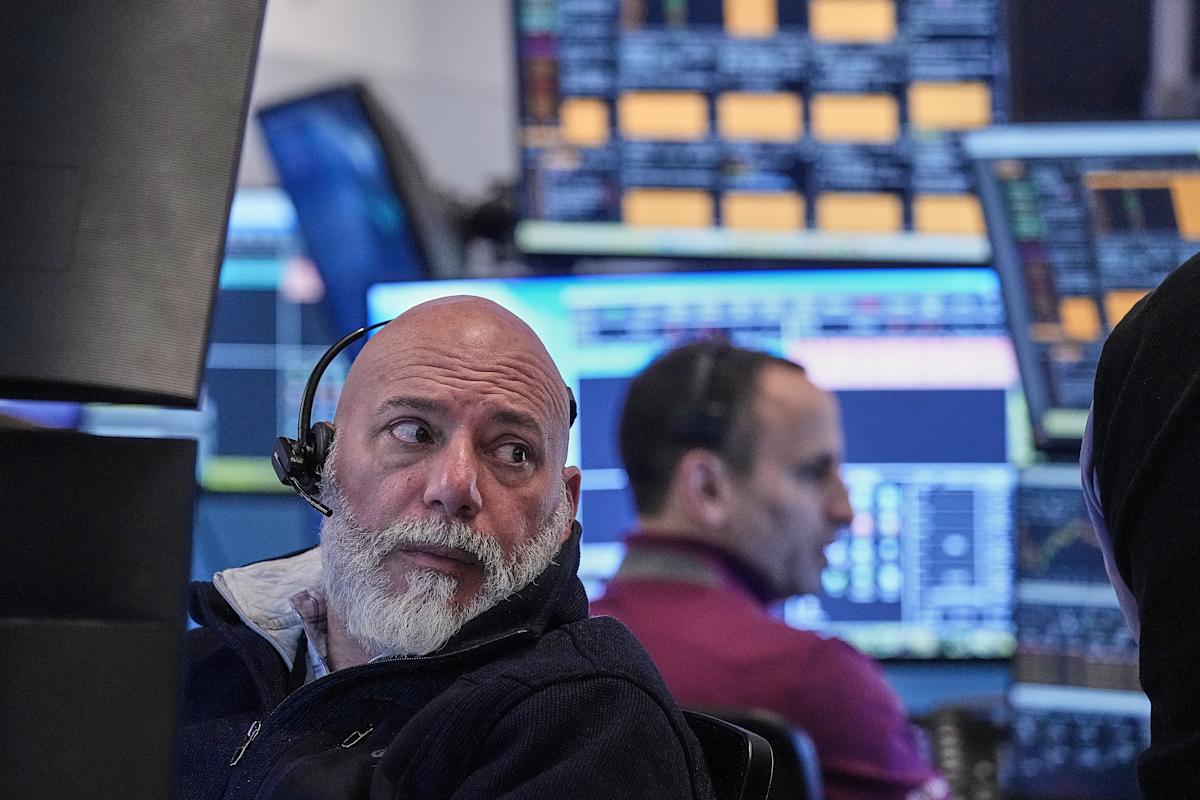
US stocks wavered on Friday, after chipmaker Intel’s (INTC) disappointing financial outlook and a turbulent week stoked by President Trump’s heated pursuit of Greenland.
The Dow Jones Industrial Average (^DJI) retreated roughly 0.6%. The S&P 500 (^GSPC) hovered above the flat line, and the Nasdaq Composite (^IXIC) rose 0.3%.
Intel posted worse-than-expected first quarter guidance late Thursday, weighing on tech sentiment. The chip giant swung to a quarterly loss as it struggled to meet demand for its server chips used in AI data centers. Shares sank nearly 15% Friday morning.
The S&P 500 is poised for back-to-back weekly losses, as the relief that lifted stocks for two straight days of gains wears off. After a rough start to a holiday-shortened trading week, investors took heart from Trump cooling his Greenland rhetoric and backtracking on proposed tariffs on NATO allies. That said, a shift out of US assets is gaining traction as US-EU tensions weigh on the dollar (DX-Y.NYB).
Against that backdrop, gold (GC=F) continued to gain after breaking above $4,900 for the first time on Thursday, boosted in part by a Goldman Sachs (GS) call for gold to hit $5,400 by the end of 2026.
But there were signs of progress on the China-US front, as TikTok and ByteDance finally closed a deal with Oracle (ORCL) and others to let it operate in the US. Meanwhile, Beijing has reportedly told China’s big techs they can start preparations to order Nvidia’s (NVDA) H200 chips, whose imports are currently curbed.
In data releases, slight upticks in US manufacturing and services activity in January aren’t expected to move the needle on interest rate expectations ahead of the Federal Reserve’s meeting next week. Trump said Thursday he has a pick for next Fed chair in mind after wrapping up interviews, and he will name the replacement for Jerome Powell “soon.”
LIVE 15 updates
-
Consumer sentiment nudges higher in January
US consumers felt slightly better about the economy in January.
The University of Michigan’s index of consumer sentiment hit 56.4 this month, above the 52.9 reading in December and the 54 expected by economists polled by Bloomberg.
“While the overall improvement was small, it was broad based, seen across the income distribution, educational attainment, older and younger consumers, and Republicans and Democrats alike,” wrote UMichigan’s Joanne Hsu.
She added: “However, national sentiment remains more than 20% below a year ago, as consumers continue to report pressures on their purchasing power stemming from high prices and the prospect of weakening labor markets.”
One year inflation expectations fell back to 4%, the lowest reading in a year, while five to ten year inflation expectations inched up to 3.3% from 3.2% last month.
“Long-run expectations softened over the last two months of 2025, then edged up in January 2026,” wrote Hsu. “Expectations exhibit substantial uncertainty, though less than in mid-2025.”
-

Capital One stock sinks after Brex deal, the latest challenging turn for financials
Credit card giant Capital One was first out the blocks in 2026 among major financial institutions to announce a significant merger.
In response, its stock was getting hit on Friday, falling about 4%.
After the close on Thursday, Capital One announced a deal to acquire Brex, one of the recent class of venture-backed corporate finance solutions — a group that most notably includes Ramp, recently valued at over $30 billion — for $5 billion.
This deal marks a roughly 60% discount to Brex’s peak valuation just north of $12 billion clinched at the peak of the post-pandemic funding boom in the fall of 2021. Its also a notable takeout for venture-backed decacorns likely looking at 2026 as a year to find an exit, either via acquisition or an IPO.
The fintech boom that Brex and others rode has passed as the current meta in venture circles; now, it is all about AI. (See a16z’s latest fundraising announcement splash for a sense of where the big bets are being placed.)
For the established financial industry, this year opened with many companies enjoying stock prices trading at record highs and optimism about the regulatory latitude and capital markets flexibility to make deals happen, both for clients and themselves.
A surprise proposal from the White House that would cap credit card fees at 10% shook companies in the business of card issuing, Capital One notable among them. Earnings results from America’s biggest banks were also met with some skepticism from investors, and their stocks mostly traded down in response.
Recent hostilities from President Trump lobbed at JPMorgan may also cool optimism in the sector, long a punching bag for politicians on both sides of the aisle.
But the Capital One-Brex deal is still, in its way, a template of sorts for where industry observers saw this year going. And we’d be surprised if this were the last time an established financial leader announced plans for a deal like this.
-
January PMI initial readings show ‘sustained’ but cooling economic growth
A preliminary reading on S&P Global’s US Manufacturing PMI showed the activity-tracking index hitting 51.9 in January. That was slightly below the 52 expected by economists tracked by Bloomberg, but a hair above the 51.8 print last month.
Meanwhile, the US Services PMI was 52.5 in January (so far), also short of the 52.9 projected but unchanged from the previous month. A reading above 50 signals growth, while those below reflect contraction.
Similarly, the Composite PMI, which combines the manufacturing and services surveys, hit 52.8 this month. That was higher than December’s 52.7 but beneath economists’ consensus estimate of 53.
The PMI, or Purchasing Managers’ Index, measures the health of the manufacturing or services sector based on surveys of business leaders. Overall, the readings showed business activity was relatively unchanged in January from the previous month.
“The flash PMI brought news of sustained economic growth at the start of the year, but there are further signs that the rate of expansion has cooled over the turn of the new year compared to the hotter pace indicated back in the fall,” wrote Chris Williamson, Chief Business Economist at S&P Global Market Intelligence.
He continued: “Increased costs, widely blamed on tariffs, are again cited as a key driver of higher prices for both goods and services in January, meaning inflation and affordability remains a widespread concern among businesses.”
-
Stocks slip at the open
US stocks nudged down at the market open after a turbulent week marred by geopolitical tensions stoked by President Trump.
The Dow Jones Industrial Average (^DJI) retreated roughly 0.5%. The S&P 500 (^GSPC) fell nearly 0.2%, and the Nasdaq Composite (^IXIC) dipped below the flat line.
The three major US indexes are all set for fractional weekly losses.
-
Booz Allen Hamilton stock pops as government awards reaccelerate
Defense IT consultancy Booz Allen Hamilton (BAH) indicated that it’s seeing contracts reaccelerate after government cost-cutting efforts, such as the Department of Government Efficiency (DOGE), created a choppy environment.
The stock rose 7% in premarket trading after dropping more than 30% over the past year.
“Our national security business continues to see good growth and very good prospects, but I think what’s really exciting to us is our civil business is starting to reignite,” CEO Horacio Rozanski said on the earnings call, adding, “The market does feel like it’s at an inflection point.”
The company’s sales backlog rose 2% year over year to $38 billion in the third quarter.
Overall revenue in the third quarter declined 10% year over year to $2.6 billion, missing Wall Street estimates of $2.7 billion, according to S&P Global Market Intelligence. But adjusted profits rose to $1.77 per share, beating analysts’ estimates of $1.27.
The company slightly lowered the top end of its full-year revenue guidance to a range of $11.3 billion-$11.4 billion from $11.3 billion-$11.5 billion previously. But it raised its adjusted diluted earnings per share guidance to $5.95-$6.15 from $5.45-$5.65 previously.
-
Intel stock tumbles as company’s Q1 outlook falls short of Wall Street expectations
Intel (INTC) stock tanked by 13% on Friday morning following the company’s fourth quarter results. The US-based chipmaker’s first quarter financial outlook was a disappointment on the Street, and executives’ comments that the company was struggling to keep up with demand also raised concerns.
Yahoo Finance’s Laura Bratton reports:
-
3 questions about Musk’s Davos appearance
Yahoo Finance’s Hamza Shaban reports:
Read the answers in the takeaway from today’s Morning Brief.
-
China tells Alibaba, big tech companies to prep Nvidia H200 orders
Nvidia (NVDA) stock rose before the bell after Bloomberg reported that Beijing has given the go-ahead for China’s tech giants to prepare orders for its H200 chips.
US-listed shares of Nvidia supplier TSMC (TSM) also moved higher on the sign that China is close to granting full formal approval to import the chips, seen as key to AI data centers.
Bloomberg reports:
-
US stocks saw outflow in week Trump threatened tariffs: BofA
Data from the Bank of America (BAC) has shown that investors pulled nearly $17 billion out of US stocks this week, as President Trump vowed to impose tariffs on Europe over Greenland.
Bloomberg News reports:
-
Market’s most reliable dip buyers cash in on latest ‘TACO’ turn
The retail crowd’s faith never wavered, even as President Trump escalated his rhetoric against Europe.
Bloomberg News reports:
-
Premarket trending tickers: Capital One, Intuitive Surgical, and Coupang
Capital One (COF) stock fell 3% before the bell on Friday. The group released its fourth-quarter results and announced it would acquire startup company Brex for $5.15 billion.
Intuitive Surgical (ISRG) stock rose 3% during premarket hours on Friday after beating Wall Street estimates for its fourth quarter revenue and profit on Thursday. The company cited growing demand for its surgical robots used in minimally invasive procedures.
South Korea’s largest e-commerce group, Coupang (CPNG), saw its stock climb on Friday by around 3% after receiving an upgrade from Deutsche Bank (DB) to Buy from Hold. Coupang suffered a cyberattack late last year, leaving investors to seek a US probe over South Korea’s handling of the data leak.
-
‘Quiet-quitting’ of US assets fuels boom in bets from EM stocks to gold
Emerging-market stocks, currencies and precious metals are extending a storming start to 2026 as tensions between the US and Europe weigh on the dollar. The rally gathered pace Friday, with the MSCI Emerging Markets Index heading for a fifth successive week of gains, its longest winning streak since May.
Bloomberg reports:
Investors are pouring cash into emerging-market funds at a record pace as momentum builds for a rotation out of US holdings. It’s sent the EM stocks gauge to a record high.
While Asian technology shares drive the rally, other regions are also catching up. The benchmark for Emerging Europe, Middle East and Africa has risen on all five days of this week and is on course for its best month since 2020. The MSCI EM Latin America Index of equities on Thursday closed its highest since April 2018.
The Greenland tussle — even if it has been mitigated for now — has revived questions about US exceptionalism and the role of the dollar, spurring funds from Europe to India to diversify away from Treasuries. The flow has added an impetus to an EM rally fueled by robust global growth, the AI spending boom and political shifts in Latin America, as well as fiscal and monetary policy orthodoxy in much of the developing world.
People “are looking to diversify away from US assets, and I would kind of describe it as quiet-quitting of US bonds,” TCW Group Inc. Chief Executive Officer Katie Koch said in a Bloomberg Television interview. “I don’t think there’s going to be a massive announcement, I just think they’re going to look for opportunities to diversify away.”
-
US natural gas falls after record-breaking 3-day rally
From Bloomberg:
US natural gas futures (NG=F) pared a record breaking three-day rally, after traders finished exiting short positions and the market braced for a historic winter storm.
Front-month contracts dropped as much as 7.6% to $4.660 per million British thermal units on Friday, after surging 63% over the previous three sessions. Prices were still on track for their biggest weekly gain in records going back to 1990.
This week’s surge was driven by forecasts for below normal temperatures across most of the country, threatening to boost gas consumption and drain inventories. The freeze — particularly in the southern gas-producing states — has raised concerns about water icing in pipelines, potentially disrupting output from this weekend.
-
Gold on track for best week since 2020 after safe haven surge
Bloomberg reports:
-
TikTok closes deal with Oracle, Silver Lake and MGX for US operation
Bloomberg reports: