2 min read
US stocks were mixed on Tuesday, though the Dow built on its latest record close, as a slowdown in retail sales figures led out a flood of crucial data highlighted by the looming release of the monthly jobs report.
The blue chip-heavy Dow Jones Industrial Average (^DJI) held on to gains, rising 0.2%, while the S&P 500 (^GSPC) lost about 0.1%. The Nasdaq Composite (^IXIC) fell 0.2% as Big Tech titans Nvidia (NVDA) and Alphabet (GOOG) fluctuated.
December retail sales remained “virtually unchanged” from the month prior. The flatlining sales data signals a slowdown in spending through the end of the holiday season from November’s month-on-month growth of 0.6%, and it fell well below economist expectations.
The weak number appeared to lead to an increase in bets on interest rate cuts from the Federal Reserve. While most traders still expect the Fed to hold steady next month and April, those majorities are shrinking. Meanwhile, over 75% of traders now expect rates to be lower by June.
The consumer data lays the ground for Wednesday‘s all-important January jobs report, in high focus following last week’s signs of softening in the labor market. The latest Consumer Price Index reading is then due on Friday to give a look at inflation pressures, as the Fed continues to balance both sides of its dual mandate
In the corporate world, investors combed through the latest batch of quarterly earnings, Coca-Cola (KO) and CVS Health (CVS) among them. Ford (F) is a highlight on Tuesday’s docket after the market close.
Gold (GC=F) and bitcoin (BTC-USD) are still on investors’ radar, as the assets try to stabilize after last week’s sharp pullback. After rallying above $5,000 to start the week, gold slipped back slightly early Tuesday, though strategists remain bullish on its prospects this year. But a risk-off mood weighed on bitcoin, which resumed its slide to trade near $69,000. The leading cryptocurrency has seen heavy volatility, driven by what one analyst called a “crisis of confidence.“
LIVE 18 updates
-
Superhuman CEO says AI isn’t taking jobs, it’s giving every human 100 digital agents
Yahoo Finance’s Francisco Velasquez reports:
Read more here.
-
Coming Wednesday: The ‘Super Bowl of jobs reports’
Yahoo Finance’s Emma Ockerman reports:
Read more here.
-
Cleveland Fed’s Hammack: Interest rates could be on hold ‘for quite some time’
-
Oil demand peak is further out than previously thought, top independent oil trader says
Vitol, the world’s largest independent oil trader, pushed back its estimates for when oil demand will peak in a new report released Monday, forecasting a peak in the mid-2030s against previous predictions of a peak in the early 2030s.
The commodities trading house said demand could “at its height … reach around 112 million [barrels per day], and is likely to remain close to this level with only minimal decline by the end of the forecast,” adding that demand in 2040 is likely to be around 5 million bpd higher than its current level.
Current global demand sits a bit above 100 million bpd.
“Population growth, rising incomes, and continued urbanisation are sustaining underlying demand for mobility, plastics, chemicals, and energy — and by extensions, oil,” the trading house, which trades roughly 7% of global oil every day, wrote in its new report.
“This dynamic is reinforced in several regions by a stronger industrial policy orientation, with a greater emphasis on domestic competitiveness and security of supply.”
Vitol noted in its report that a slower-than-expected adoption of electric vehicles in the US and Asian markets is one of the primary drivers of its pushed-back demand thesis, “only partly counterbalanced by faster adoption in emerging markets and a more constructive outlook for electric heavy commercial vehicles.”
The firm also sees demand for jet fuel and liquified petroleum gas (LPG) to rise as key drivers of underlying oil demand.
Predictions throughout the industry had coalesced around the view that a deep oversupply glut would push prices down throughout at least the first half of 2026. However, prices have instead strengthened as a mixture of geopolitics and stronger-than-expected demand have dominated this year’s oil market.
Brent crude (BZ=F), the international pricing benchmark, is up 11% on the year, while US benchmark West Texas Intermediate (WTI) crude (CL=F) is up 10.4%. Talks between the US and Iran over the Iranian regime’s nuclear enrichment program are currently top of mind for oil industry watchers, given Iran’s control over the Strait of Hormuz, a crucial shipping chokepoint.
-
Goldman Sachs CEO Solomon calls software rout ‘too broad’ as Wall Street looks to steady investor nerves
-
EVs and aluminum plant fire take center stage on Ford earnings after the bell
EV sales and the lasting effects of a major fire at an aluminum plant are expected capture investor attention when automaker giant Ford reports fourth-quarter earnings after the bell on Tuesday. The stock picked up roughly 07% in Tuesday morning trading ahead of the release.
Yahoo Finance’s Pras Subramanian reports:
-
Paramount offers to pay $2.8 billion Netflix termination fee, $650 million ticking fee to shareholders
Paramount Skydance (PSKY) isn’t giving up in its attempt to acquire Warner Bros. Discovery (WBD), as Netflix (NFLX) is in the hot seat, undergoing an investigation by the DOJ.
On Tuesday before market open, Paramount enhanced its all-cash, $30 per share offer to acquire all of Warner Bros. with a $0.25 per share “ticking fee,” or roughly $650 million cash value, that would be payable to Warner Bros.’ shareholders every quarter the transaction is not closed beyond Dec. 31, 2026.
The move comes as its offer is set to expire on Feb. 20, after a previous extension of its $108 billion hostile takeover bid.
In a release, Paramount said this ticking fee is meant “to underscore confidence in the speed and certainty of its regulatory pathway.”
The company also said it would pay the $2.8 billion termination fee to end its deal with Netflix and “offers solutions to WBD’s debt financing costs and obligations.”
“We are making meaningful enhancements — backing this offer with billions of dollars, providing shareholders with certainty in value, a clear regulatory path, and protection against market volatility,” Paramount Skydance CEO David Ellison said.
Meanwhile, Netflix executives are pushing forward. The Department of Justice is holding a hearing to investigate whether Netflix’s $83 billion deal to acquire Warner Bros. would create a monopoly.
-
Coca-Cola stock sinks on disappointing outlook as Coke Zero, water power surprise sales increase
Coca-Cola (KO) stock fell by about 2% after the company offered what CEO James Quincey called a “prudent” outlook for 2026 as the company aims to reverse pressure on international sales.
“We’ve taken what we think is a realistic, but prudent, approach relative to a number of international markets [where] we need to see improve through the course of 2026,” Quincey told Yahoo Finance.
In the fourth quarter, organic revenue grew 5% across the company’s geographies, outpacing the 4.8% growth expected by Wall Street. For 2026, the company expects organic sales to grow 4%-5%, below the 5% growth expected by analysts, according to Bloomberg data. Coca-Cola’s adjusted earnings are expected to grow in a range of 7%-8% this year after growing 9% in 2025.
Regions where the company is experiencing pressure include China, India, and Mexico, where a soft drink tax was recently implemented. Sales in its Asia Pacific region were flat in the fourth quarter.
In North America, the company said volumes grew 1% while prices were up 4% in the fourth quarter as consumers continued to turn to less-sugary options.
-
S&P Global starts to reverse steep loss after Q4 earnings report
Shares in S&P Global (SPGI) began to dig out of a deep post-earnings slump on Tuesday, reversing a roughly 20% loss as executives spoke with analysts and investors on the company’s fourth quarter earnings call.
The company’s shares initially plummeted on Tuesday morning after S&P Global reported 2026 profit expectations below analyst estimates, forecasting adjusted per-share profit of $19.40 to $19.65, against estimates of $19.94.
S&P Global also reported adjusted earnings per share at $4.30, missing analyst estimates of $4.34 per share. Top-line revenue for the quarter came in at $3.916 billion, above estimates of $3.91 billion.
Despite the reversal of losses on Tuesday morning, shares in S&P Global remain down by more than 20% on the year. The company has been caught in the software sector sell-off that racked the market through the first week of February.
-
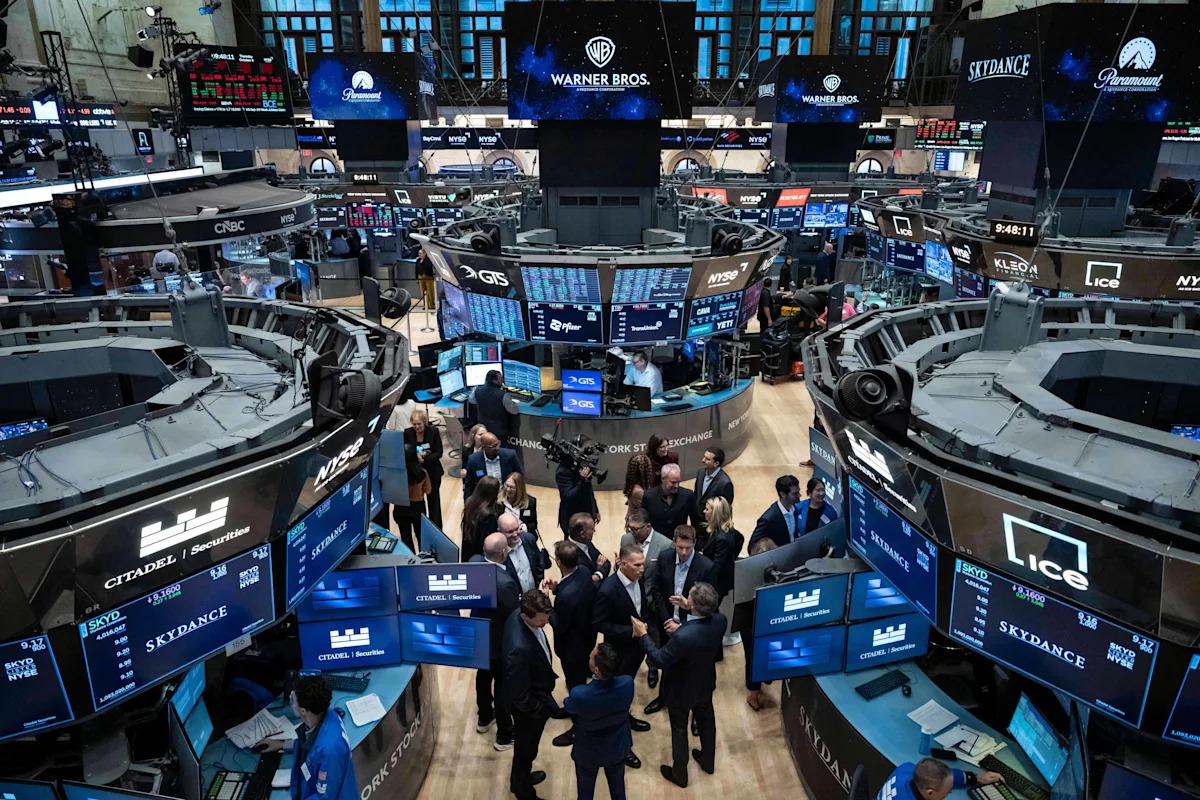
US stocks rise at the open
US stocks rose at the start of trading on Tuesday, setting the Dow (^DJI) on track to build on Monday’s record close.
The blue chip-heavy Dow Jones Industrial Average (^DJI) led gains, picking up 0.5% to put a fresh closing high within reach. The S&P 500 (^GSPC) and the Nasdaq Composite (^IXIC) also ticked up, gaining roughly 0.1% each.
The push into the green came as investors digested December’s slowdown in retail sales. The report is the first in this week’s flood of crucial data, highlighted by the monthly jobs report to come on Wednesday.
In the corporate world, investors received fourth-quarter earnings from Coca-Cola (KO) and CVS Health (CVS) Tuesday morning, with Ford (F) yet to come after the market close. Nvidia (NVDA) chipmaker Taiwan Semiconductor’s (TSM) sales grew at their fastest rate in months in January, buoying hopes around the AI market.
Gold (GC=F) clung to $5,000 per troy ounce on Tuesday even as the broader metals complex pulled back. Meanwhile, bitcoin (BTC-USD) managed to climb back above $69,000.
Oil prices (BZ=F, CL=F) also picked up as investors digested what looked like positive moves toward diplomacy in talks between the US and Iran on Friday.
-
December retail sales come in flat month-on-month, suggesting slowdown in consumer spending
Retail spending remained virtually unchanged from the previous month in December 2025, according to data released on Tuesday, signaling a potential slowdown in consumer activity.
Adjusted advance monthly sales for retail and food services for December moved 0% from November, at $735 billion compared to November’s $735.1 billion, the Census Bureau said Tuesday morning.
The month-on-month stall comes after November, when sales grew by 0.6%. December’s number also falls below consensus expectations for month-on-month retail sales growth of 0.4%. Sales excluding motor vehicles and gasoline also remained flat, contrary to expectations of month-on-month growth of 0.4%.
The flat numbers suggest an unexpected slowdown in spending that coincides with December’s holiday season, typically a strong time of year for consumer spending. Eight out of 13 spending categories measured by the Census Bureau saw drawdowns.
-
Stocks moving after earnings: Spotify, CVS, BP, Oscar Health
Here’s a look at some stocks trending on Yahoo Finance after following a slew of earnings reports:
-
Bitcoin, ether resume drop after steady start to week
Selling resumed in bitcoin (BTC-USD) on Tuesday after a calm start to the week, pushing the cryptocurrency below $69,000. Ether (ETH-USD) also slid to $2,013 per token as bearish sentiment returned and the crypto market looked for a sense of direction.
The losses came after a volatile week that saw bitcoin face its worst daily drop since November 2022, followed by a sharp rebound.
Bernstein analyst Gautam Chhugani wrote in a note on Monday morning that the bear case for bitcoin remains weak, however.
“The current bitcoin price action is a mere crisis of confidence,” Chhugani wrote. “Nothing broke, no skeletons will show up.”
-
Gold holds above $5,000 as banks remain bullish after rout
Gold (GC=F) is trading steady above $5,000 an ounce, holding onto a two-day gain after a historic sell-off,
While many traders are debating whether prices have found a bottom, banks are staying upbeat on gold’s prospects. BNP Paribas strategist David Wilson said the precious metal may climb to $6,000 by the end of the year, as geopolitical risks persist and investors search for risk protection.
Bloomberg reports:
-
US plans Big Tech carve-out from next wave of chip tariffs
The Financial Times reports:
Donald Trump’s administration intends to spare companies including Amazon (AMZN), Google (GOOG) and Microsoft (MSFT) from forthcoming tariffs on chips as they race to build the data centers powering the AI boom.
The commerce department is planning to provide US hyperscalers with tariff carve-outs, which would be tied to investment commitments made by Taiwan-based chip group Taiwan Semiconductor Manufacturing Company (TSM, 2330.TW), people familiar with the matter said.
The exemption scheme underscores President Trump’s determination to impose tariffs on chips and incentivise US domestic chipmaking, while offering some relief for the companies powering the US’s rapid AI expansion, which rely heavily on imported semiconductors.
Trump has used the threat of tariffs to push for more US manufacturing. But the administration has stopped short of applying broad tariffs on semiconductors from Taiwan, which would rock Big Tech’s AI supply chain.
-
On Semiconductor stock slides after Q4 earnings miss
On Semiconductor (ON) stock skidded in premarket trading on Tuesday, falling by 4%, after the company recorded lower profits in the fourth quarter than a year ago but said it’s seeing “signs of stabilization” in its key markets.
The chipmaker reported earnings per share of $0.45 on revenue of $1.53 billion, missing earnings estimates of $0.59 per share and falling below earnings per share of $0.88 in the same period a year ago, according to S&P Global Market Intelligence. The company’s fourth quarter revenue was in line with estimates.
The company saw annual sales declines across all of its business groups: Power Solutions, Analog & Mixed Signal, and Intelligent Sensing. Intelligent Sensing was the only segment that saw sales grow quarter over quarter, while Power Solutions and Analog & Mixed Signal sales fell 2% and 5%, respectively.
For the first quarter, On Semiconductor expects revenue in the range of $1.43 billion to $1.53 billion, which has a midpoint below the consensus estimate of $1.5 billion. Adjusted diluted earnings per share are expected to be between $0.56 and $0.66; Wall Street expects $0.61.
-
Memory chip surging cost tanks profits across electronics companies
Bloomberg reports:
-
Japanese election result leads benchmark index surge, major gauges across region rise
AP Finance reports: