Wall Street expects another good year for the S&P 500 despite economic uncertainty created by President Trump’s tariffs.
The S&P 500 (^GSPC 1.57%), the most popular benchmark for the U.S. stock market, posted double-digit returns in 2023, 2024, and 2025. And the index is off to a relatively strong start in 2026, adding a little more than 1% year to date amid continued enthusiasm about artificial intelligence.
However, President Trump’s tariffs have created a great deal of uncertainty, and businesses have responded by hiring fewer workers. The economy added just 181,000 jobs in 2025, a sharp decline from 1.2 million in 2024. In fact, jobs growth has not been so weak since the pandemic in 2020.
So what? Slow jobs growth hints at an economic slowdown, which is particularly concerning because the S&P 500 trades at a very expensive valuation. Nevertheless, most Wall Street analysts anticipate double-digit gains in the remaining months of 2026. Here’s what investors should know.

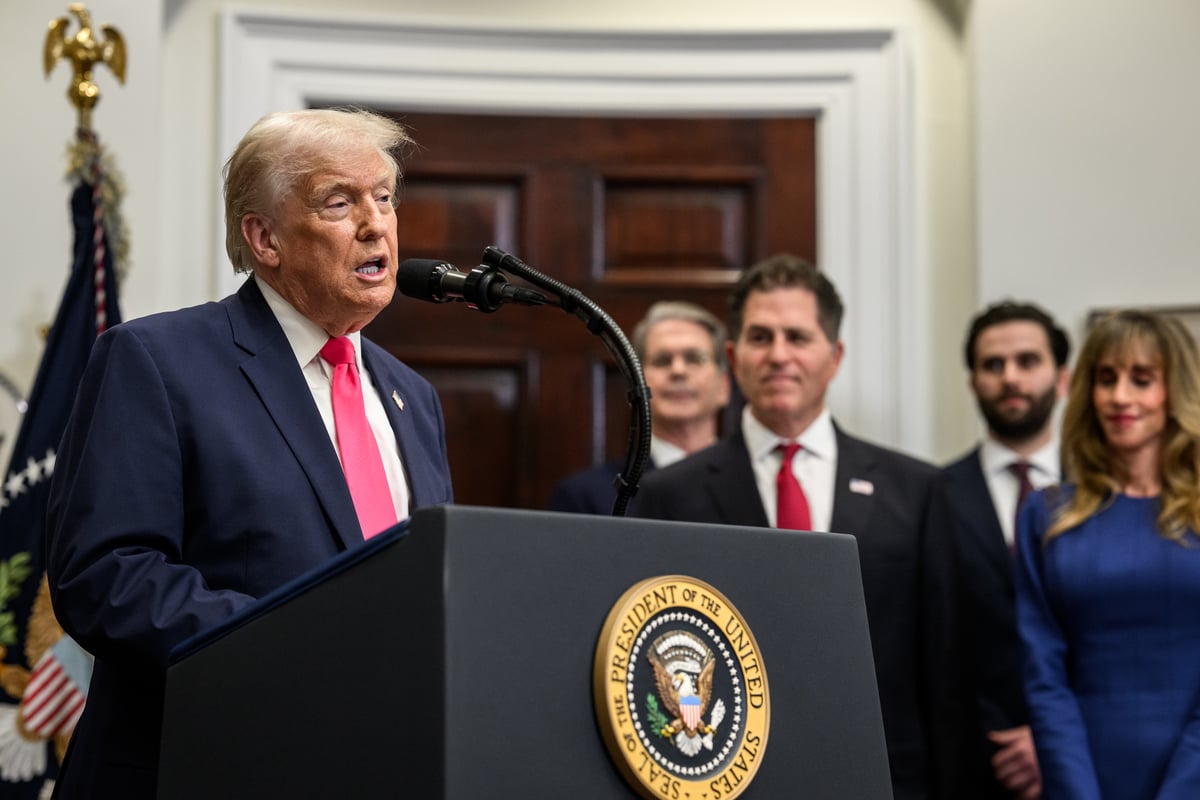
Image source: Official White House Photo.
The Wall Street consensus says the S&P 500 will climb about 10% in the remaining months of 2026
Collectively, S&P 500 companies reported an acceleration in revenue and earnings growth in 2025, and Wall Street anticipates another acceleration in 2026, driven by solid economic growth (supported by tax cuts and artificial intelligence spending) and one or two interest rate cuts from the Federal Reserve.
In turn, most analysts expect double-digit gains in the S&P 500 in the remaining months of the year. The chart below provides a consolidated view of where various Wall Street research organizations and investment banks think the benchmark index will finish the year. It also shows the implied upside from the current level of 6,940.
|
Wall Street Firm |
S&P 500 Year-End Target |
Upside |
|---|---|---|
|
Oppenheimer |
8,100 |
17% |
|
Deutsche Bank |
8,000 |
15% |
|
Morgan Stanley |
7,800 |
12% |
|
Seaport Research |
7,800 |
12% |
|
Evercore |
7,750 |
12% |
|
RBC Capital |
7,750 |
12% |
|
Citigroup |
7,700 |
11% |
|
Fundstrat |
7,700 |
11% |
|
UBS |
7,700 |
11% |
|
Yardeni Research |
7,700 |
11% |
|
Goldman Sachs |
7,600 |
10% |
|
Canaccord Genuity |
7,500 |
8% |
|
HSBC |
7,500 |
8% |
|
Jefferies |
7,500 |
8% |
|
JPMorgan Chase |
7,500 |
8% |
|
Wells Fargo |
7,500 |
8% |
|
Barclays |
7,400 |
7% |
|
CFRA Research |
7,400 |
7% |
|
Societe Generale |
7,300 |
5% |
|
Bank of America |
7,100 |
2% |
|
Median |
7,650 |
10% |
Data source: Reuters, Yahoo Finance. The chart above shows year-end forecasts for the S&P 500 in 2026. Upside percentages have been rounded to the nearest whole number and are based on the index’s level of 6,940 when this article was written.
The 20 Wall Street research organizations and investment banks listed above expect the S&P 500 to move higher in the remaining months of 2026, with projected returns ranging from roughly 2% to 17%. But the median forecast says the index will advance about 10%.
However, Wall Street has historically done a poor job forecasting where the S&P 500 will close in a given year, not because analysts are incompetent, but rather because predicting the future is impossible. In the last four years, the median year-end estimate for the S&P 500 was incorrect by an average of 16 percentage points.
Why Wall Street might be wrong about the S&P 500 in 2026
The S&P 500 currently trades at 22 times forward earnings, a valuation it has more or less maintained for the last 18 months. That is a meaningful premium to the 10-year average of 18.8 times forward earnings.
Previously, the S&P 500 has only sustained such an expensive valuation during two periods in history: the dot-com bubble in the late 1990s/early 2000s and the Covid-19 pandemic in the early 2020s. In both cases, the index ultimately dropped into a bear market.
The odds of a bear market in 2026 are arguably elevated because President Trump’s tariffs are a source of economic uncertainty even in the best case scenario. Businesses have already cut back on hiring, and policy uncertainty will likely intensify as midterm elections approach. And uncertainty makes investors nervous.
Since 1950, the S&P 500 has return an average of just 4.6% in midterm election years, according to Carson Investment Research. More concerning, the S&P 500 has suffered an average intra-year drawdown of 17% during midterm election years. In other words, history says the index is likely to fall 17% at some point in 2026.
Importantly, investors should not interpret anything I’ve said as a reason to exit the stock market today. Past performance is never a guarantee of future results. But the current market environment warrants caution. Limit stock purchases to your highest-conviction ideas, and never buy stocks you aren’t willing to hold through a steep drawdown.
HSBC Holdings is an advertising partner of Motley Fool Money. Bank of America is an advertising partner of Motley Fool Money. Citigroup is an advertising partner of Motley Fool Money. JPMorgan Chase is an advertising partner of Motley Fool Money. Wells Fargo is an advertising partner of Motley Fool Money. Trevor Jennewine has no position in any of the stocks mentioned. The Motley Fool has positions in and recommends Evercore, Goldman Sachs Group, JPMorgan Chase, and Jefferies Financial Group. The Motley Fool recommends Barclays Plc and HSBC Holdings. The Motley Fool has a disclosure policy.