Investors have grown more cautious than they were last year.
The S&P 500 recently completed three years of excellence. The famous benchmark scored double-digit gains in each of those years as the bull market marched on, reaching record high after record high. Investors piled into artificial intelligence (AI) stocks, quantum computing players, and other growth names that generally benefit from positive market environments. These stocks delivered great gains, and many could be on track to roar higher over the long term, too.
It’s important to remember that the AI and quantum computing stories are in their early stages of development — so a lot more growth may unfold in the years to come. But, in recent weeks, overall stock market momentum has slowed.
The S&P 500 is off to a rocky start this year amid a variety of elements weighing on investors’ minds — from worries about the pace of interest rate cuts to concerns that AI companies may not meet growth expectations. Strong earnings reports from tech companies such as Meta Platforms and Taiwan Semiconductor Manufacturing have brought some relief to the market, but investors aren’t as quick to jump into tech stocks as they were several months ago.
Against this backdrop, it’s key to take note of a rather rare stock market move. The S&P 500 is doing something that’s only been witnessed twice over the past 154 years — and history is crystal clear about what’s to come.

Image source: Getty Images.
What’s weighed on stocks in 2026
So, first, a bit more detail about some of the worries that have hurt market momentum so far this year. The Fed began a series of interest rate cuts in 2024 that continued last year, but held rates steady in a decision last month. Markets don’t like uncertainty, so interest rate policy hasn’t been a positive catalyst for stocks in recent times.
Meanwhile, though tech companies have reported strong earnings and spoken of great demand from AI customers, this message hasn’t been enough to truly push the index higher in a major way. In fact, comments about ongoing hefty AI spending from tech giants such as Alphabet and Amazon have worried investors, and that’s pushed these stocks and others lower. As a result, the S&P 500 is little changed so far this year.

Today’s Change
Current Price
This leads me to the move we haven’t often seen from the index, and it has to do with valuation. The S&P 500 Shiller CAPE ratio, an inflation-adjusted look at stock price in relation to earnings per share, has reached beyond the level of 39 — something it’s only done once before, and that time it was right before the dot-com bubble burst.
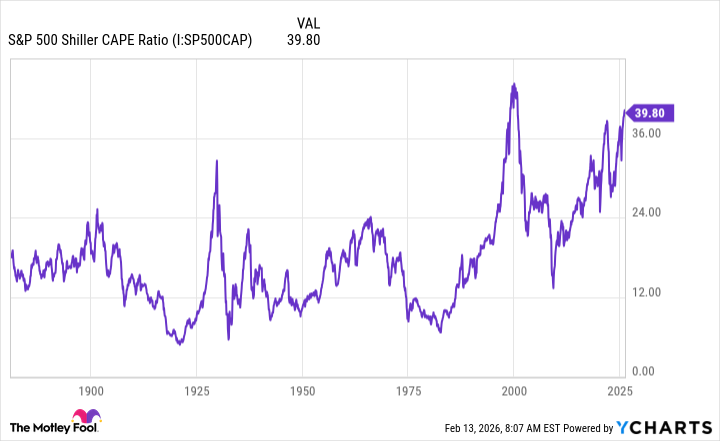
S&P 500 Shiller CAPE Ratio data by YCharts
What history says
If we zoom in for a closer look, using the past decade as an example, we can see what history shows us: The index, after reaching a peak in valuation, has gone on to fall.
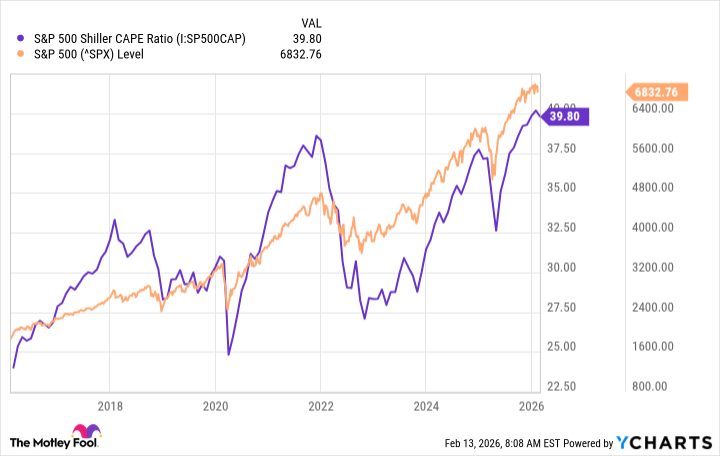
S&P 500 Shiller CAPE Ratio data by YCharts
A look at the past month, with valuation starting to slightly dip from its peak, shows us this movement could be starting.
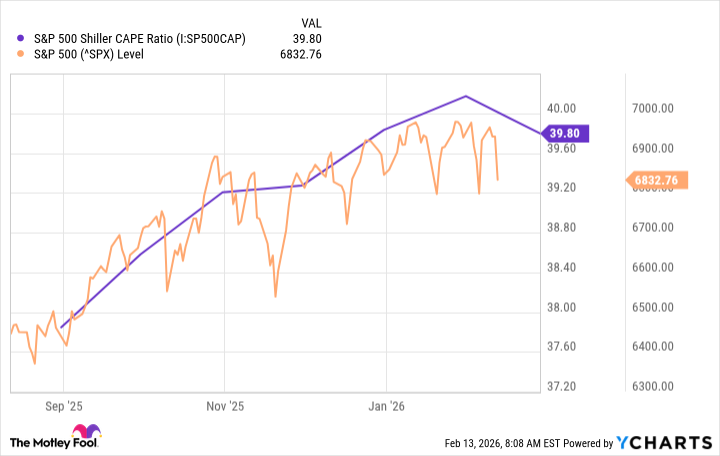
S&P 500 Shiller CAPE Ratio data by YCharts
Does this mean we should prepare for a big decline in 2026? Not necessarily. Though history shows us high valuations have always led to a drop, that drop isn’t always long-lasting. It’s possible the index will slip a bit, valuations will come down, and then the index will recover and finish the year higher.
Meanwhile, whether declines in the S&P 500 are short-lived or result in negative performance this year, investors should keep this crucial point in mind: The S&P 500 consistently has recovered from tough moments — even the worst of market crashes — and gone on to gain. This is great news because it means that even if you go through one of these difficult periods — as you likely will when you invest over a period of years — it’s a temporary situation.
If you buy quality stocks and hold onto them for the long term, it’s OK if the market drops here and there — even in 2026 — as you’re well positioned to score a win over time.