Canada’s main stock index opened lower on Tuesday, dragged down by mining shares after a pullback in precious metals, while investors assessed January inflation data.
At 9:33 a.m. ET, the S&P/TSX Composite Index was down 0.68 per cent at 32,849.87 points.
Canada’s annual inflation rate in January accelerated at a slower pace than the previous month as a big drop in gasoline prices helped cushion the impact of higher food and clothing prices, Statistics Canada said on Tuesday.
The consumer price index rose 2.3 per cent in January compared with 2.4 per cent in December, beating an analysts’ poll which pegged January’s expected rise in consumer prices at 2.4 per cent.
On a monthly basis, the CPI was unchanged from the prior month, data showed.
The gasoline price index was the largest contributor to the deceleration in headline inflation, StatsCan said, as the yearly decline in gasoline prices were huge.
Prices at petrol pumps fell on average 16.7 per cent in January, after a decline of 13.8 per cent in December. But, excluding gasoline, the CPI rose 3 per cent in January, matching the increase in December, the statistics agency said.
The S&P 500 and the Nasdaq opened lower on Tuesday after the long weekend as worries about AI-triggered disruptions rattled market confidence and investors focused on developments in nuclear talks between the United States and Iran.
The Dow Jones Industrial Average rose 24.4 points, or 0.05 per cent, at the open to 49,525.37. The S&P 500 fell 16.3 points, or 0.24 per cent, at the open to 6,819.86, while the Nasdaq Composite dropped 151.9 points, or 0.67 per cent, to 22,394.756 at the opening bell.
Concerns over artificial intelligence impacting business models sparked a selloff in software firms, brokerages and trucking companies the previous week, causing Wall Street’s three main indexes to log their steepest weekly decline since mid-November.
Potential risks from Chinese AI players also added to the uncertainty. On Monday, Alibaba unveiled a new AI model, Qwen 3.5, designed to independently execute complex tasks.
Most U.S. tech stocks were lower on the day, with Nvidia losing 0.6 per cent and Microsoft down 0.9 per cent in early trading.
“The Alibaba AI product is one of the variables weighing on markets today and that’s a part of a much larger dynamic that’s at play here,” said Stash Graham, managing director and CIO at Graham Capital Wealth Management.
“You are seeing a rebalance… for the markets to take a breather off such a strong year last year; it’s natural.”
Iran’s supreme leader said U.S. attempts to depose his government would fail, as the two nations started indirect talks in Geneva over a long-running nuclear dispute.
This week, the personal consumption expenditure report – the U.S. Federal Reserve’s preferred inflation gauge – will be closely watched for insight into inflation and could impact the central bank’s rate-cut trajectory.
The dataset follows a cooler-than-expected consumer inflation reading last week that slightly raised bets on interest-rate cuts this year.
Traders are pricing in a 25-basis-point reduction in June, with the odds at 52 per cent, compared with a close-to-49 per cent chance a week ago, according to CME’s FedWatch Tool.
Corporate earnings are in the final lap of the earnings season. Of the over 73 per cent of S&P 500 companies that have reported earnings this quarter, 74.5 per cent posted results above analysts’ estimates compared to 67 per cent in a typical quarter, LSEG data on Friday showed.
Markets await comments from Fed Governor Michael Barr and San Francisco President Mary Daly later in the day.
On Friday, investors will track the U.S. Supreme Court’s next opinion day, when a verdict on President Donald Trump’s trade tariffs could be announced.
Elsewhere, European shares were mixed after a quiet day in Asia, where most markets were closed for Lunar New Year holidays.
France’s CAC 40 ticked down 0.1 per cent in midday trading, while Germany’s DAX was flat and Britain’s FTSE 100 picked up 0.2 per cent.
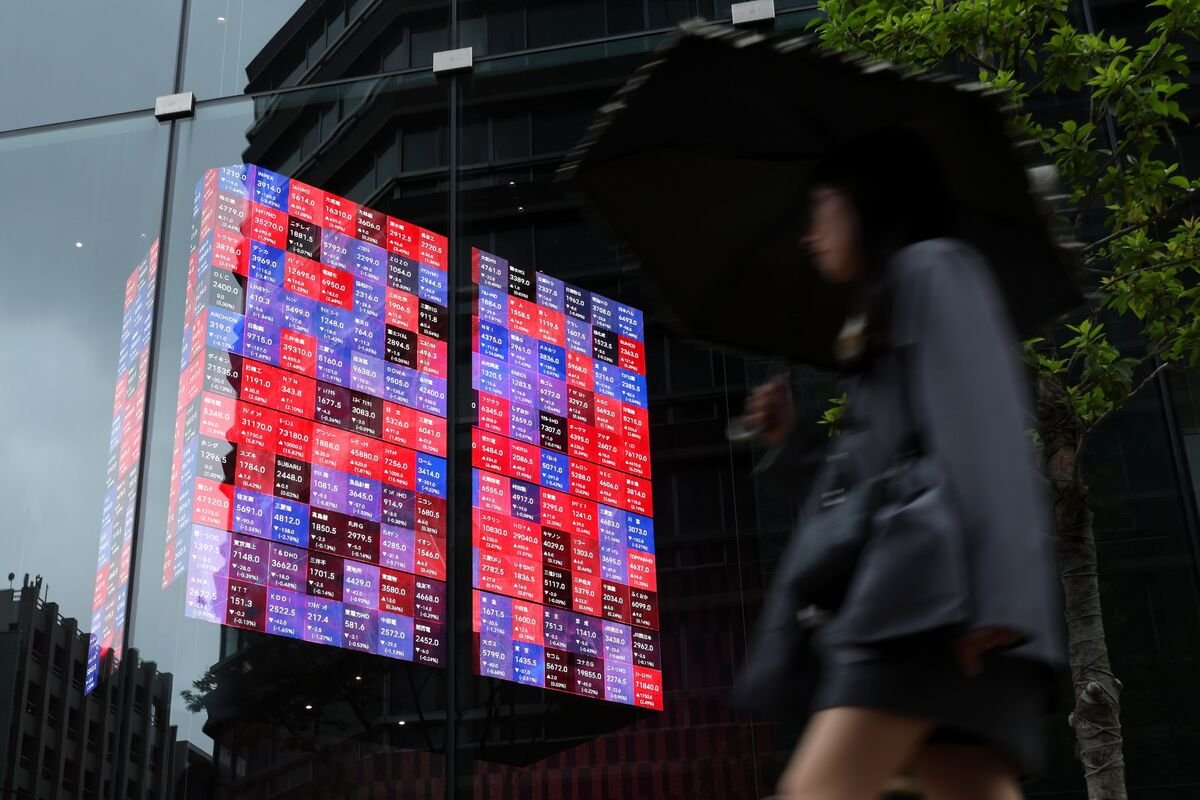
Weak economic data for Japan appeared to be clouding sentiment in Tokyo, and a 5.1 per cent decline for tech giant SoftBank Group also pulled shares lower. The decline follows a big rally after a resounding win for Prime Minister Sanae Takaichi’s ruling party in a Feb. 8 general election.
The Nikkei 225 slipped 0.4 per cent to finish at 56,566.49.
Traders likely were locking in profits from the recent gains that took the Nikkei to record levels. Polls show Takaichi’s popularity is slowly slipping, as hopes for economic revival from her plans to increase government spending and cut taxes subside.
In Australia, the S&P/ASX 200 gained 0.2 per cent to 8,958.90, while India’s Sensex edged 0.2 per cent higher. In Thailand, the SET added 1.4 per cent.
In energy trading early Tuesday, benchmark U.S. crude rose 70 cents to $63.59 a barrel. Brent crude, the international standard, lost 16 cents to $68.49 a barrel.
The U.S. dollar slipped to 153.08 Japanese yen from 153.51 yen. The euro cost $1.1829 down from $1.1852.
The price of gold fell nearly 2 per cent to $4,951 an ounce and silver was down 4.5 per cent. to $74.51.
Bitcoin fell 1.4 per cent to just under $68,000.
Reuters and The Associated Press