If you judged the solely by its flat year-to-date performance, you may assume it has been an uneventful year for the U.S. equity market. However, underneath the surface of the market is a much different story, as individual stocks are charting increasingly independent paths. Several key factors are driving the dispersion.
First, the economy is creating uneven sector performance as different industries face an evolving set of tailwinds and headwinds. For most of 2025, stocks with artificial intelligence (AI) exposure attracted steady inflows, fueled by optimism around productivity gains, robust earnings growth, and rising capital expenditures. However, the narrative began to change last fall as percolating AI bubble fears transformed into concerns over AI disruption — as discussed in our Weekly Market Commentary. As investors have more recently discovered, the perceived threat of traditional business models being displaced by accelerating AI capabilities has created a growing list of winners and losers well beyond the software sector.
Second, the rotation out of big tech has underpinned sizable capital flows into value-oriented stocks, small caps, and international equities. Since the tech sector represents roughly one‑third of the S&P 500, this shift has created a “drinking water from a fire hose” effect for many smaller segments of the market absorbing these outsized inflows.
Third, an improving economic backdrop supported by the resumption of the Federal Reserve’s (Fed) rate-cutting cycle, easing inflation pressures, and pro-growth policies from the One Big Beautiful Bill Act (OBBBA) supported broadening growth beyond big tech. The S&P 493, which excludes the Magnificent (“Mag”) Seven names , , , , , , and , is projected to grow full-year 2026 earnings per share (EPS) by nearly 14%, up from an estimated 10% in 2025 (Bloomberg).
Fourth, accelerating flows into actively managed funds are directing more capital into individual stocks rather than broad index vehicles. While passive funds still represent 64% of all equity assets under management, demand for active equity exchange-traded funds (ETFs) has surged. According to J.P. Morgan Asset Management data, active U.S. equity ETFs now account for 32% of all ETF flows, up from only 6% in 2021.
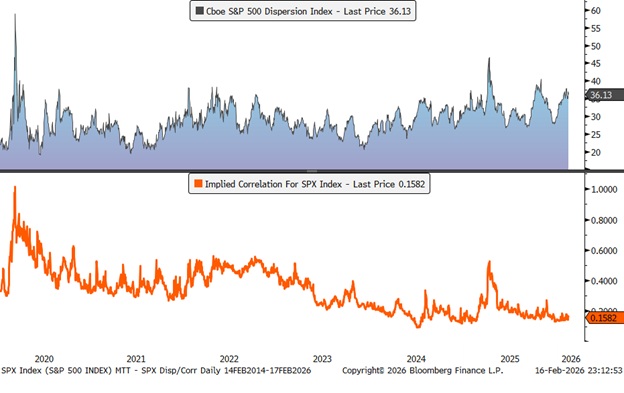
The rising dispersion in returns and relatively low correlation among S&P 500 stocks has become increasingly apparent on the CBOE S&P 500 Dispersion Index and the CBOE Three-Month Implied Correlation Index. The dispersion index, which has climbed to near multi-month highs, compares the prices of S&P 500 constituent stock options and S&P 500 Index options to quantify market expectations for how differently individual stocks are likely to perform relative to each other. A higher index level implies higher expectations for wider deviations in returns within the S&P 500, and with higher dispersion comes more opportunities for alpha generation (finding winners vs. benchmarks) via active management. The correlation index quantifies the expected average correlation among S&P 500 stocks over a rolling three-month period. Higher readings imply higher expectations for stocks to move more in tandem, while lower values (like now) suggest the market is pricing in more idiosyncratic moves within the S&P 500.
Source: LPL Research, Bloomberg 02/13/25
From Worst to First
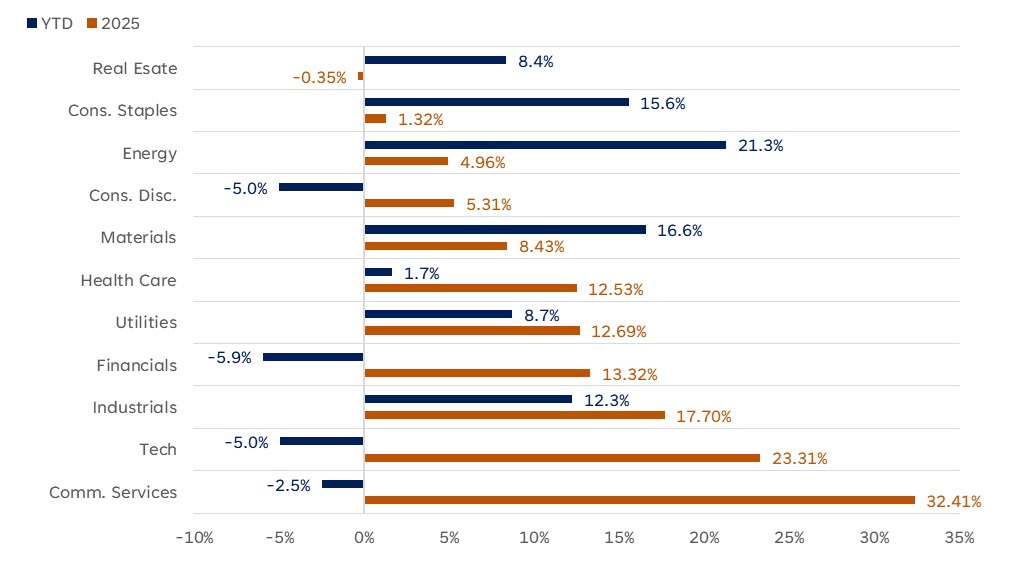
Dispersion is showing up across S&P 500 sectors as well, with this year’s performance trends flipping last year’s script. Many of 2025’s laggards are now leading, while several of last year’s top performers are trailing. One notable exception is industrials, which has climbed 12% year to date and continues to outperform the broader market.
The energy sector, representing only 3.2% of the S&P 500, has been the standout, gaining 21.3% as of February 13. The surge has been fueled by substantial inflows, with energy‑focused ETFs pulling in $6.3 billion in January alone. That marks the largest single month of inflows to the sector in Bloomberg’s 10‑year dataset, providing a clear example of the “drinking water from a fire hose” effect described earlier.
Source: LPL Research, Bloomberg 02/16/25
Conclusion
The U.S. equity market may look steady on the surface but rising dispersion and falling correlations among S&P 500 stocks reveal a far more dynamic environment beneath. Shifts in the AI narrative, rotations out of mega‑cap tech, improving economic conditions, and accelerating inflows into active strategies are all driving performance gaps across sectors, with more value-tilted and economically sensitive sectors emerging as early 2026 winners. Against this backdrop, investors may benefit from active management, selective stock picking, and sector‑rotation strategies designed to capitalize on broader dispersion and the increased opportunities it presents.
***
Important Disclosures
This material is for general information only and is not intended to provide specific advice or recommendations for any individual. There is no assurance that the views or strategies discussed are suitable for all investors. To determine which investment(s) may be appropriate for you, please consult your financial professional prior to investing.
Investing involves risks including possible loss of principal. No investment strategy or risk management technique can guarantee return or eliminate risk.