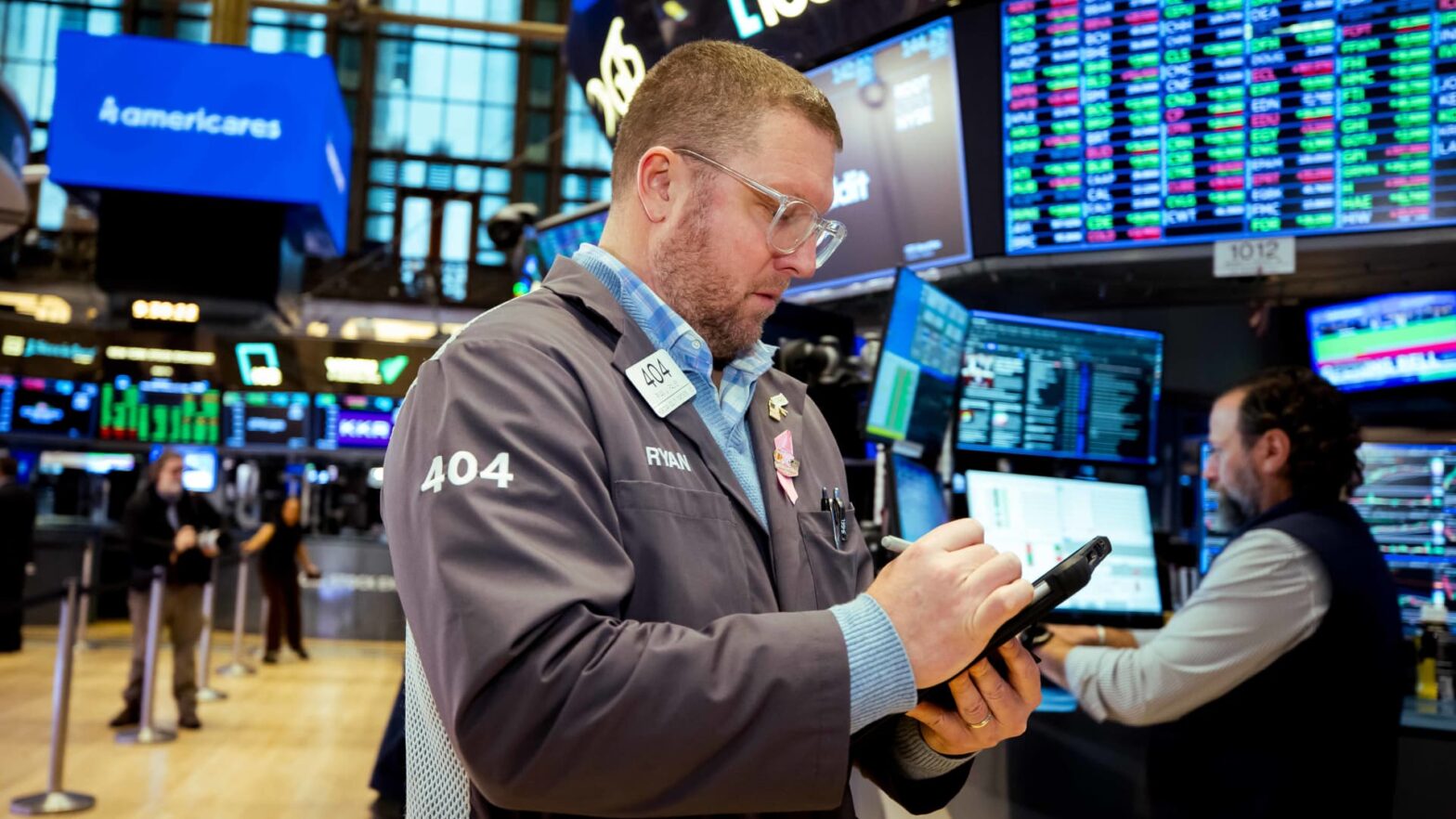
Traders work at the New York Stock Exchange on Feb. 25, 2026.
NYSE
Stock futures slipped Thursday night after the S&P 500 closed lower, dragged down by losses in Nvidia. Traders also looked ahead to an inflation reading due Friday morning.
Futures tied to the Dow Jones Industrial Average dropped 268 points, or 0.5%. S&P 500 futures fell 0.4%, while Nasdaq 100 futures slid 0.4%.
In extended trading, notable software names fell. Salesforce tumbled more than 2%, and Microsoft lost about 1%, weighing on Dow futures. Cybersecurity company Zscaler shed nearly 10% after deferred revenue and billings in the fiscal second quarter missed expectations. CoreWeave fell 8% on disappointing guidance.
Downbeat reactions to key tech earnings pressured the broader market on Thursday. The S&P 500 lost 0.5%, while the tech-heavy Nasdaq Composite declined 1.2%. The 30-stock Dow ended the session higher by 17 points, or less than 0.1%.
Nvidia‘s 5.5% loss on the day came to a surprise to many investors, who remain bullish on the chipmaker given its blowout fourth-quarter results and upcoming product cycle. Market participants attributed the decline in shares to doubts around Nvidia’s deal with OpenAI, weak sentiment over the artificial intelligence trade and concerns about hyperscalers’ lofty AI capital expenditures.
“A beat-and-raise earnings report from Nvidia signaled robust demand for AI capital expenditures, but stocks are tanking anyway amid a lackluster mood on Wall Street,” said Jose Torres, senior economist Interactive Brokers. “Concerns that much of modern technology’s runway has been covered, leading to worries about maturity, are causing losses across all of the Magnificent Seven names.”
Thursday’s session also saw investors flock toward more cyclical areas of the market, with financials and industrials among the session’s top-performing sectors. Tensions around President Donald Trump’s tariff policies and U.S.-Iran relations remain in the back of investors’ minds.
“Investors are pumping the brakes on positioning as the level of uncertainty is increasing,” said Sameer Samana, head of global equities and real assets at Wells Fargo Investment Institute. Samana remains confident that growth of the economy and companies’ earnings will lead the S&P 500 to overcome near-term issues and break higher from current levels.
Looking ahead, investors are anticipating the release of January’s producer price index, a measure of wholesale inflation. Economists polled by Dow Jones see the headline reading coming in at 0.3%, while core PPI, which excludes energy and food prices, is also anticipated to land at 0.3%.
Friday marks the final trading day of February, a rocky month that saw tech stocks rattled to their core amid fears of AI disruption. To that end, the Nasdaq Composite is on pace for a 2.5% slide and its worst monthly performance since last March. The S&P 500 is on track for a 0.4% loss in February, while the Dow is on pace for a 1.2% advance.
— Jeff Cox contributed reporting.
Individual investor bullishness drops for 4th straight week, AAII survey shows
Optimism about the six-month outlook for stocks fell for a fourth straight week, according to the latest weekly survey by the American Association of Individual Investors.
Bullish investors now account for only a third, 33.2%, of those sampled by AAII, down from 34.5% last week; 38.5% two weeks ago; 39.7% in the week ended Feb. 4 and a recent high of 44.4% in the week ended Jan. 28.
Contrarians follow sentiment readings because excessive bullishness can signal the market may be poised to decline, the idea being that investors are reflecting the fact they’re fully invested and have already put most of their spare cash in new positions.
Nearly half of individual investors polled by AAII, or 49.5%, described themselves as bullish as recently as Jan. 14, this year’s high and the highest since all the way back in Nov. 2024, when 49.8% were optimistic.
— Scott Schnipper