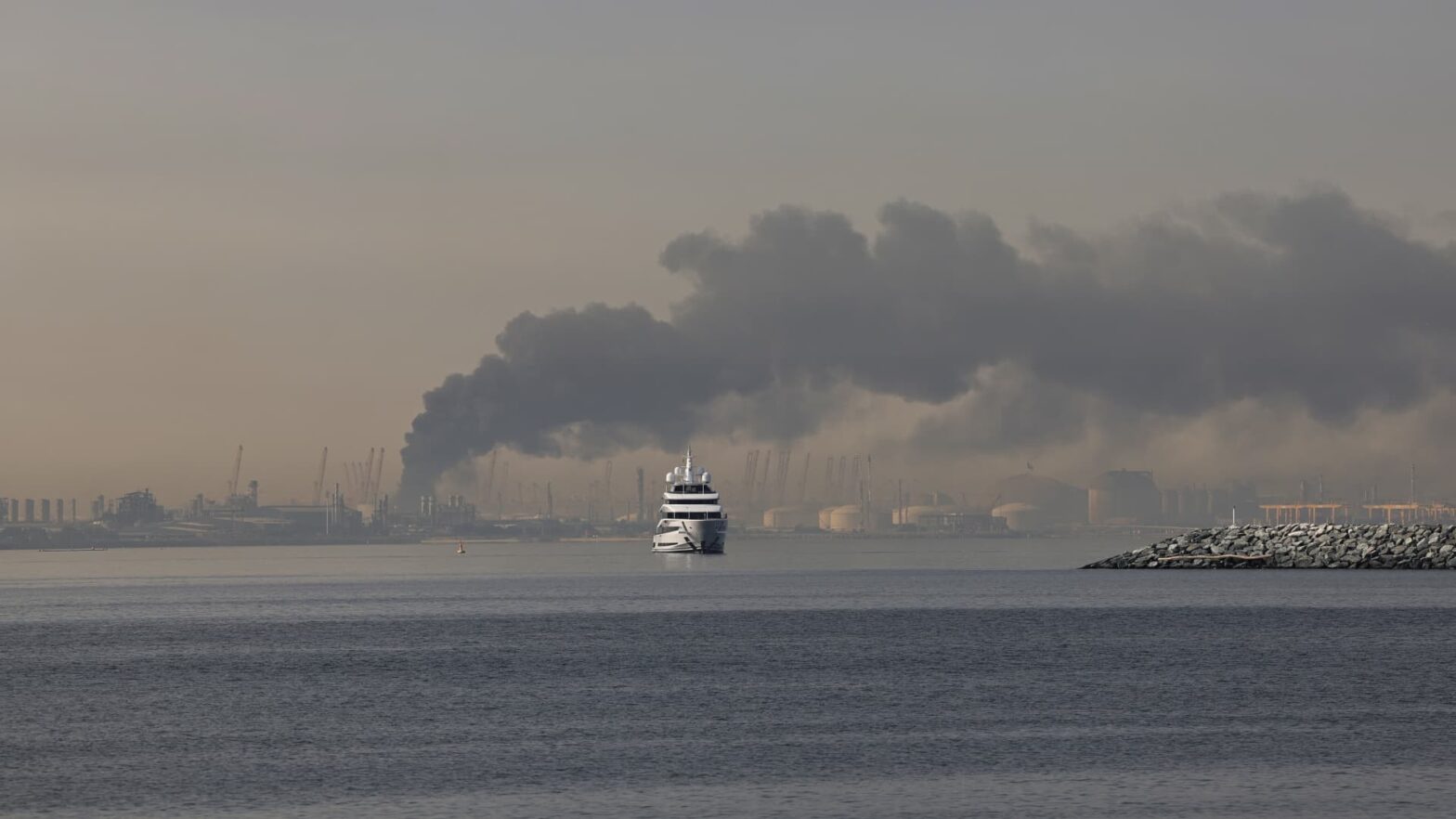
A yacht sails past a plume of smoke rising from the port of Jebel Ali following a reported Iranian strike in Dubai on March 1, 2026. Fresh blasts were heard across the Gulf cities of Dubai, Doha and Manama on Sunday morning after a day of Iran strikes in the region in retaliation for US and Israeli attacks.
Fadel Senna | Afp | Getty Images
What you need to know
- The United States and Israel launched a massive attack on Iran overnight Saturday.
- The U.S.-Israel attack came after Iran refused American demands that it reduce its nuclear program.
- Iran launched counterattacks against multiple cities in the Middle East, including Jerusalem.
- Iran’s Supreme Leader Ayatollah Ali Khamenei was killed, Iranian state media confirmed.
- More than 1,400 flights in and out of Middle East destinations are canceled on Sunday.
- Congress aims to vote on war powers resolution in the coming week.
Iran’s retaliation is intensifying after U.S.-Israeli strikes killed Supreme Leader Ayatollah Ali Khamenei, triggering one of the most consequential moments for the Islamic Republic since 1979.
Tehran has launched counterattacks across Israel and several Gulf states that host U.S. assets, with explosions reported in multiple cities and damage to key infrastructure. Airports have suspended operations, flights across the Middle East have been disrupted, and governments are scrambling to assess the security fallout.
The escalation comes as Iran begins a formal succession process to replace Khamenei, only the second leadership transition since the 1979 Islamic Revolution. While some Iranians have expressed hope for change, analysts caution that leadership change does not automatically mean regime change.
Markets, policymakers and regional leaders are now watching closely to see how far the conflict spreads, and whether the power shift in Tehran alters Iran’s political trajectory or further entrenches its security-first stance. Follow here for live updates.
CNBC’s reporters are covering the strikes from our bureaus in Washington; London; Singapore; San Francisco; and Englewood Cliffs, New Jersey.
U.S.-Israel strikes Iran: What we know as markets brace for turmoil
Investors are bracing for risk-off trades once markets reopen after the weekend. as the conflict in the Middle East widens.
Gains are expected in so-called safe-haven assets like the U.S. dollar and gold, while equities could pull back.
Oil market participants have been closely watching the conflict, which risks a major oil supply shock in the Middle East.
Markets could swing between risk-on relief — if regime collapse removes the threat of oil blockades or nuclear escalation — and risk-off persistence if conflict drags on and supply disruptions intensify, according to Ben Emons of FedWatch Advisors.
Airlines have canceled hundreds of flights, while dozens of others were rerouted mid-flight due to closed airspace over a large swath of the Middle East. Airspace closures also forced carriers to scrub flights that would normally transit the region.
Read the full story here.
— Anniek Bao
Iran’s internet has been down for more than 24 hours, monitoring organization says
Iran’s internet been down for more than 24 hours, an online traffic monitoring organization said Sunday.
“The measure limits civic engagement at a key moment for the country’s future after the killing of Ayatollah Khamenei in US and Israeli airstrikes,” NetBlocks said in a post on X.
Network connectivity in Iran from Feb. 24, 2026 to March 1, 2026. NetBlocks.org.
NetBlocks.org
— Azhar Sukri
Israel says it has carried out more strikes in Tehran
Israel said Sunday it has carried out more strikes against Iran’s government in the capital.
“The Air Force, guided by Military Intelligence, has now launched a broad wave of strikes toward targets of the Iranian terror regime in the heart of Tehran,” the Israel Defense Forces said in a post on X.
“Over the past day, the Air Force conducted extensive strikes to achieve air superiority and open the path to Tehran,” the IDF said.
— Azhar Sukri
Investors reassess risk after Khamenei strike, with oil in spotlight
Iran woke up Sunday to a once-in-a-generation shock: state media confirmed Supreme Leader Ayatollah Ali Khamenei was killed in a joint U.S.–Israel strike.
For markets, the key question is what comes next.
Standard Chartered’s Global Head of Research, Eric Robertsen, said in a note that investors had already been underpricing geopolitical risk. The U.S. dollar is only modestly weaker year-to-date, but the dispersion beneath the surface is telling: commodity-linked currencies are outperforming, suggesting markets are paying for exposure to scarce resources and terms-of-trade winners.
Ben Emons of FedWatch Advisors adds a high-volatility geopolitical lens. Leadership strikes in Tehran raise regime-change tail risks and leave an uncertain endgame. Markets could swing between risk-on relief — if regime collapse removes the threat of oil blockades or nuclear escalation — and risk-off persistence if conflict drags on and supply disruptions intensify.
The immediate pressure point may be energy. A sustained surge in crude would ripple quickly through inflation expectations and hit Asia’s oil-importing economies hardest, analysts say.
As trading resumes, investors will be watching oil prices and the U.S. dollar versus Asian currencies for the first real signal of how seriously this shock is being priced in.
— Spriha Srivastava
Middle East markets lower on Sunday as regional tensions rise
Markets in the Middle East opened lower on Sunday due to regional tensions.
Shares in Muscat opened lower as investors withdrew funds, indicating market fear that the weekend’s events would turn into a protracted conflict after Israel and the U.S. attacked Iran, and the Islamic Republic retaliated across Arab and Gulf cities.
Muscat’s main index, the .MSX30 tumbled more than 3% in Sunday trade. The country was not targeted by the Islamic Republic as it played a key mediation role in talks between the U.S. and Iran in recent weeks. Oman’s foreign minister took to X to express his “dismay” at the joint strikes on Iran by the U.S. and Israel, saying “active and serious negotiations have yet again been undermined.”
Kuwait’s stock exchange implemented a trading suspension until further notice. Kuwait was hit by Iranian missiles, as was Amman, Doha and Riyadh, which remained open on Sunday.
Saudi’s Tadawul was down nearly 1.5 percent, while Qatar’s main benchmark traded down nearly two percent. Amman’s bourse was also down two percent while Bahrain’s exchange hovered around .88 percent lower.
The United Arab Emirates has been subjected to a second day of explosions, heard by CNBC’s team on the ground in the country. Dubai and Abu Dhabi’s exchanges open for trade Monday morning, they closed lower in Friday’s trade.
Israel’s Tel Aviv stock exchange opens Monday morning for trading as well, the exchange shifted in January to Monday-Friday trading in line with global markets.
— Emma Graham
Iran’s Larijani says U.S., Israel seek to “plunder and disintegrate Iran”: state TV
Iran’s top security official Ali Larijani said the United States and Israel are seeking to “plunder and disintegrate” the country, Reuters reported citing state television, as Tehran moves to shore up control following the killing of Supreme Leader Ayatollah Ali Khamenei.
Larijani said a temporary leadership council would be established on Sunday and warned that any “secessionist groups” attempting to take action would face a harsh response.
—Lee Ying Shan
UAE announces remote learning for schools, universities from Monday as Iran targets Gulf states
The United Arab Emirates has ordered schools and universities nationwide to switch to remote learning from Monday to Wednesday as Iran launches attacks on Arab states with U.S. assets.
In a post on X Sunday, the UAE’s Ministry of Education and the Ministry of Higher Education and Scientific Research said that students, educational and administrative staff in all public and private schools nationwide will switch to “distance learning” for the upcoming three days.
— Anniek Bao
Trump warns Iran against retaliation, vows using force “never been seen before”
U.S. President Donald Trump warned Sunday that Washington would respond with unprecedented force if Iran retaliates against recent U.S. strikes.
In a post on Truth Social, Trump wrote: “Iran just stated that they are going to hit very hard today, harder than they have ever been hit before,” adding, “THEY BETTER NOT DO THAT, HOWEVER, BECAUSE IF THEY DO, WE WILL HIT THEM WITH A FORCE THAT HAS NEVER BEEN SEEN BEFORE!”
— Lee Ying Shan
Waves of loud blasts reported in Doha for second day: media reports
Several loud explosions were heard in the Qatari capital Doha for a second day on Sunday, according to media reports.
Reuters reported blasts were heard in the Dubai area as well as Doha. In a video posted by Doha News on Sunday, thick smoke was seen billowing near Barwa in Doha after Iran launched missiles towards Qatar that hosts U.S. military bases.
— Anniek Bao
Iran after Khamenei: What’s next and what it means for the world?
The death of Iran’s Supreme Leader Ayatollah Ali Khamenei sets in motion a formal succession process that could have significant implications for the country’s political stability, sanctions outlook and already strained economy.
However, analysts warned that elimination of the supreme leader does not equal transformation.
“Taking out Iranian Supreme Leader Ayatollah Ali Khamenei is not the same as regime change. The Islamic Revolutionary Guard Corps is the regime,” the Council on Foreign Relations noted following his passing, limiting the prospects for immediate political or economic transformation.
Marko Papic, chief strategist at Clocktower Group, echoed a similar views: “The Iranian economy is soon to be a parking lot unless the next Supreme Leader is more amenable to negotiating with the U.S.”
Read the full story here.
— Lee Ying Shan
Airports in Gulf states, hotel damaged as Iran retaliates against U.S.-Israeli strikes
Airports in Dubai and Abu Dhabi were damaged overnight as Iranian retaliatory attacks spread across the Gulf states.
“An incident” at Dubai International Airport (DXB) left four staff injured, according to a social media post by the emirate’s media office.
Most airport terminals had been cleared of passengers, the authority said, adding that further updates will be provided as they become available.
Authorities in Abu Dhabi also reported an interception of a drone that targeted the Zayed International airport, killing an Asian national and leaving seven injured.
Iran has responded to the U.S.-Israel strikes by targeting Israel and multiple Gulf states, including UAE, Qatar, Bahrain, Saudi Arabia, Kuwait and Jordan that host U.S. assets.
An intercepted Iranian drone reportedly caused a minor fire on the Burj Al Arab’s outer facade.
One of the berths at Dubai’s Jebel Ali Port also caught fire because of debris resulting from an aerial interception, according to local media reports, citing Dubai authorities.
— Anniek Bao
Iran hit by near-total internet blackout as conflict intensifies
Iran experienced a near-total internet shutdown starting around 2 a.m. ET Saturday, according to independent internet monitoring group NetBlocks.
The organization, which uses network measurement and web traffic analytics to detect government-imposed outages, reported that national connectivity fell to just 4% of normal levels.
Posting on X, NetBlocks said the disruption coincided with U.S. and Israeli military operations and resembled restrictions imposed during last year’s conflict with Israel.
—Lee Ying Shan
Islamic Revolutionary Guards Corps chief dies in U.S.-Israeli attack: reports
Commander-in-chief of the Islamic Revolutionary Guards Corps died in the U.S.-Israeli attack against Tehran on Saturday, the country’s official news agency reported. Ali Shamkhani, representative of the Supreme Leader in the Supreme Defense Council, was also killed.
“We are hearing that many of their IRGC, Military, and other Security and Police Forces, no longer want to fight, and are looking for Immunity from us,” U.S. President Donald Trump said in the aftermath of Iranian Supreme Leader Ayatollah Ali Khamenei’s death.
— Vinay Dwivedi