Hundreds of thousands of stranded travelers scrambled to make new connections and get through to airlines on jammed phone lines after the attack on Iran by the United States and Israel shut down much of the Middle East to air travel.
Tourists and business travelers crowded hotels and airports, with no word on when many airports would reopen or when flights to and through the Middle East would resume. Some governments advised their stranded citizens to shelter in place.
Shutdown airports in Dubai, Abu Dhabi and Doha — including Dubai International Airport, one of the busiest in the world — are important hubs for travel between Europe, Africa and the West to Asia. All three were directly hit by strikes.
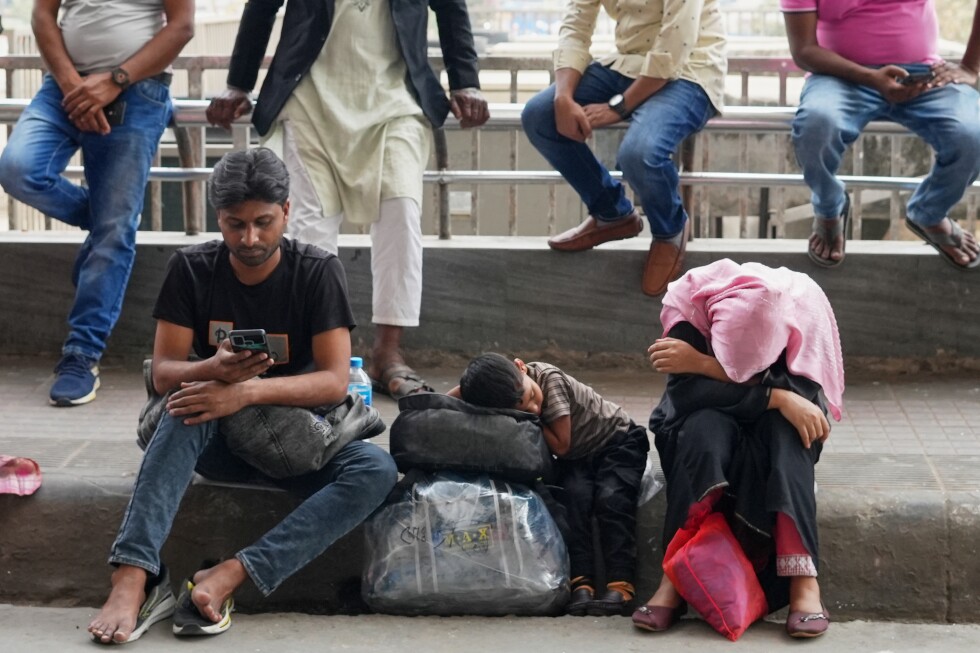
Mohammad Abdul Mannan, in the crowd at Hazrat Shahjalal International Airport in Dhaka, Bangladesh, said he wasn’t concerned about the war, but that he needs to get his flight to the Middle East to make a living.
“We have set out to go for work, and we must go,” he said. “My only concern is how to go abroad and how to earn an income.”
In Dubai, stranded travelers could hear fighter jets overhead and an explosion when the Fairmont Palm Hotel was hit by a missile strike.
Many were unable to get updated flight information from tour operators or Dubai-based Emirates Airlines, which suspended all flights to and from Dubai until at least Monday afternoon.
Louise Herrle and her husband had their flight to Washington canceled on their way back to their Pittsburgh home after a tour of Dubai and Abu Dhabi, with no word when they could reschedule.
“We’re in the hotel room, we are not leaving it, so you’re not going to give it up until we know we have a flight out of here,” Herrle said. “I’m sure everyone else is in the same situation.”
Passengers whose flights were cancelled, wait at the departure terminal of Rafik Hariri International Airport in Beirut, Lebanon, Saturday, Feb. 28, 2026, as many airlines canceled flights due to the conflict involving the United States, Israel and Iran. (AP Photo/Hassan Ammar)
Passengers whose flights were cancelled, wait at the departure terminal of Rafik Hariri International Airport in Beirut, Lebanon, Saturday, Feb. 28, 2026, as many airlines canceled flights due to the conflict involving the United States, Israel and Iran. (AP Photo/Hassan Ammar)
Cirium, an aviation analytics firm, said it is hard to calculate the number of travelers affected worldwide.
However, it estimated that at least 90,000 people alone change flights daily in the airports in Dubai, Doha or Abu Dhabi on just three airlines, Emirates, Qatar Airways and Etihad Airways.
Airports and airspaces still closed
Travelers check departure times as many flights are cancelled at Beirut Rafik Hariri International Airport in Beirut, Lebanon, Saturday, Feb. 28, 2026, as many airlines canceled flights due to the conflict involving the United States, Israel and Iran. (AP Photo/Hassan Ammar)
Travelers check departure times as many flights are cancelled at Beirut Rafik Hariri International Airport in Beirut, Lebanon, Saturday, Feb. 28, 2026, as many airlines canceled flights due to the conflict involving the United States, Israel and Iran. (AP Photo/Hassan Ammar)
Airspace or airports in Israel, Qatar, Syria, Iran, Iraq, Kuwait, Bahrain, Oman and the United Arab Emirates were closed, according to flight tracking sites and government agencies there.
More than 1,800 flights were canceled Sunday to airports across the Middle East, including those in Saudi Arabia, Jordan, Turkey and Egypt, according to Cirium. At least that number of flights were canceled Saturday.
Cancellations will extend beyond Sunday, at least.
Emirates Airlines suspended all flights to and from Dubai until at least Monday afternoon. The Qatar airport was closed until at least Monday morning, according to Qatar Airways. Israeli airline El Al said it was preparing a recovery effort to bring home Israelis stranded abroad once the airspace reopened.
Two airports in the United Arab Emirates reported strikes as the government there condemned what it called a “blatant attack involving Iranian ballistic missiles” on Saturday.
Officials at Dubai International Airport said four people were injured, while Zayed International Airport in Abu Dhabi said one person was killed and seven others were injured in a drone strike. Strikes were also reported at Kuwait International Airport.
Iran did not publicly claim responsibility.
Flight delays and cancellations are likely to continue
Airlines urged passengers to check their flight status online before heading to the airport. Some airlines issued waivers to affected travelers that will allow them to rebook their flight plans without paying extra fees or higher fares.
“For travelers, there’s no way to sugarcoat this,” said Henry Harteveldt, an airline industry analyst and president of Atmosphere Research Group. “You should prepare for delays or cancellations for the next few days as these attacks evolve and hopefully end.”
Mike McCormick, who used to oversee air traffic control for the Federal Aviation Administration, said countries might reopen their airspace once American and Israeli officials tell airlines where military flights are operating and how capable Iran remains at firing missiles.
Check your flight status before you travel
The reverberations echoed far outside the Middle East — for example, airport authorities in the resort island of Bali in Indonesia said more than 1,600 tourists were stranded at I Gusti Ngurah Rai International Airport on Sunday after five flights to the Middle East were canceled or postponed.
Airlines that are crossing the Middle East will have to reroute flights around the conflict with many flights headed south over Saudi Arabia. That will cause delays and higher costs.
Jonathan Escott and his partner had arrived at the airport in Newcastle, England, on Saturday only to find out that his direct flight to Dubai on Emirates airline was canceled, leaving everyone on the flight stuck there.
Escott had no idea when he may be able to travel.
“No one knows,” Escott said. “No one really knows what’s going on with the conflict, really. Not Emirates, Emirates don’t have a clue. No one has a clue.”
___
Levy reported from Harrisburg, Pennsylvania. Associated Press writers Josh Funk in Omaha, Nebraska, Adam Schreck in Bangkok, Sam Metz in Ramallah, West Bank, Melanie Lidman in Jerusalem and Niniek Karmini in Jakarta contributed to this report.