Key Points
-
Although the Dow Jones Industrial Average, S&P 500, and Nasdaq Composite have soared in recent years, things may not be as rosy for Wall Street as these indexes suggest.
-
The Iran war may bring the Fed’s rate-easing cycle to a halt, which would be a devastating blow for a historically expensive stock market.
-
Furthermore, historic divisions within the FOMC, coupled with a pending change in Fed chair, put the nation’s central bank (and Wall Street) in a precarious position.
Since the start of 2019, things have gone exceptionally well for Wall Street and investors. The S&P 500 (SNPINDEX: ^GSPC) has registered at least a 16% gain in six of the last seven years, while the Dow Jones Industrial Average (DJINDICES: ^DJI) and Nasdaq Composite (NASDAQINDEX: ^IXIC) have both motored to several record-closing highs.
Upside catalysts have been abundant, including the evolution of artificial intelligence, better-than-expected corporate earnings, stock-split euphoria, record S&P 500 share buybacks, and the Federal Reserve’s rate-easing cycle, which began in September 2024.
Will AI create the world’s first trillionaire? Our team just released a report on the one little-known company, called an “Indispensable Monopoly” providing the critical technology Nvidia and Intel both need. Continue »
However, things may not be as rosy for Wall Street as the performance of its three leading stock indexes indicates. The Donald Trump-led Iran war, which commenced on Feb. 28, potentially opens a can of worms for America’s foremost financial institution, the Federal Reserve. When added to existing concerns, the Fed is facing a possible triple whammy that would, in all likelihood, adversely impact a historically pricey stock market.

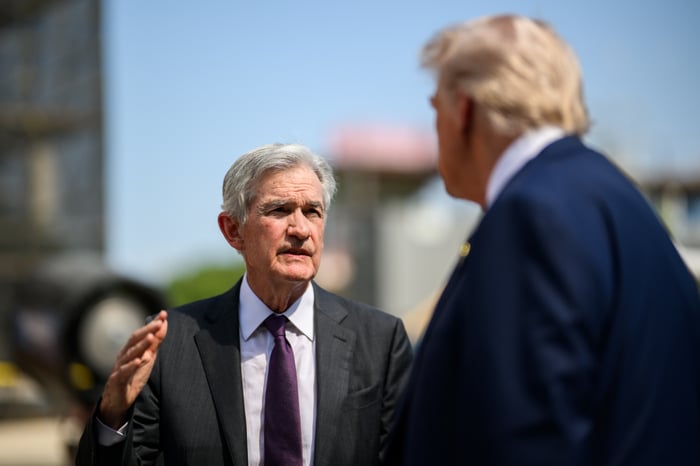
Jerome Powell talking to Donald Trump in front of the Federal Reserve’s headquarters in Washington, D.C.
Fed Chair Jerome Powell speaking with President Trump. Image source: Official White House Photo by Daniel Torok.
The Iran war raises stagflation worries and (likely) places the Fed’s rate-easing cycle on ice
Two weeks ago, the U.S. and Israel began military operations against Iran. Shortly after the conflict commenced, Iran virtually closed the Strait of Hormuz to oil exports. According to the Energy Information Administration, approximately 20% of the world’s liquid petroleum needs move through the Strait of Hormuz daily.
When the supply of a basic necessity, such as oil, is constrained or disrupted, the law of supply and demand tells us that the price of that good will head higher. Between Feb. 27 and March 9, the spot price of West Texas Intermediate crude oil skyrocketed from $67 to as high as $119.
While most consumers worry about how higher oil prices will impact what they pay at the gas pump, there are far bigger implications.
Historically, oil price spikes have commonly correlated with periods of consumer spending weakness, higher unemployment, and, most importantly, higher inflation. If these puzzle pieces are arranged just right, you’d get the Federal Reserve’s nightmare scenario: stagflation. Stagflation involves rising unemployment and inflation, with weaker or stagnant economic growth.
Although the nation’s central bank has plenty of tools on its proverbial toolbelt, there isn’t a one-size-fits-all blueprint to combating stagflation. Lowering interest rates to fuel economic growth threatens to fan the flames of rising inflation. Meanwhile, raising interest rates can further increase the unemployment rate and weaken the U.S. economy.
If the Iran war oil price spike persists beyond a couple of weeks and the prevailing inflation rate increases, it would only be logical for the Fed to put its rate-easing cycle on ice. That’s a problem, because the stock market is historically expensive, and investors have been counting on additional rate cuts in 2026.
The Trump-led Iran war potentially places America’s foremost financial institution in a no-win scenario.

Jerome Powell fielding questions from reporters following a Federal Open Market Committee meeting.
Jerome Powell’s term as Fed chair ends on May 15, 2026. Image source: Official Federal Reserve Photo.
Historic division within the FOMC may cost the Fed its most important attribute: credibility
Secondly, a dubious bit of history is threatening the Federal Reserve’s credibility in the eyes of investors.
The Federal Open Market Committee (FOMC) is a 12-person body, including Fed Chair Jerome Powell, responsible for setting the nation’s monetary policy. It does this by adjusting the federal funds target rate (the overnight lending rate between financial institutions) and/or conducting open-market operations, including buying and selling U.S. Treasury bonds.
The FOMC doesn’t always make timely or correct monetary policy decisions. Using backward-looking economic data often means the FOMC is late to the party when adjusting interest rates.
However, investors are usually willing to accept Federal Reserve slip-ups as long as all voting members are on the same page. In other words, if there are no dissenting opinions, investors are generally happy.
Although Jerome Powell has enjoyed the lowest dissent rate of any Fed chair since 1978, dissents have been piling up since the midpoint of 2025. There’s been at least one dissenting opinion in each of the last five FOMC meetings, with dubious history made in the October and December meetings.
In October and December, we witnessed dissenting opinions in opposite directions. While the FOMC voted to lower the federal funds target rate by 25 basis points at both meetings, at least one member voted for no reduction, while another favored a more aggressive 50-basis-point cut. There have only been three FOMC meetings since 1990 with dissents in opposite directions, and two have occurred since late October.
While the argument can be made that opposing views and dissents are healthy, an FOMC without a unified monetary policy approach can spell trouble for the stock market. The longer dissents persist, the more likely it is that the Fed will lose credibility.
Trump’s Fed chair nominee, Kevin Warsh, may come back to bite Wall Street
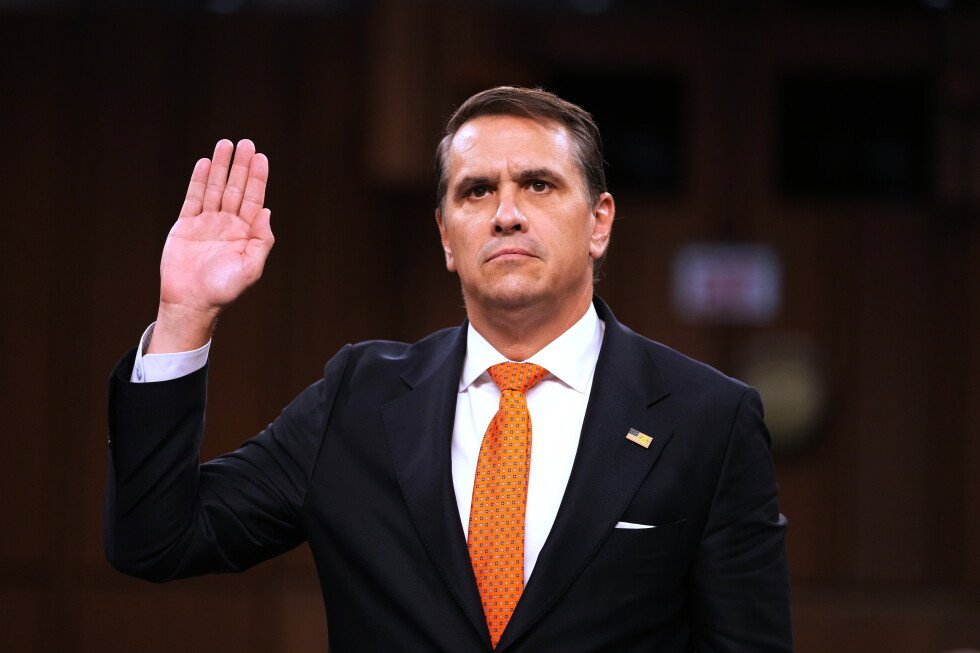
The third part of the Federal Reserve triple whammy has to do with President Trump’s nomination of Kevin Warsh to replace Jerome Powell, whose term as Fed chair comes to a close on May 15, 2026.
On paper, Warsh is a logical pick to replace Powell. He was previously a member of the Board of Governors of the Federal Reserve from Feb. 24, 2006, to March 31, 2011, and was a voting member of the FOMC before, during, and after the financial crisis. He brings experience to a high-profile position.
However, Kevin Warsh’s voting track record and his vocal critiques of the Fed’s balance sheet raise concerns for stocks and the U.S. economy.
While his voting record doesn’t guarantee how he’ll vote in future FOMC meetings (assuming he earns the requisite votes from the Senate Banking Committee and U.S. Senate to succeed Powell), Warsh has consistently been labeled a “hawk.” In other words, he’s favored higher interest rate environments and placed greater emphasis on keeping inflation down rather than maximizing employment. His voting record suggests the historic division we’ve recently observed within the FOMC isn’t going to be resolved if/when he succeeds Powell.
Additionally, Warsh has criticized the Fed’s balance sheet, which has ballooned in the wake of the Great Recession. The roughly $6.6 trillion in assets currently held by the nation’s central bank is primarily comprised of U.S. Treasury bonds and mortgage-backed securities (MBSs).
Trump’s Fed chair nominee wants to see America’s foremost financial institution take a back seat and be a passive market participant. This would entail selling Treasury bonds and MBSs and meaningfully reducing what the Fed holds on its balance sheet.
But there’s a potential snafu. Since bond prices and yields are inversely related, selling Treasury bonds and MBSs would likely increase borrowing rates, including mortgage rates.
Warsh’s desire to deleverage the Fed’s balance sheet would probably draw the ire of President Trump, who’s been vocally critical of Jerome Powell’s slow-stepped rate-cutting approach, and it could work against the aforementioned pricey stock market that’s expecting interest rates to decline, not increase.
Should you buy stock in S&P 500 Index right now?
Before you buy stock in S&P 500 Index, consider this:
The Motley Fool Stock Advisor analyst team just identified what they believe are the 10 best stocks for investors to buy now… and S&P 500 Index wasn’t one of them. The 10 stocks that made the cut could produce monster returns in the coming years.
Consider when Netflix made this list on December 17, 2004… if you invested $1,000 at the time of our recommendation, you’d have $508,607!* Or when Nvidia made this list on April 15, 2005… if you invested $1,000 at the time of our recommendation, you’d have $1,122,746!*
Now, it’s worth noting Stock Advisor’s total average return is 933% — a market-crushing outperformance compared to 188% for the S&P 500. Don’t miss the latest top 10 list, available with Stock Advisor, and join an investing community built by individual investors for individual investors.
*Stock Advisor returns as of March 14, 2026.
Sean Williams has no position in any of the stocks mentioned. The Motley Fool has no position in any of the stocks mentioned. The Motley Fool has a disclosure policy.