When Warren Buffett stepped down as CEO of Berkshire Hathaway (BRKA 0.24%)(BRKB 0.38%) at the end of 2025, he left behind a gargantuan war chest worth $373.3 billion. He also spent his last few years as CEO being a net seller of stock, trimming Berkshire’s massive investment portfolio even as the S&P 500 hit record highs.
Why would the “Oracle of Omaha” have been so seemingly cautious when so much of Wall Street is all in on the current bull run?

Image source: Getty Images.
The numbers tell a striking story
Berkshire sold approximately $134 billion in equities during 2024 alone while the bull market raged. The selling continued through 2025, with Berkshire slashing its Apple position repeatedly, trimming Bank of America, and cutting its Amazon stake by 77% in the fourth quarter.
And during the same period, Buffett steadily grew his company’s war chest. From 2022 through today, Berkshire’s cash and short-term investments increased from $128.6 billion to today’s $373.3 billion. You can see the rapid growth in the chart below.
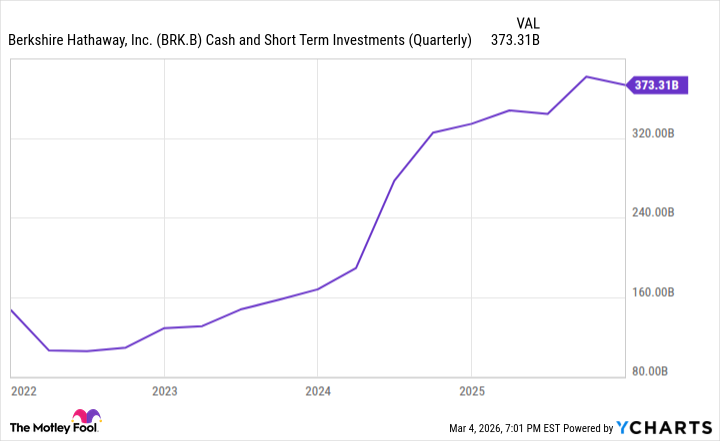
BRK.B Cash and Short Term Investments (Quarterly) data by YCharts
Buffett’s attitude
In his second-to-last annual letter to shareholders, Buffett compared the modern stock market to a casino, writing that markets exhibit “far more casino-like behavior” than when he was young and that their active participants are “neither more emotionally stable nor better taught.” He warned of Wall Street’s affinity for “feverish activity” and reaffirmed that Berkshire would “never risk permanent loss of capital.”
It would seem that Buffett was concerned by what he saw: artificial intelligence (AI) fueled euphoria, an increasing willingness from investors to pay a premium for the possibility of future returns, global instability, and stocks trading at extreme levels.
The theory
If Buffett saw signs of a coming “conflagration,” as he calls market meltdowns, it would make sense for him to play defense — locking in profits from his investments and growing his cash reserves. That’s not just caution for the sake of caution. It’s a playbook that has served him extraordinarily well.
During the 2008 financial crisis, Buffett deployed roughly $14.5 billion across deals with Goldman Sachs, what was then General Electric, and Bank of America. Because he was one of the few investors with both capital and nerve, he was able to negotiate terms that were only available after a crash. The Goldman deal alone — $5 billion in preferred shares at a 10% dividend plus warrants — generated around $3.1 billion in returns. His Bank of America warrants eventually became a $12 billion gain.
The counterargument
Of course, there are more generous interpretations of Buffett’s defensive posture. By leaving his successor, Greg Abel, with an unprecedented war chest, Buffett may have given him the widest possible runway to define his own legacy. Abel’s first shareholder letter emphasized exactly that flexibility, writing that Berkshire’s “substantial liquidity” enables it to “respond swiftly when opportunities arise.”

Today’s Change
Current Price
There’s also the straightforward math problem. Berkshire is so enormous that very few investments can meaningfully move the needle. Accumulating cash may simply be the default when you manage hundreds of billions of dollars and refuse to overpay.
And even if Buffett does see a crash on the horizon, we shouldn’t forget that he’s human. He’s made mistakes — the Kraft Heinz acquisition and selling airline stocks at pandemic lows, to name a couple. He’s an incredibly successful investor, but he’s not infallible.
What it means for you
At the end of the day, I can’t know his thinking — not for certain — but I do think Buffett had serious concerns about the market before he stepped down.
That doesn’t mean you need to sell everything. Rather, take a hard look at your portfolio and ask yourself whether you believe in the companies you own and their ability to survive and thrive on the other side of a major correction. And maintaining a cash position, as Buffett has demonstrated time and again, is a great way to take advantage of opportunities when they arise.
Bank of America is an advertising partner of Motley Fool Money. Johnny Rice has no position in any of the stocks mentioned. The Motley Fool has positions in and recommends Amazon, Apple, Berkshire Hathaway, and Goldman Sachs Group and is short shares of Apple. The Motley Fool recommends Kraft Heinz. The Motley Fool has a disclosure policy.