Have you ever wondered what analysts mean when they say a stock, or the broader market, is overvalued or undervalued?
Broadly speaking, stock researchers will analyze metrics such as price-to-sales (P/S) or price-to-earnings (P/E) and benchmark these ratios against historical levels and industry peers to help gauge a company’s valuation profile. While useful, these metrics can fall short, as they only account for one year’s worth of data.
An often overlooked valuation tool that could prove more useful is the cyclically adjusted price-to-earnings (CAPE) ratio. The CAPE ratio provides a more thorough look at market valuations, as it accounts for a decade’s worth of inflation-adjusted earnings. This approach helps smooth out one-time anomalies and economic cycles.
Let’s take a look at the S&P 500’s current CAPE ratio and compare it to prior periods. From there, smart investors should be able to develop a solid game plan for navigating ongoing volatility in 2026.

Image source: Getty Images.
What is the CAPE ratio, and why is it important?
As noted, the CAPE ratio differs from more standard metrics such as the P/E multiple because it is not distorted by one-time events. The CAPE offers a normalized view of long-term value by smoothing out short-term fluctuations.
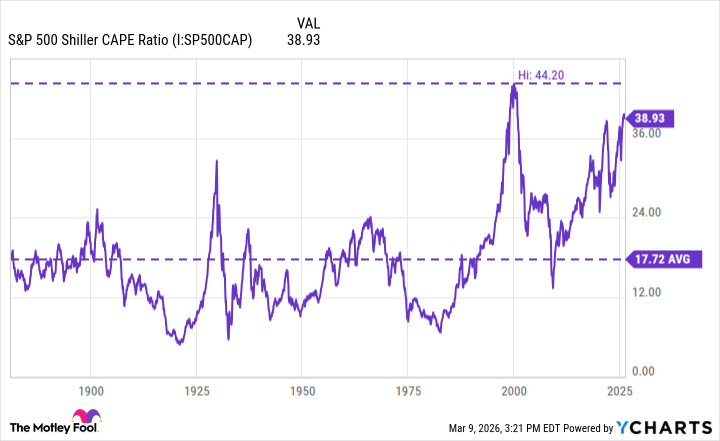
S&P 500 Shiller CAPE Ratio data by YCharts
Currently, the CAPE ratio stands at 39 — more than double its long-term average and inching closer to its all-time high. The only other times in history when the CAPE ratio was near its current level were in the late 1920s and in 2000.
In both periods, the stock market ultimately plummeted — crashing during the Great Depression and during the dot-com bubble burst. This is important to note because it could signal that the CAPE ratio is a good barometer of stock market crashes.
What does a rising CAPE ratio signal?
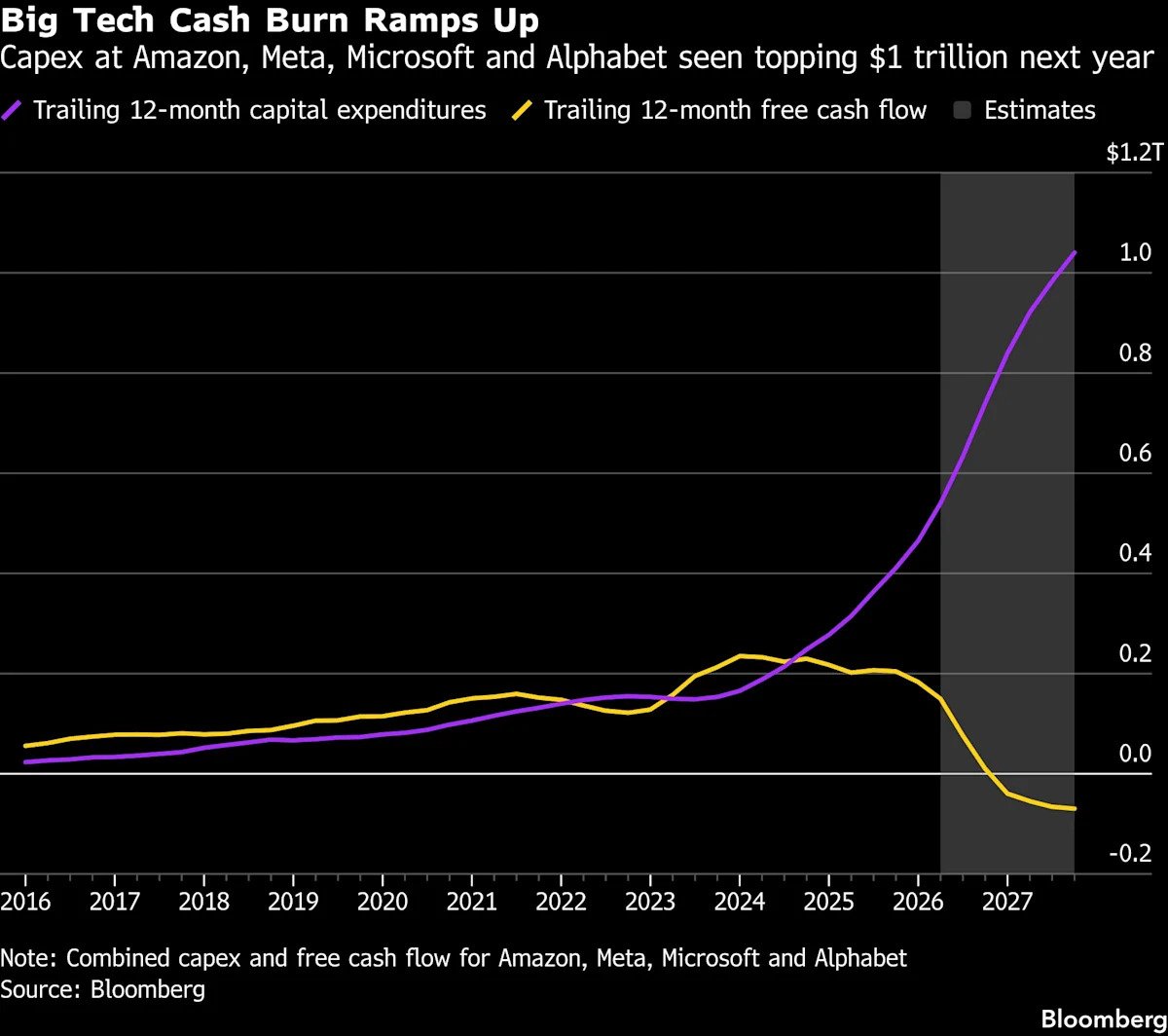
Right now, the stock market remains elevated relative to historical levels, driven by tailwinds from demand for artificial intelligence (AI). Hyperscalers such as Microsoft, Amazon, Alphabet, and Meta Platforms are spending hundreds of billions of dollars procuring chips from Nvidia, Broadcom, and Advanced Micro Devices for their next-generation data centers.
This investment in AI infrastructure is fueling valuations higher. Hence, the CAPE ratio is climbing higher, supported by the notion of higher earnings. However, based on these trends, it’s clear that once the CAPE oscillates above 25 to 30, the stock market tends to enter a correction.
The clearest outlier in the CAPE’s history occurred in 2000, when it peaked at 44. Ultimately, the S&P 500 (^GSPC +1.01%) cratered more than 40% between 2000 and 2002 in the aftermath of the dot-com bubble.
Broadly speaking, a rising CAPE ratio suggests that stock prices are detached from underlying business fundamentals — potentially signaling overvaluation.
Is the stock market going to crash this year?
The S&P 500 is currently just 4% away from its all-time high. If you look at this figure in isolation, you might be convinced that the market is frothy and teetering on becoming overvalued.
But if you take this analysis one step further, many of the world’s largest technology companies, in particular, are trading for reasonable P/E levels when compared to earlier periods of the AI revolution.
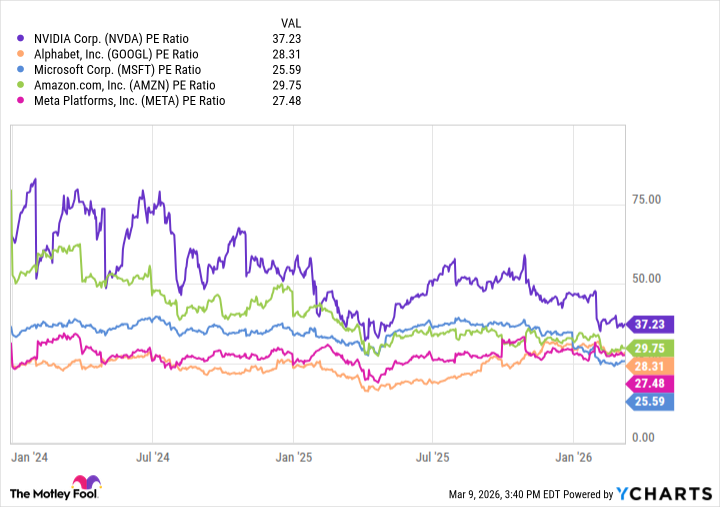
NVDA PE Ratio data by YCharts
To me, there is a stark difference between the current AI boom and the dot-com bubble. Unlike the early days of the internet, many hyperscalers have already monetized their AI investments profitably. Against this backdrop, some investors may argue that record profits and cash flow from the AI supercycle support a market premium.
Nevertheless, smart investors should still plan strategically. While a rising CAPE ratio does not guarantee a harsh correction is imminent, it’s historically been a good proxy for sell-offs.
With this in mind, a good strategy could be to trim your exposure to volatile growth stocks and unpredictable speculative positions. Instead, I’d opt for blue chip stocks with durable, diversified business models. In addition, complementing high-conviction positions with cash will further insulate you from any downturns while providing you the flexibility to buy the dip.
Ultimately, the S&P 500 has proven to be a resilient, money-making machine in the long run — moving higher over the course of various economic cycles. Hence, investing your capital wisely right now — even during a downturn — should prove profitable over time.