Updated 1 min read
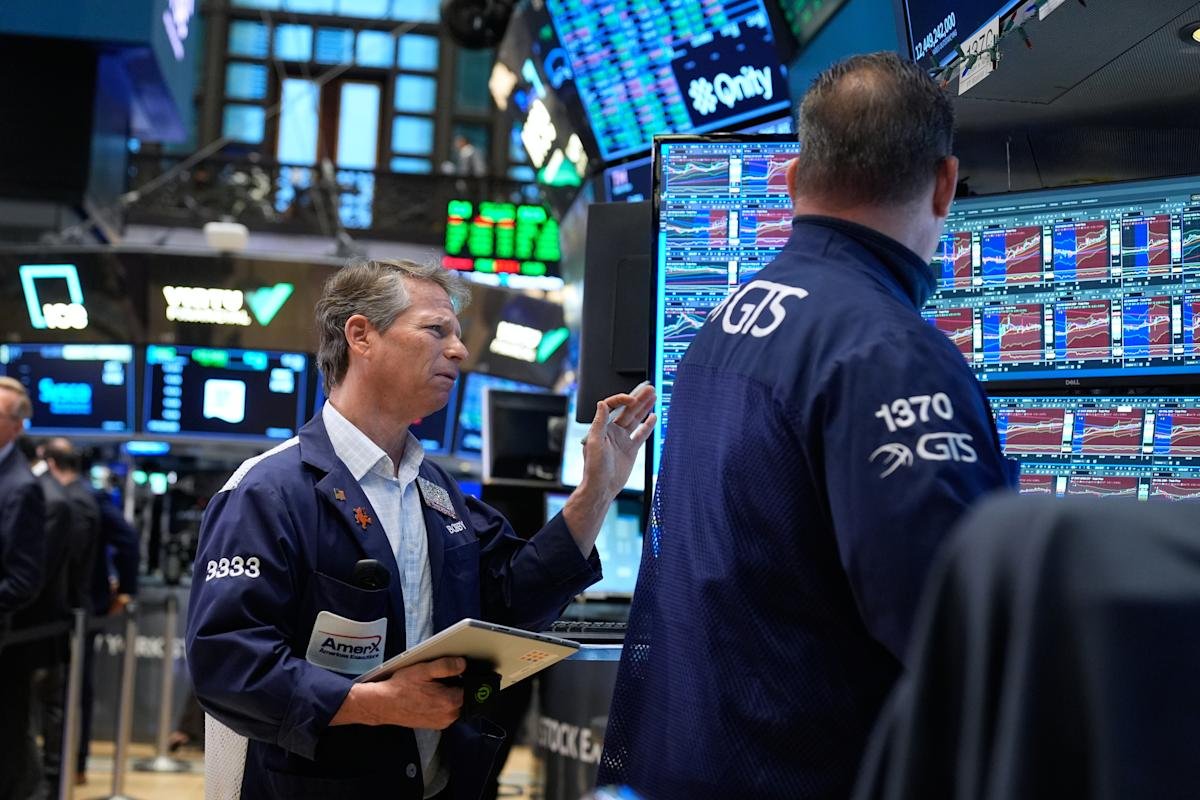
US stocks gained on Wednesday following a powerful rally across Wall Street to wrap up the first quarter, while investors weighed remarks from Trump indicating he may be winding down hostilities against Iran.
The S&P 500 (^GSPC) rose 0.7%, while the Nasdaq Composite (^IXIC) gained roughly 1.1%, and the Dow Jones Industrial Average (^DJI) climbed 0.5%.
The market-shifting moves were fueled by reports suggesting a potential diplomatic off-ramp in the Iran conflict. According to comments made to state media, Iranian President Masoud Pezeshkian is open to deescalation under certain conditions, stating Iran has “the necessary will to end this war.”
Comments from the White House also indicated a shift in US posture. Trump has discussed ending the war even if the Strait of Hormuz remains closed, stating the war won’t last “much longer” and that US involvement could end “within two weeks, maybe two weeks, maybe three.”
Trump will deliver an update about the war in Iran in a speech to the nation on Wednesday at 9 p.m. ET.
Oil futures fell as stocks rose. Brent crude (BZ=F) traded fell around 3% to settle just above $100 per barrel following steeper losses earlier in the session. US benchmark West Texas Intermediate crude (CL=F) settled at just under $100 per barrel.
LIVE COVERAGE IS OVER 23 updates
-
Oil prices dip as Politico reports Trump set to announce wind-down in US involvement in Iran
Oil prices dipped briefly before rebounding after Politico reported that President Trump is set to say US involvement in the war in Iran is winding down and that other countries need to handle any reopening of the Strait of Hormuz.
Future on Brent crude (BZ=F), the international benchmark, were trading down by roughly 3.1%, hovering around $100.70 per barrel, in the minutes after the news broke. Those on the US benchmark West Texas Intermediate (WTI) crude (CL=F) were down by 2% to trade at $99.40 per barrel.
Just before the close of the trading session on Wednesday, Politico reported that the US president will use his national address tonight to declare that US involvement in Iran is coming to a close and that control over the Strait of Hormuz — the world’s most critical chokepoint for the energy trade — will be left to other nations.
The president’s speech, his first major public address since the war began, comes roughly a week ahead of his originally stated four- to six-week timeline for war with Iran. Throughout the five weeks of conflict so far, Iran’s closure of the Strait of Hormuz and attacks on the wider Gulf region have thrown the market into disarray.
Prices on Brent and WTI have soared by more than 40% each, pushing US gasoline prices at the pump over $4 per gallon nationally months ahead of the midterm elections. Prices on fertilizer, iron ore, European natural gas, and other commodities have also surged throughout the conflict.
The war is now expected to materially impact economic growth both in the US and globally. Politico noted that the president will look to assuage concerns from Americans about both US military involvement in the Middle East and the rapidly proliferating economic consequences of the conflict.
In a Truth Social post on Tuesday, Trump said to other nations impacted by Iranian violence in the Strait of Hormuz, “build up some delayed courage, go to the Strait, and just TAKE IT. You’ll have to start learning how to fight for yourself, the U.S.A. won’t be there to help you anymore.”
The president also said to reporters on Tuesday that the US military presence is set to end within two to three weeks.
-
Dow, S&P 500, Nasdaq extend gains for second day amid optimism of swift Middle East conflict resolution
Stocks moved higher on Wednesday, extending gains from the prior session’s monster rebound amid hopes of a quick end to the Iran war.
The S&P 500 (^GSPC) inched up 0.7% while the Nasdaq Composite (^IXIC) rose 1.1%. The Dow Jones Industrial Average (^DJI) also gained 0.5%.
Oil prices edged lower after President Trump signaled the possibility of withdrawing from the Middle East war in two to three additional weeks.
He also said that Iran is asking for a ceasefire but that he will consider it only when the strategic Strait of Hormuz “is open, free, and clear.”
Futures on Brent crude (BZ=F), the international pricing benchmark, shed roughly 3% to settle just above $100 per barrel. Those on US benchmark West Texas Intermediate (WTI) crude (CL=F) turned down by a similar 2% settle just below $100.
The president will address the nation at 9 p.m. ET.
-
Why sky-high oil prices haven’t shaken Wall Street’s confidence in Delta stock Inbox
Yahoo Finance’s Brian Sozzi reports:
Read more here.
-
Ahead of national address, Trump says Strait of Hormuz must be ‘open, free and clear’ before ceasefire talks
Yahoo Finance’s Ben Werschkul reports:
Read more here.
-
Nike set the stage for a turnaround. Global events keep getting in its way
Yahoo Finance’s Brooke DiPalma reports:
Nike’s (NKE) CEO Elliott Hill is determined to get the sportswear brand back to its glory days. But investors are losing patience as uncontrollable global factors get in the way of his plans.
The company took a prudent approach to its outlook during its latest earnings call, noting that the war in the Middle East and tariffs have created volatility for input costs. On a call with investors, Hill said the turnaround is proving challenging and that the external environment is partially to blame.
“We do have some external factors that we’re having to deal with while we’re in a major comeback, but that’s no excuse,” Hill said. “We’re controlling what we can control.”
Read more here.
-
Stock rally lifts confidence in year-end calls for S&P 500
The recent surge in stocks, driven by hopes for a swift resolution to the Middle East conflict, has boosted Wall Street’s confidence in its year-end outlook.
“If Trump is declaring mission accomplished, then so are we regarding our stock market correction call,” wrote Ed Yardeni and Elias Griepentrog on Tuesday night, adding their firm will likely lower its recession probability from 35% to 20% once there is greater clarity on whether the Middle East conflict has truly ended.
“Nevertheless, we are maintaining our 7,700 S&P 500 year-end target and our commitment to our ‘Roaring 2020s’ base case,” said the note.
UBS strategists noted the sharp rally in stocks over the past 24 hours demonstrates how a resolution to the conflict—or even hopes of one—can quickly drive markets higher, “reinforcing the importance for long-term investors to stay invested and positioned for upside.”
“We continue to believe global stock markets will end the year higher than they are today,” wrote Ulrike Hoffmann-Burchardi, CIO Americas at UBS Global Wealth Management.
Earlier this year UBS forecast the S&P 500could reach 7,300 by June of this year, and 7,700 by the end of this year.
-
Eli Lilly stock gains on approval for new weight loss pill
Shares in Eli Lilly (LLY) popped by more than 6% on Wednesday after the Food and Drug Administration (FDA) approved a new weight loss drug that Eli Lilly says can be taken “any time of day without food or water restrictions.”
Danish drugmaker Novo Nordisk (NVO), Eli Lilly’s main competitor in the weight-loss drug space, fell by roughly 0.2% on the news.
Eli Lilly’s Foundayo drug is designed to help overweight adults or adults with obesity lose weight. The pill is taken once daily, Lilly said in its announcement.
Eli Lilly and Novo Nordisk have spent the last three to four years locked in a battle for control of the weight-loss market. While Novo initially led the market with the launch of its GLP-1 drugs Ozempic and Wegovy, Eli Lilly’s Zepbound has quickly gained popularity.
Both companies have spent roughly the past two years working on pill forms, moving away from injections toward lower-barrier medicines.
-
The US is facing ‘mild stagflation’ from the economic fallout of the Iran war, BofA says
The war in Iran has sent prices of energy and other key commodities soaring. Economists at Bank of America are forecasting slower growth and higher inflation as a result, especially as the timelines for heightened energy price outlooks continue to lengthen.
Our Ines Ferré reports:
-
SpaceX confidentially files for public offering
Elon Musk’s SpaceX has confidentially filed for an IPO, Bloomberg reported Wednesday, with the company reportedly seeking a valuation of more than $1.75 trillion. The filing comes ahead of AI developers OpenAI (OPAI.PVT) and Anthropic (ANTH.PVT), both of whom are reported to be working toward potential 2026 IPOs.
Our Pras Subramanian reports:
-

The rebound in stocks is about to meet its first real test
I was skeptical of Tuesday’s monster bounce, which looked a lot like quarter-end short covering after a bruising March. Today’s follow-through makes that move look less like a one-off squeeze.
The S&P 500 (^GSPC), Nasdaq Composite (^IXIC), and Dow Jones Industrial Average (^DJI) are building on that move.
Meanwhile, industrials (XLI), tech (XLK), consumer discretionary (XLY), transports (^DJT, IYT), aerospace & defense (ITA), and semiconductors (^SOX, SOXX) are all posting some of their biggest two-day jumps since last April or May.
Broad cyclical participation gives the rebound more credibility.
But now comes the real test. The S&P 500 is now only about 1% away from a huge technical hurdle. Its 200-day moving average is overhead near 6,640, and just beyond that is the 50% retracement of the full drop from the late-January all-time high.
That 6640 to 6660 zone could entice shorts to reload.
-
Boeing stock rises on 7-year defense framework, ahead of Artemis II launch
Boeing (BA) stock gained 4% on Wednesday, helping to lift the Dow Jones Industrial Average (^DJI) by about 400 points.
The aerospace and defense company announced it agreed to a seven-year framework deal with the Department of Defense to triple production of its PAC-3 seekers, key components in the US’s missile defense architecture.
Boeing said Lockheed Martin (LMT) will also ramp up production this year, and the companies will negotiate toward a multiyear contract award later this year. Lockheed Martin stock rose 1.3%.
While Boeing did not disclose the size of such a contract, it has invested more than $200 million since 2024 to expand PAC-3 seeker production capacity in Huntsville, Ala.
Investors may also be keying in on Boeing today ahead of the Artemis II launch, part of NASA’s mission to transport humans back to the moon. A crew of four astronauts will board a Boeing-built rocket as early as 6:24 p.m. ET for a 10-day lunar flyby mission.
-
Stocks gain after Trump says US will consider a ceasefire after Hormuz is ‘open, free, and clear’
Stocks continued to power higher, extending Tuesday’s rally, after President Trump said in a Truth Social post that Iran’s regime “has just asked the United States for a CEASEFIRE!”
“We will consider when Hormuz Strait is open, free, and clear,” Trump added. “Until then, we are blasting Iran into oblivion or, as they say, back to the Stone Ages!!!”
Trump’s comments were the latest sign of an off-ramp to the hostilities in the region, which have rattled markets for more than a month. On Tuesday, Iran’s Islamic Revolutionary Guard Corps (IRGC) threatened to strike 18 US companies, including Intel (INTC), Oracle (ORCL), Microsoft (MSFT), Apple (AAPL), Google (GOOG), Meta (META), Palantir (PLTR), and Nvidia (NVDA).
-
Nike stock plunges to lowest price since 2015 on weak outlook
Shares in Nike (NKE) fell 13% at the opening bell to reach their lowest intraday price since 2015 after the company released an outlook report that came in below analyst expectations.
Shares traded below the $46 mark as of 10:00 a.m. ET. The company’s stock is now down 28% since Jan. 1.
During Nike’s Tuesday earnings call, the global apparel giant forecast that revenue would decline 2% to 4% in the fiscal fourth quarter and continue dropping throughout the rest of 2026. Analysts had been expecting forecast revenue growth of 2% for this quarter and larger gains deeper into the year, according to Bloomberg.
The company attributed the miss to a 20% decline in China sales as well as other inventory and margin pressures.
“This quarter we took meaningful actions to improve the health and quality of our business,” president and CEO Elliott Hill said. “The work is not finished, but the direction is clear, our teams are moving with focus and urgency, and our foundation is getting even stronger to build the future of NIKE.”
-
US stocks move up at the opening bell
US stocks moved further into the green on Wednesday following a rally on Tuesday to end the first quarter as investors digested signals from Washington and Tehran that the two nations may be willing to find an end to the war that has ravaged the markets.
The S&P 500 (^GSPC) picked 0.6% to start the session, while the Nasdaq Composite (^IXIC) and Dow Jones Industrial Average (^DJI) gained 0.7% and 0.8%, respectively
In comments on Tuesday reported by regional media, Iranian President Masoud Pezeshkian said Iran has “the necessary will to end this war” under certain conditions. In Washington, President Trump said he sees US involvement wrapping up “within two weeks, maybe two weeks, maybe three.”
Brent crude (BZ=F) lost roughly 1.2% to trade near $103 per barrel after deeper losses earlier in the session, while US benchmark West Texas Intermediate crude (CL=F) dropped to trade below $100 per barrel before rebounding above that line
On the economic calendar, ADP data showed private employers added 62,000 jobs in March, and the US retail sales rose by 0.6% month over month, both exceeding expectations.
-
Oil pulls back on comments from Washington and Tehran hinting at possible near end to conflict
Oil prices pulled back Wednesday morning after a bevy of headlines suggesting Iran and the US may both be looking for an end to the war that has now dragged on into its fifth week.
Futures on Brent crude (BZ=F), the international pricing benchmark, shed roughly 2.2% to trade around $101.70 per barrel. Those on US benchmark West Texas Intermediate (WTI) crude (CL=F) turned down by a similar 2.1% to sit around $99.30 per barrel, pulling back below the key $100 level.
Kicking off the pullback in oil — and a matching surge in global equity markets — were comments from Iranian president Masoud Pezeshkian, first reported in regional media on Tuesday. On a call with the EU Council president, Pezeshkian said Iran has “the necessary will to end this war” but expects certain guarantees in exchange.
In Washington, President Trump said on Tuesday in comments to reporters that the US would end its involvement in the war in Iran “within two weeks, maybe two weeks, maybe three.”
That said, analysts caution that while oil has pulled back, the risk premium embedded in current prices has not yet abated. President Trump has said the US may withdraw without resolving the conflict over the Strait of Hormuz, leaving control of the world’s most critical energy chokepoint an open question.
In a Truth Social post on Wednesday morning, President Trump said any ceasefire negotiations are conditioned on a reopening of the strait.
“Iran’s New Regime President, much less Radicalized and far more intelligent than his predecessors, has just asked the United States of America for a CEASEFIRE! We will consider when Hormuz Strait is open, free, and clear. Until then, we are blasting Iran into oblivion or, as they say, back to the Stone Ages!!!” the president wrote.
An end to conflict will also not immediately fix the longer-term effects of infrastructure damage, wellhead shut-ins, insurance premiums, and other components of the war.
-
US retail sales in February top forecasts, a sign of consumer resilience ahead of Iran war
US retail sales rose 0.6% from the prior month in February, a jump after January showed a decline in sales and a rise that topped Wall Street forecasts.
Wall Street economists expected retail sales rose 0.5% last month, according to Bloomberg data. In the year’s first month, sales fell 0.1%. Compared to a year ago, retail sales rose 3.7% in February.
Excluding autos, retail sales grew by 0.5% on the month, coming in hotter than the previous month’s 0.0% reading and expectations of a 0.3% uptick. The same measure grew by 3.6% year-on-year.
Notably, gasoline sales dropped 0.7% year-on-year in the final month before the effects of the war in Iran will likely begin to show up in the data. The war began with US and Israeli airstrikes against Iran on Feb. 28.
-
Private companies add 62,000 jobs in March, exceeding expectations
Private payrolls fell slightly month over month in March but strongly outperformed expectations, according to a release from data provider ADP.
The private sector added 62,000 jobs in March, according to ADP, slightly below February’s 66,000. Economists had been looking for 40,000 jobs added, roughly a third lower.
Goods-producing sectors added 30,000 jobs on the month, with strong gains in construction offsetting the 11,000-job loss in manufacturing.
Service-providing sectors added 32,000 jobs. A monthly loss of 58,000 jobs in the “trade/transportation/utilities” sectors was counterbalanced by an equal number of jobs gained in education and healthcare, alongside smaller adds in other sectors.
Year-on-year pay changes for people who stay at their jobs remained steady at a 4.5% increase for the third month in a row, while pay changes for job-changers rose to a 6.6% gain.
“Overall hiring is steady, but job growth continues to favor certain industries, including health care,” Nela Richardson, chief economist at ADP, said.
-
The bond market is helping resolve the Fed’s interest rate dilemma
The bond market may be doing the Fed’s work for it, Yahoo Finance’s Jennifer Schonberger writes.
-
RH stock sinks after missing analyst estimates
RH (RH) stock sank 19% before the bell on Wednesday after the luxury furniture retailer’s earnings fell short of analysts’ expectations.
Investing.com reports:
-
Nike stock falls as company takes steps to tackle weakness in China
Nike stock fell 9% before the bell on Wednesday, despite beating analysts’ estimates, the sportswear company said recovery efforts in China dragged on the quarter.
Yahoo Finance’s senior reports Brooke DiPalma reports: