Volatility is the name of the game with the stock market right now. Uncertainty reigns amid concerns about the Middle East and resurgent inflation. The odds of a U.S. recession have increased sharply in betting markets.
All of this could easily become overwhelming, especially to new investors and those hoping to retire soon. Some are probably tempted to sell everything and only hold cash. Others check their portfolios frequently, fearful of what they might see. Neither approach is ideal.
I have been an investor for over 30 years. I’ve written about investing for 14 years. After watching multiple market cycles, if I could tell investors one thing about the stock market right now, it would be this: The biggest mistake you can make is to focus on short-term uncertainty instead of the long-term opportunity.

Image source: Getty Images.
Market chaos is more common than you might think
Morgan Housel said it best, “Volatility is the price of admission… You have to pay the price to get the returns.” He’s exactly right.
The reality is that market chaos is more common than you might think. The stock market has always been volatile. Corrections occur around once every one to two years, on average. Not coincidentally, the Dow Jones Industrial Average (^DJI 0.56%) and the Nasdaq Composite Index (^IXIC +0.35%) entered correction territory in 2025 and 2026.
Bear markets happen every three to five years, on average. The last one was in 2022.
I have seen the Dow plunge 22.6% in a single day. I lived through the dot-com bubble bursting. I watched the market meltdown in 2008. I vividly recall the panic selling during the early days of the COVID-19 pandemic. Every single one of those steep market downturns presented tremendous buying opportunities. However, many investors were so focused on the short-term that they missed out.
Reasons for long-term optimism
Is today’s volatility somehow different from that in the past? I don’t think so. We don’t have to look hard to find several reasons for long-term optimism amid the general doom and gloom.
For one thing, corporate earnings have proven to be more resilient than many expected. Despite the highest tariffs in decades and significant geopolitical uncertainty, most companies continue to generate more money. Of the 503 stocks in the S&P 500 (^GSPC 0.11%) (there are more than 500 because some companies have multiple share classes), 424 (over 84%) have grown their earnings per share year over year.
Concerns that the market is overly dependent on the so-called “Magnificent Seven” stocks have proven to be overblown. The S&P 500 has held up much better than those seven mega-cap members have so far in 2026.
Although some are worried about AI, the opportunities it will likely create for businesses remain staggering. And AI is just one example of how innovation is accelerating. Companies are making major advances in biotech, energy storage, quantum computing, robotics, and more that could pay off handsomely for forward-looking investors.
Zoom out
I’m not saying that the stock market won’t decline sharply; it might. However, I think the smartest thing that investors can do right now is to zoom out — way out. Look at the S&P 500’s performance since 1950. Despite multiple bear markets and global crises, the index has skyrocketed.
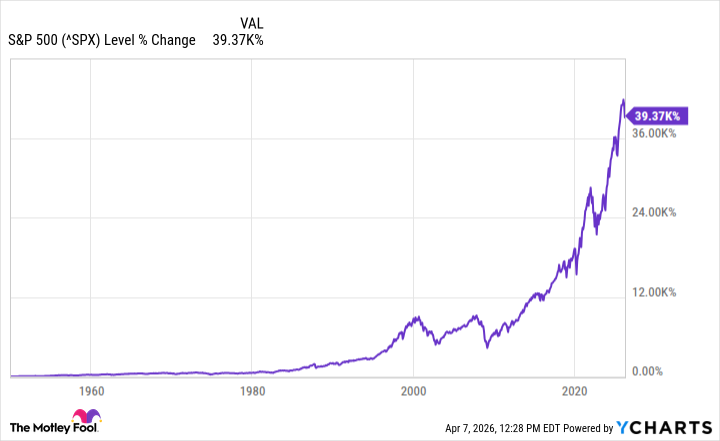
The long-term case for stocks is stronger than the short-term noise. You don’t have to predict what will happen over the next three months or the next three years. If you hold a diversified basket of stocks long enough, you should be fine.
Warren Buffett once said, “The stock market is a device for transferring money from the impatient to the patient.” Patience has paid off during past periods of volatility. It will again.