Over the long term, stocks tend to rise in price. But these long periods of growth are usually interrupted by market corrections, which are temporary drawdowns of over 10%. Let’s discuss some reasons why the Nasdaq Index looks overdue for one of these dips and discuss strategies investors can use to make the most of the situation.
Interest rates and inflation
In late February, the US and Israel commenced military strikes on Iran, a nation responsible for around 4% of the world’s oil supply. The war is having a profound impact on the energy markets, which could have knock-on effects throughout the global economy and financial markets.
For stock market investors, the biggest challenge will be potential stagflation. These are periods of slow growth and rising prices that historically followed other Middle Eastern supply shocks, such as the 1973 OPEC oil embargo and the Iranian Revolution in 1979. Back then, higher energy costs reduced the amount of money consumers were able to spend on other things, which hurt corporate earnings and margins.

Image source: Getty Images.
Interest rates are another big challenge. In April, the Federal Reserve voted to keep the benchmark rate unchanged at 3.5% to 3.75%, citing uncertainty related to the war and Trump’s erratic trade policy. While these rates are not particularly bad from a historical perspective, they are significantly higher than the near-zero rates enjoyed for much of the pre-pandemic period. And many credit-dependent industries, like automotive and real estate, are experiencing lower growth because the higher rates have brought monthly payments to unaffordable levels.
Higher rates also mean growing companies will have a harder time securing the capital they need to expand. Furthermore, investors will generally have less money to put into risk assets, pressuring equity prices. This comes at a time when valuations are already stretched.
The market flashes a warning not seen in over 20 years
There are many ways to value the stock market. But one of the most useful tools is the cyclically adjusted price-to-earnings (CAPE) ratio. This metric is designed to smooth out the influence of the business cycle by averaging real corporate earnings over 10 years. And it gives investors an idea of how cheap or expensive stocks are from a historical perspective.
With a CAPE ratio of almost 40.9, U.S. stocks are trading at highs not seen since the dot-com bubble, when they peaked at 44. Back then, investors were pouring money into speculative internet stocks in a situation that is eerily reminiscent of the current generative artificial intelligence (AI) boom.
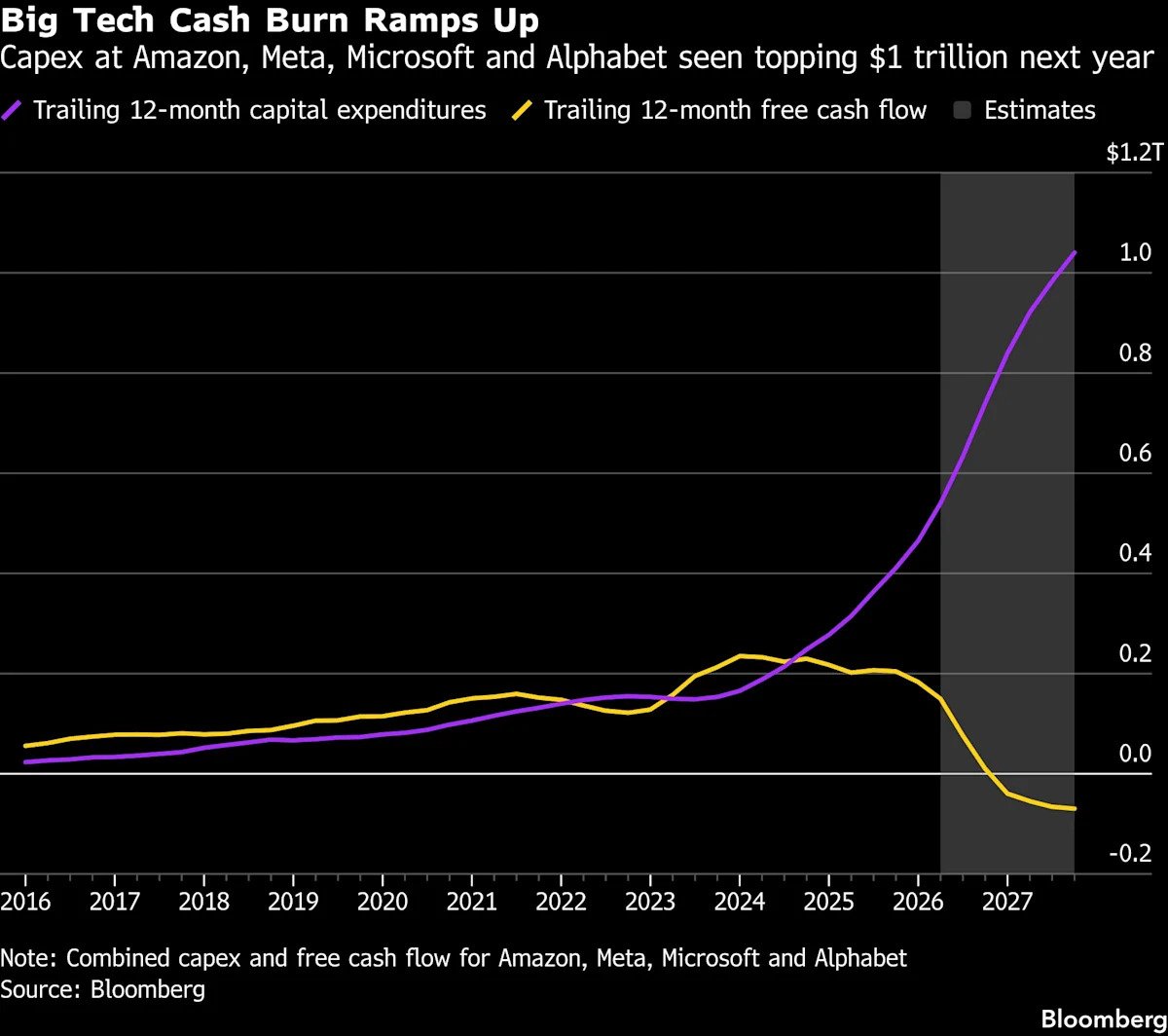
Technologists generally believe that generative AI will eventually become an important — if not transformational — technology megatrend. But from a financial perspective, it is far from a sure bet. The challenge comes from the vast amounts of capital needed to build and run AI data centers, coupled with high competition and unclear monetization strategies for the consumer-facing large language models (LLMs) themselves.
The clearest example comes from the industry leader OpenAI, which is expected to burn through an eye-popping $115 billion (in combined losses and capital expenditures) by 2029. It is far from the only AI company that is struggling. Elon Musk’s privately owned SpaceX is believed to have generated an operating loss of $5 billion because of its recent AI investments. And other AI companies are likely facing similar challenges.
What should investors do?
Corrections are natural and expected in the stock market, and investors shouldn’t look at them as a negative thing. Instead, try to see dips as an opportunity to buy quality stocks at a discount and bet on an eventual rebound. It might be a good idea to keep a pile of cash ready.