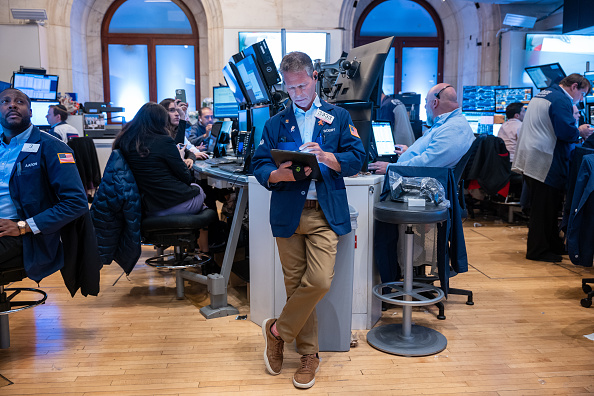
Wall Street on Thursday gave up its morning gains to trade mixed, amid continued uncertainty over the future of monetary policy.
Latest data on the labor market and manufacturing activity underscored the strength in the economy and led to further bets that the Federal Reserve would be in no hurry to cut interest rates.
Investors were also looking ahead to quarterly results from Netflix (NFLX) after the closing bell, with the streaming giant kicking off the earnings season for the megacap technology names.
All three major averages opened higher then steadily ate into their advance. The tech-heavy Nasdaq Composite (COMP:IND) was last down 0.03% to 15,678.53 points in afternoon trade, while the benchmark S&P 500 (SP500) had advanced 0.07% to 5,025.65 points. The blue-chip Dow (DJI) climbed 0.14% to 37,804.90 points.
Of the 11 S&P sectors, seven were in the green.
The S&P (SP500) slumped to a four-day retreat in the previous session, matching its longest losing streak of the year, and extending its April losses to more than 4%. Much of the decline has been due to market participants significantly dialing back their expectations for rate cuts. Moreover, with its recent pullback, the S&P (SP500) is close to oversold levels.
On Thursday, before the opening bell, data showed that the number of Americans filing for initial jobless claims in the past week remained unchanged at 212K, pointing to continued resilience in the labor market. At the same time, the Philadelphia Fed said manufacturing activity in the region expanded at its highest level since April 2022.
Also on the economic calendar, existing home sales dropped slightly less than expected in March. Notably, the U.S. leading indicator index fell 0.3% last month, proving February’s first positive reading in nearly two years to be “ephemeral“. The index has long been seen as a recession bellwether, however its divergence over the last two years or so from an economy that is clearly robust had called that status into question.
“Despite the monthly decline in the LEI (leading economic index), the index is no longer signaling a recession,” Wells Fargo’s Tim Quinlan said. “The index’s increase in February and relatively smaller monthly declines over the past few months helped lift it above the recession threshold for the first time since July 2022, without a recession ensuing.”
“The move corroborates the ISM manufacturing index breaking into expansionary territory for the first time in 16 months in March. While other recession bellwethers like the inverted yield curve are still flashing red, the LEI’s improvement suggests the economy’s underlying strength remains intact even if the pace of expansion is set to moderate in the coming months,” Quinlan added.
Traders also digested comments from New York Fed President John Williams at a summit in Washington, D.C. Williams said that the strong state of the U.S. economy meant that there was no pressing case to lower interest rates right now.
Treasury yields resumed their climb following the economic data and Williams comments, rendering yesterday’s respite from an extended bond sell-off short lived. The longer-end 30-year yield (US30Y) was up 4 basis points to 4.74%, while the 10-year yield (US10Y) was up 6 basis points to 4.65%. The shorter-end more rate-sensitive 2-year yield (US2Y) was up 5 basis points to 5.00%.
See live data on how Treasury yields are doing across the curve at the Seeking Alpha bond page.
The earnings season garnered a chunk of the spotlight on Thursday. Semiconductor stocks lost ground after Taiwan Semiconductor Manufacturing (TSM) – the world’s largest contract chipmaker and a major supplier to Nvidia (NVDA) and Apple (AAPL) – lowered its growth forecast for the 2024 overall semiconductor market.
Blackstone (BX) slipped, despite the world’s largest private equity firm delivering a quarterly Y/Y rise in distributable earnings.
Genuine Parts (GPC) surged and was the top percentage gainer on the S&P 500 (SP500), after the industrial supplier raised its annual profit guidance.