
For most of the past two years, investors have focused on the stock market’s resilience. The S&P 500 kept climbing, artificial intelligence spending exploded, and traders repeatedly bet the Federal Reserve would ride to the rescue with lower interest rates. But while equities grabbed the headlines, the bond market quietly started delivering a much darker message.
Now that message is getting harder to ignore.
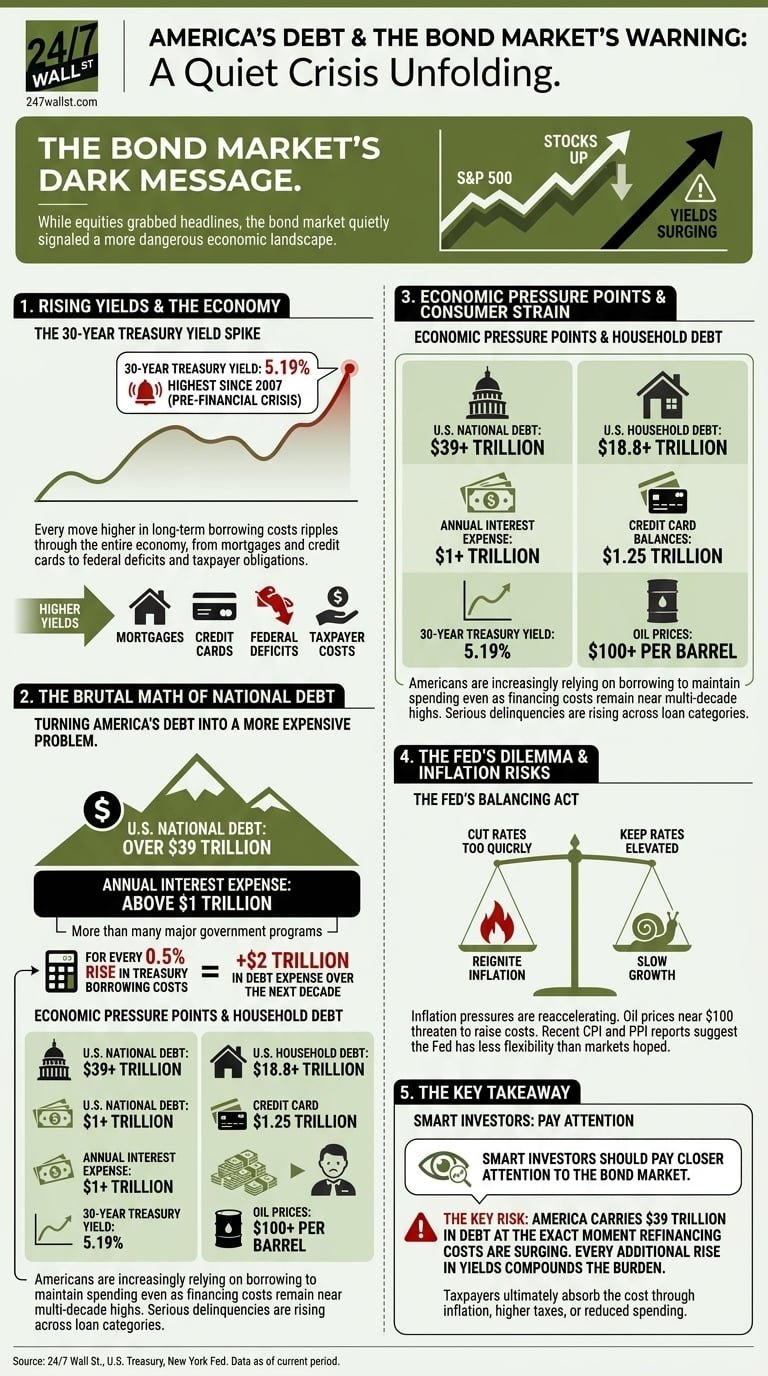
The 30-year Treasury yield recently climbed to 5.19%, according to U.S. Treasury market data — the highest level since 2007, just before the financial crisis reshaped global markets. Why does that matter? Because every move higher in long-term borrowing costs ripples through the entire economy, from mortgages and credit cards to federal deficits and taxpayer obligations.
And the math is brutal.
Rising Yields Are Turning America’s Debt Into a More Expensive Problem
For every half-percentage-point rise in Treasury borrowing costs, the federal government adds roughly $2 trillion in debt expense over the next decade relative to prior budget projections. That’s not theoretical. It’s the direct consequence of refinancing a mountain of existing debt at higher rates.
According to U.S. Treasury data, total national debt now exceeds $39 trillion. Annual interest expense alone has already climbed above $1 trillion. That means Washington is now spending more on interest payments than on many major government programs.
Granted, the U.S. has carried large debt loads before. The difference today is the speed at which borrowing costs are rising while deficits remain elevated.
Consider the backdrop:
| Economic Pressure Point | Current Figure |
| U.S. National Debt | Over $39 trillion |
| Annual Interest Expense | Above $1 trillion |
| 30-Year Treasury Yield | 5.19% |
| U.S. Household Debt | Roughly $18.8 trillion |
| Credit Card Balances | $1.25 trillion |
| Oil Prices | Over $100 per barrel |
Essentially, the federal government is borrowing heavily into a rising-rate environment. That combination rarely ends cheaply.
Consumers Are Feeling the Same Pressure
The government isn’t the only borrower under strain. According to New York Fed household credit data, total U.S. household debt climbed to roughly $18.8 trillion in the first quarter. Credit card balances alone reached $1.25 trillion, while serious delinquencies continued rising across several loan categories.
In short, Americans are increasingly relying on borrowing to maintain spending even as financing costs remain near multi-decade highs.
That creates a dangerous setup for the broader economy because higher Treasury yields don’t stay confined to Washington. Mortgage rates, auto loans, business lending, and credit cards all move higher alongside government borrowing costs.
Surprisingly, many investors expected 2026 to bring aggressive Fed rate cuts. Instead, inflation pressures are starting to reaccelerate.
Oil prices hovering near $100 per barrel threaten to raise transportation, manufacturing, and consumer costs again. Recent CPI and PPI reports showed inflation rising again, suggesting that the Federal Reserve may have less flexibility than markets hoped.
That said, the Fed now faces a difficult balancing act. Cutting rates too quickly could reignite inflation. Keeping rates elevated risks slowing growth while debt costs continue compounding.
The Bond Market Is Warning Investors About Instability Ahead
Bond investors tend to focus less on headlines and more on arithmetic. Right now, the arithmetic is becoming uncomfortable.
The combination of 5.19% long-term Treasury yields, rising inflation pressures, $100 oil, massive federal deficits, and fading hopes for Fed rate cuts creates an environment that looks increasingly unstable. In short, the bond market is signaling concern that America’s debt growth is outpacing its ability to finance it cheaply.
That doesn’t guarantee a crisis tomorrow. The U.S. dollar remains the world’s reserve currency, and Treasury markets are still the deepest in the world. But when all is said and done, taxpayers ultimately absorb the cost of higher borrowing — either through inflation, higher taxes, reduced spending flexibility, or all three.
Key Takeaway
Smart investors should pay closer attention to the bond market than they have over the past year. Stocks can ignore rising debt costs for a while. Bond markets usually don’t.
The key risk isn’t simply that rates are high. It’s that America now carries $39 trillion in debt at the exact moment refinancing costs are surging. Every additional rise in yields compounds the burden.
For taxpayers, that half-point move higher in rates translating into $2 trillion in added debt expense isn’t just a market statistic. It’s a warning about how expensive America’s borrowing habit is becoming.