Melbourne has one of the highest office vacancy rates in the nation.
Here’s what it looked like in January, according to the Property Council of Australia.
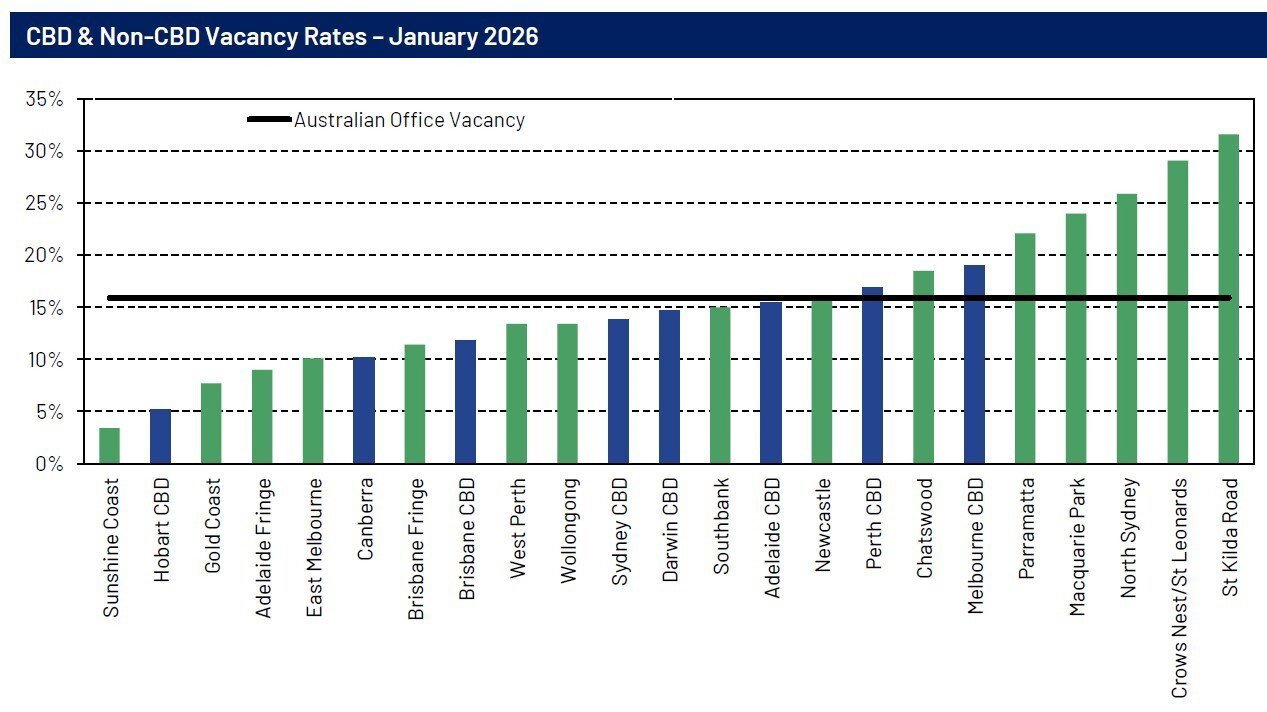
You can see Melbourne’s central business district (CBD) – the blue bar closest to the right – is higher than the average.
Four of the five worst performers for empty offices are non-CBD parts of Sydney, like Parramatta and Crows Nest.
Melbourne’s St Kilda Road is the worst in the nation, but also tangled in with the fact it has just finished five years of construction and disruption that has left it with a shiny new underground train station – which makes it a more enticing option for companies looking for space.
Why am I bringing this up today?
Because the Victorian Chamber of Commerce and Industry (VCCI) is on a tear about the state government’s plan to legislate that workers can work from home.
Victorian workers’ right to work from home at least two days a week will be protected by law, if laws pass.
The WFH conflict is substantial, pitting the government against big business, the Lord Mayor and people who don’t have the opportunity to work remotely.
(There are also some fairly substantial questions about the legality of it given the Commonwealth covers industrial relations).
The Victorian Chamber of Commerce and Industry (VCCI) wants a Legislative Impact Assessment before proceeding with the legislation, that models compliance costs, productivity impacts, workforce implications and effects on small businesses.
It says there are “increasing reports of jobs being sent offshore which is another unintended consequence of this policy push”.
Victorian Chamber of Commerce and Industry acting chief executive Amelia Bitsis warns businesses are already under pressure:
“Fuel costs remain elevated, supply chain disruption continues, operating margins are tightening and confidence remains fragile.
“The overwhelming message from business right now is not that flexibility is failing — it is that businesses need room to manage through increasingly difficult economic conditions.
“The Victorian Government has acknowledged that more than a third of workers, including around 60 per cent of professionals, already regularly work from home. That demonstrates businesses are enabling flexibility where it works operationally, commercially and practically.
“This is not a system that requires legislative intervention and in fact that intervention is sending a negative signal to employing businesses, with increasing reports of jobs being sent offshore.
“No other Premier in Australia is pursuing this approach — and for good reason.
“At a time when Victoria is already facing serious competitiveness challenges, this risks sending exactly the wrong signal to employers and investors.
“The reality is many Victorian businesses are already making flexibility work sensibly and collaboratively. Good employers understand flexibility helps attract and retain talent.
“But flexibility works best when it can be adapted to the operational realities of individual workplaces — not imposed through a rigid, one-size-fits-all legislative framework.”
The Labor Government in Victoria has been in power for 23 of the 27 years since 1999.
Polling this far out from an election is not always particularly insightful, but it is fair to say the government is being substantially challenged by the Liberal opposition – who themselves are being challenged by One Nation.
With a substantial proportion of workers already working from home regularly, as VCCI acknowledges, will the competing parties loudly profess they’re against the legislation?
Even though it doesn’t mean they’re against the WFH concept itself.
This confusion didn’t work out very well for the Peter Dutton-led Liberal Party campaign in 2025.
One to watch.