Justina Lee, Vivien Ngo, Elena Popina and Matthew Griffin
6 min read
(Bloomberg) — President Donald Trump’s latest financial disclosure has drawn scrutiny for its astonishing scale: 3,711 trades, almost entirely in shares of companies across America, including many whose fortunes can turn on federal policy.
Most Read from Bloomberg
-
Trump to Force Foreigners Seeking Green Cards to Go Home First
-
Attack on UAE Nuclear Plant From Iraq ‘Warning Shot’ by Iran
-
Messi Joins Ronaldo in Billionaire Football Ranks After US Deals
Collectively, they constitute an unprecedented burst of stock-market activity by a sitting president that has fueled fascination among the day-trading masses and prompted detractors to warn of insider-dealing.
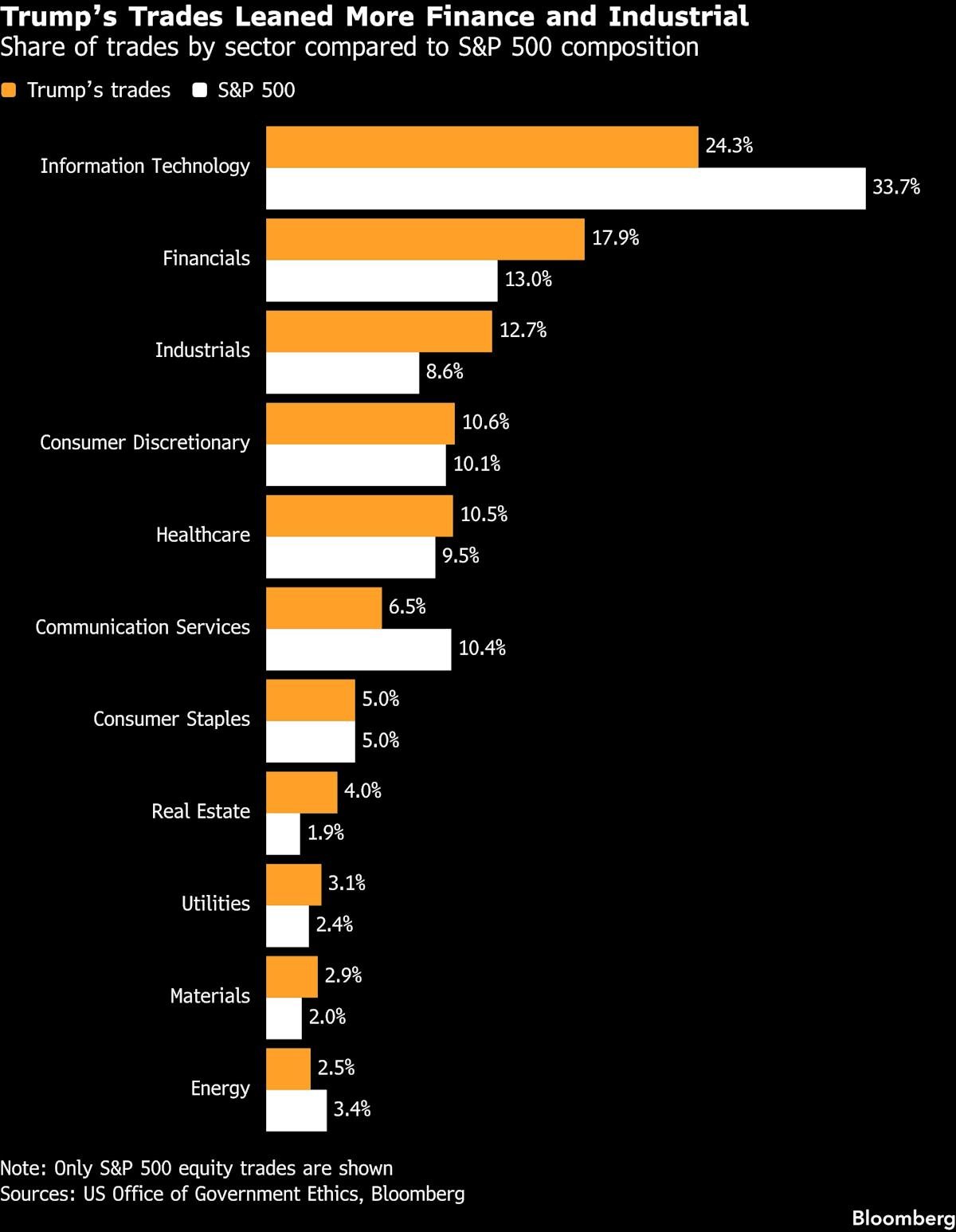
But a review of the transactions, combined with interviews with investment experts, reveals trading so multifaceted it doesn’t easily lend itself to definitive interpretation. The patterns bear the hallmarks of overlapping portfolio-management strategies, often index-based and much of it likely automated, and all of it difficult to disentangle.
To a large extent, that conforms with the Trump Organization’s public explanation of the matter. It says the president’s holdings are independently managed by third-party financial institutions that control all investment decisions, including asset allocation, trading, rebalancing, and portfolio management. Trades are executed through “automated, model-based portfolios and direct indexing strategies” with no input from Trump, his family or company. On Tuesday, Vice President JD Vance said the notion the president was trading from the Oval Office was “absurd.”
Contacted for comment, White House officials referred Bloomberg News back to the Trump Organization.
“That is an inherent problem with the president owning stocks and individual companies: that people are going to assume that he’s going to make investments that he knows are going to be profitable and he is able to influence,” said Kedric Payne, general counsel at the Campaign Legal Center, which has backed legislation that would ban stock trading by members of Congress. “There should be no appearance that the president is using his position to benefit himself financially.”
Trump critics were quick to link specific transactions to public actions and statement by the president. Elizabeth Warren, a Democratic senator from Massachusetts, decried “trades on companies that the Trump administration influenced with its own policies,” citing the purchase of $1 million of Nvidia Corp. stock before the sale of advanced chips to China was approved. “What Trump is doing should be illegal,” she said in a video on her website.