1 / 5
Copyright 2026 The Associated Press. All rights reserved
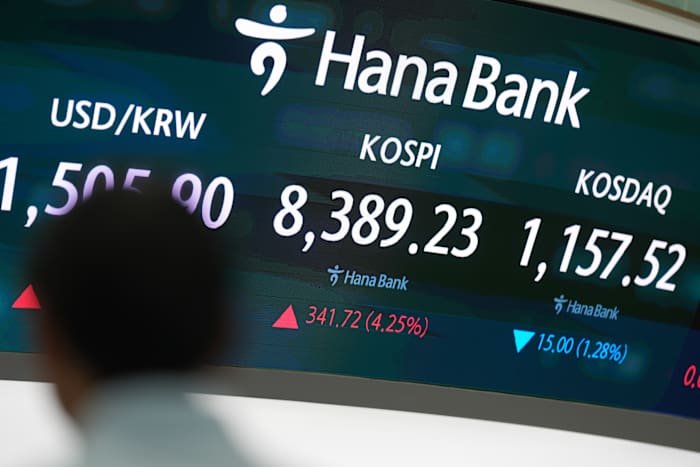
A dealer stands near the screens showing the Korea Composite Stock Price Index (KOSPI), the foreign exchange rate between U.S. dollar and South Korean won and the Korean Securities Dealers Automated Quotations (KOSDAQ) at a dealing room of Hana Bank in Seoul, South Korea, Wednesday, May 27, 2026. (AP Photo/Lee Jin-man)
Asian shares were mostly higher on Wednesday and oil prices fell after the U.S. stock market rose to more records.
South Korea’s Kospi jumped more than 2% and Taiwan’s benchmark also surged as the boom in artificial intelligence drove heavy buying of computer chipmakers and other technology companies.
In Tokyo, the Nikkei 225 also initially was lifted by gains for tech-related shares but closed nearly unchanged at 64,999.41. It topped 66,000 earlier in the day.
Computer chip equipment maker Tokyo Electron’s shares rose 2.1% and testing equipment maker Advantest gained 4.1%.
The latest rally in tech shares followed a 19.3% advance for Micron Technology, which was the strongest force lifting the S&P 500 on Tuesday after analysts at UBS led by Timothy Arcuri raised their 12-month price target for the stock to $1,625 from $535. Micron closed at $895.88.
The analysts are forecasting continued strength in demand for computer memory. Micron’s stock has more than tripled so far this year and it has become the latest Big Tech company to top an overall value of $1 trillion, joining Nvidia, Apple and Microsoft, which have each blown past $3 trillion.
The rush to invest in AI has been pushing share prices in South Korea and Taiwan to records this year.
The Kospi in Seoul gained 2.3% to 8,228.70, as Samsung Electronics’ shares gained 2.3%.
In Taiwan, the Taiex surged 1.7%.
Elsewhere in Asia, Hong Kong’s Hang Seng lost 1% to 25,350.20 and the Shanghai Composite index shed 1% to 4,104.34.
Australia’s S&P/ASX 200 picked up 0.7% to 8,717.70 and in India the Sensex was up 0.1%.
On Tuesday, U.S. stocks rose to records as the S&P 500 climbed 0.6% to 7,519.12 after trading resumed following Monday’s Memorial Day holiday. The Nasdaq composite rallied 1.2% to set its own record of 26,656.18, while the Dow Jones Industrial Average dipped 0.2% to 50,461.68.
U.S. stocks were catching up with climbs for others around the world the day before, when President Donald Trump said negotiations with Iran on ending the war were “proceeding nicely.”
“It looks like geopolitical tensions are no longer bothering investors as much as they did in previous weeks. Iran’s explicit dissatisfaction regarding the progress in talks over its nuclear program — or even US strikes — didn’t reverse hopes that the war will end soon,” Ipek Ozkardeskaya of Swissquote said in a commentary.
But the situation remains unclear as fighting has continued in the region. Markets have rallied in the past on hopes for a swift end to the war only to see the conflict drag on.
Oil prices have been at the center of financial markets’ action since the United States and Israel attacked Iran in late February. The ensuing war has closed the Strait of Hormuz and kept oil tankers pent up in the Persian Gulf instead of delivering crude to customers worldwide. That in turn has driven up oil’s price and sent a wave of painful inflation around the world.
Hopes for a deal to improve the flow of oil helped lift stocks of companies with big fuel bills. United Airlines rose 6%, and Norwegian Cruise Line Holdings steamed 4.9% higher.
Still, U.S. households have been feeling discouraged about the economy because of accelerating inflation, and a report on Tuesday said consumer confidence edged downward in May, though the number was not as bad as economists expected. It followed a report on Friday that said sentiment among U.S. consumers hit its lowest level on record.
Early Wednesday, the price for a barrel of Brent crude, the international standard, fell $1.68 to $94.99 a barrel. The price for a barrel of U.S crude oil fell $2 to $91.89.
Lower oil prices helped pull yields down in the U.S. bond market, which eased the pressure on Wall Street. The yield on the 10-year Treasury fell to 4.48% from 4.56% late Friday.
The U.S. dollar rose to 159.34 Japanese yen from 159.30 yen. The euro rose to $1.1644 from $1.1631.
Copyright 2026 The Associated Press. All rights reserved. This material may not be published, broadcast, rewritten or redistributed without permission.