The Australian share market has fallen below the 8,600 level, while oil prices have bounced back above $97 a barrel.
Meanwhile, the federal government has proposed tougher scam laws targeting tech giants.
Follow the day’s financial news and insights from our specialist business reporters on our live blog.
Disclaimer: this blog is not intended as investment advice.
Thu 28 May 2026 at 2:20pm
Market snapshot
- ASX 200: -1.7% to 8,569 points
- Australian dollar: -0.5% to 71.03 US cents
- Wall Street: Dow Jones (+0.4%), S&P 500 (flat), Nasdaq (-0.1%)
- Asia: Nikkei (-1.3%), Hang Seng (-2.3%), KOSPI (-4.4%)
- Europe: FTSE (+0.1%)
- Spot gold: -1.9% to $US4,371/ounce
- Oil: +3.7% at $US97.75/barrel
- Iron ore: -0.1% at $US108.80/tonne
- Bitcoin: -3% to $US72,923
Prices current at around 2:20pm AEST
Live updates on the major ASX indices:
Thu 28 May 2026 at 3:18pm
Transport costs drives fall in household spending, new ABS data says
Household spending fell 1.1% in April 2026, according to seasonally adjusted figures released today by the Australian Bureau of Statistics (ABS).
This follows a 1.6% rise in March and a 0.3% rise in February.
Tom Lay, ABS head of business statistics, said the 4.7% drop in transport costs was the main driver for the 1.1% fall in household spending in April.
“Annual household spending was up 4.9% compared to April 2025, slowing from the 6.2% annual rise in March.”
The fall in transport spending reflected widespread impacts and responses to the conflict in the Middle East.
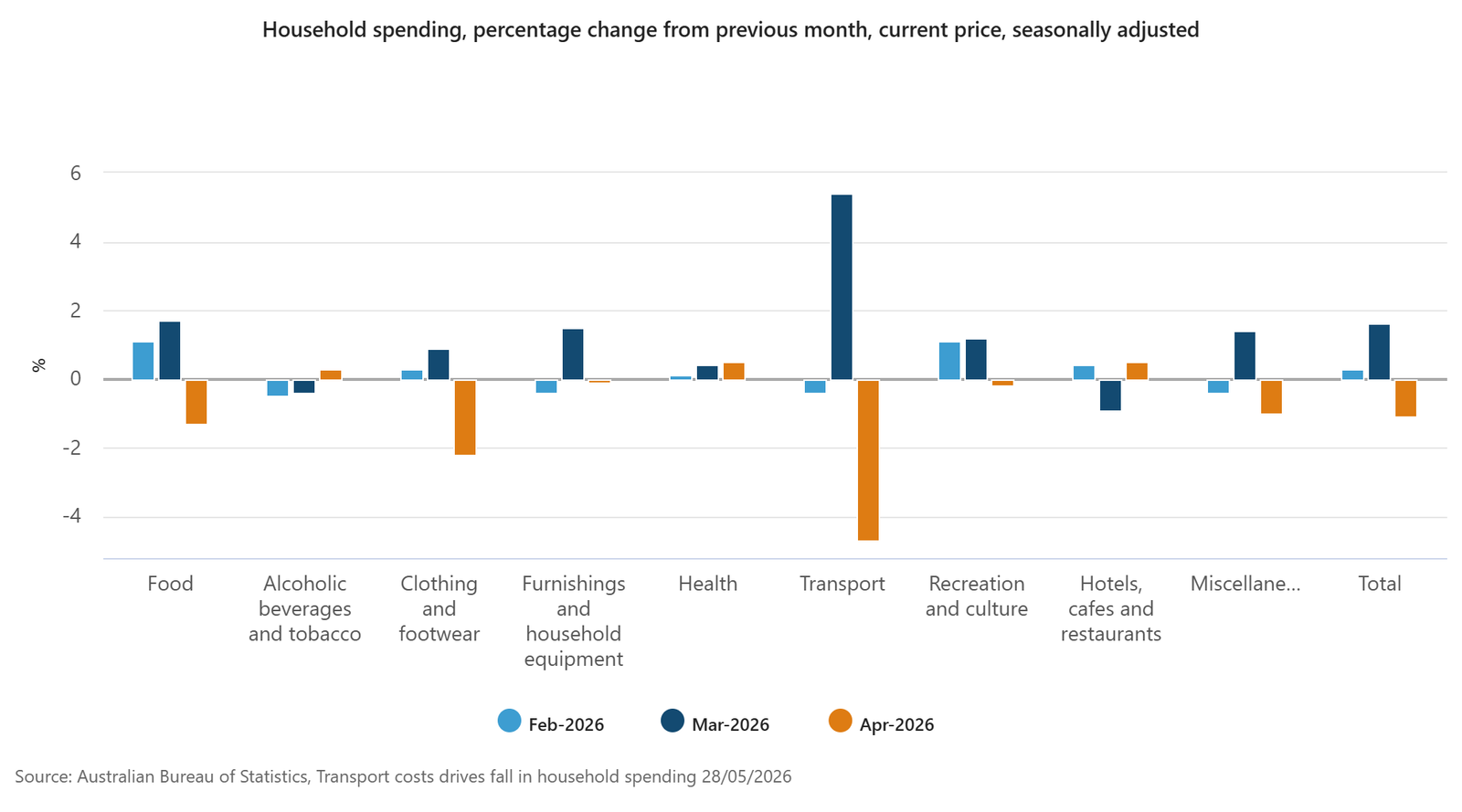
Air transport was the largest contributor to the decline, as households scaled back travel in response to broader uncertainties and higher airfares.
Higher jet fuel costs also added to the fall in transport spending, as airlines cancelled routes during the month to keep services viable. The resulting refunds are recorded as a reduction in air transport, according to the ABS figure.
Fuel spending remained elevated compared to before the Middle East conflict but eased in comparison to March. This was supported by the Federal Government halving the fuel excise duty in response to rising fuel prices, which took place from 1 April.
Experimental data from the ABS suggest that fuel spending increased by 2.0% in April, following a 1.5% fall in March.
“The fuel excise discount provided some immediate relief to household budgets. We also saw spending on public transport ease in states offering free travel, particularly Victoria and Tasmania,”Mr Lay said.
A rise in new vehicle sales provided a partial offset to the broader transport decline, ABS says.
Electric vehicle (EV) sales, which have been trending higher over the last year, increased significantly in April as EVs accounted for a growing share of overall new vehicles sales.
This points to a shift in consumer behaviour as households adjust for rising fuel prices.
“Food spending also fell by 1.3%, reflecting a return to normal levels after the higher purchases we saw in March,” Mr Lay said.
“The shift towards generic brands and cheaper products in supermarkets continued into April, reflecting ongoing price consciousness among households.”
Thu 28 May 2026 at 3:07pm
Preventing scam losses in the first place is essential: ABA
The Australian Banking Association (ABA) has said the most important policy objective of the proposed scam laws is to prevent scam losses in the first place.
As we reported earlier, the federal government released codes for key sectors, including banks, telcos, and digital platforms, setting out what they will have to do by March 31 next year.
ABA CEO Simon Birmingham said Australia’s world-leading ecosystem approach was critical as “scams are a global scourge that no government nor any single industry can solve alone”.
“Stopping consumers from being exposed to scams is the best way to drive down losses and make it harder for scammers to operate in Australia,” he said.
“Banks particularly welcome obligations that close gaps in scam prevention, such as the other sectors being required to identify who their customers are, as banks are already expected to do.
“Such basic obligations could have a profound impact on ending tragic losses such as those that begin with scam investment advertisements on social media platforms.”
Mr Birmingham added that around 90% of scam losses came from individuals losing more than $5,000, and it was critical that the scam laws focused on stopping these life-changing, high-value losses.
Thu 28 May 2026 at 2:58pm
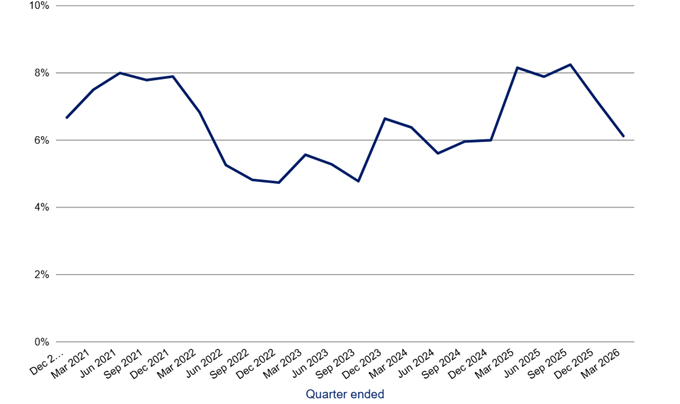
Super returns are taking a hit
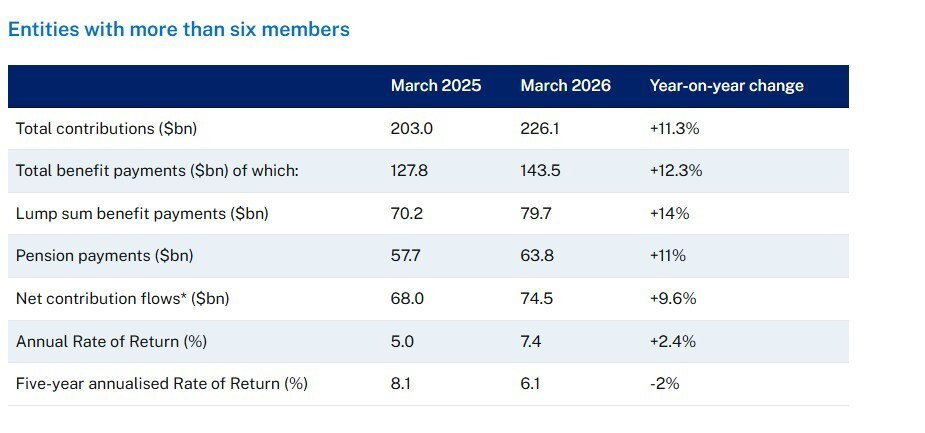
Another interesting graph from APRA on the superannuation savings pool.
Look at this chart, it shows a big dive in annualised rates of return:
Thu 28 May 2026 at 2:45pm
Super savings pool at $4.4 trillion
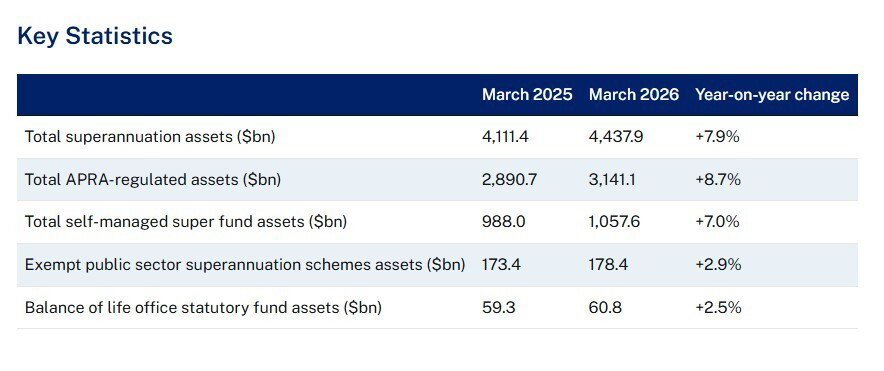
Australia’s superannuation pool has grown massively and is now standing at $4.4 trillion, according to the latest statistics from the prudential regulator APRA.
Total superannuation assets decreased slightly by 1 per cent over the quarter to $4.4 trillion as at March 2026, of which $3.1 trillion was in APRA-regulated funds.
But Australia still remains on track to become the world’s second-largest retirement savings pool by 2031.
Total contributions increased by 11.3 per cent to $226.1 billion in the year ending in March 2026.
Employer contributions increased by 8.4 per cent over the year to $159.8 billion.
Member contributions increased by 19.1 per cent over the year to $66.3 billion.
Benefit payments increased by 12.3 per cent to $143.5 billion in the year ending in March 2026.
This increase was the result of lump sum payments rising by 13.6 per cent to $79.7 billion and pension payments increasing by 10.7 per cent to $63.8 billion.
Thu 28 May 2026 at 2:31pm
Australian market extends loss while oil rebounds
The ASX 200 has extended its loss, falling 1.7% to 8,564 points.
Over the last five days, the index has lost 0.7% and 1.7% year to date.
Meanwhile, the price of oil has rebounded to $US97.75 per barrel, up 3.7%.
Thu 28 May 2026 at 2:22pm
There’s a missing piece in RBA housing investment report: expert
Laurence Troy, an associate professor at the University of Sydney, has described the RBA’s latest report on housing investment as “good data”, adding that it has long been a challenge to obtain “this type of granular information”.
“However, it most reveals what I think we all understood anyway,” he said, “The skew towards older ages underlies the generational challenges being much discussed at the moment.
“It also reflects what seems to be a wider concentration of ownership. Younger generations are increasingly locked out and only those with property wealth are able to accumulate more.
“The mortgage stats also points to this. Owning property and leveraging this becomes the way to get deposits to further invest.”
Professor Troy adds that the missing piece in this report is about market and geographic concentrations.
“New build apartment residential is almost entirely dominated by these buyers, and then in some parts of the city, you also find relative differences in activity.
“There is possibly also an element of where investors live themselves and the extent to which their primary house asset has risen in value over the past decades.
“This spatial lottery would have impacted how much could be extracted through leverage to go out in invest in further property.
“It is another dimension to the inequalities being experienced.”
We have reported earlier that a new Reserve Bank research shows the share of housing investors aged over 60 has surged in Australia over the past 20 years, while the share of younger investors has retreated.
Thu 28 May 2026 at 2:08pm
ASX falls sharply as bank, gold producers retreat — Anlaysis
The ASX 200 is down sharply as the banking sector falls 1%.
The spot price of gold too is off 2%.
The broad thematic is that unresolved geo-political tensions in the Middle East are reintroducing the threat of a global inflation spike.
In addition, changes to the capital gains tax and heightened talk of it today — as it commences its journey through the federal parliament — is seeing money leave the banks.
“On the whole it’s still early days in terms of the assessment of how these tax changes are likely to shape investment markets, outlooks and overall bank strategies on lending and housing flows,” UBS said in a note.
“High level, the headlines … suggest the relative ‘winners’ are likely to be banks with stronger business and institutional banking franchises (NAB and ANZ) and less reliance on investor mortgage beta (CBA and Westpac).
“There are a number of unknown factors which might have an impact on bank share price performance too, such as investors flows, appetite for higher dividend yield stocks and asset allocation/rebalancing.”
At its core, the stock market is pricing in negative earnings revisions to mining and banking stocks today.
In terms of the miners, it’s negative revisions to gold producers as the precious metal remains in a bear market.
Thu 28 May 2026 at 2:00pm
Tax changes about ‘changing the distribution of ownership’
Treasury secretary Jenny Wilkinson points towards the budget papers when asked about the effect of tax changes on housing.
She says the primary effect of the tax changes will be “changing the distribution of ownership” away from investors towards owner-occupiers rather than necessarily making housing cheaper and more affordable.
She says the measures to try and increase housing supply are more critical to improving affordability.
And that’s where the Q&A session ends.
Thu 28 May 2026 at 1:53pm
Treasury secretary says fiscal policy not well suited to economic management
Treasury secretary Jenny Wilkinson says she speaks regularly with Reserve Bank governor Michele Bullock.
That’s hardly surprising given that Wilkinson, by virtue of her role, is a member of the RBA’s monetary policy board.
She says it’s important that fiscal policy doesn’t work against monetary policy, but sees a limited role for the Treasury to assist the RBA in managing inflation.
“Fiscal policy is not particularly well suited to managing the (business) cycle,” she argues.
There are lots of elements of fiscal policy where you can’t ramp up or down quickly, she cites as one reason why.
However, she does acknowledge the role of automatic stabilisers, such as an increase in unemployment payments and reduction in the income tax take during downturns, to balance the economy.
She also says there is room for fiscal policy to support economies with stimulus during major shocks such as the global financial crisis and COVID pandemic.
There has been increasing discussion about the general reliance on central banks to manage inflation through interest rates.
Thu 28 May 2026 at 1:50pm
Housing investors are increasingly older and wealthier, RBA research shows
The share of housing investors aged over 60 has surged in Australia over the past 20 years, while the share of younger investors has retreated, new Reserve Bank research shows.
Housing investment has also become more skewed towards higher-income households, and the share of multiple property owners has increased, it shows.
Read more on the reporting of my colleague Gareth Hutchens.
Thu 28 May 2026 at 1:42pm
Treasury secretary doing a ‘fireside chat’ with ABE chair Besa Deda
Treasury secretary Jenny Wilkinson has wrapped up her speech and is now doing a “fireside chat” with Australian Business Economists chair Besa Deda.
It doesn’t look like she will take questions from the floor, including the media table I’m seated at.
Thu 28 May 2026 at 1:40pm
No clear evidence for capital gains tax discounts above inflation, says Treasury boss
Federal Treasury secretary Jenny Wilkinson says these are the most significant tax reforms in at least a quarter of a century.
She has pushed back on business arguments that the changes to capital gains tax will discourage investment.
She argues there is not clear evidence from the economic research to support the concessional treatment of capital gains other than to compensate for inflation, which is what the government’s proposal plans to do.
Wilkinson has also pushed back on business calls for the capital gains tax changes to be limited to housing.
She says wide application of capital gains changes with few carve-outs is necessary to avoid bringing fresh distortions into the tax system.
Thu 28 May 2026 at 1:33pm
High earners benefit most from investment tax breaks
Treasury secretary Jenny Wilkinson says it is imperative to reform the way capital gains are taxed and to limit negative gearing.
She says it doesn’t make sense to look at the effect of taxes on capital over a single year.
So Treasury has used new, more detailed data to analyse the effect of taxes over the lifetime of a taxpayer, rather than in a single year.
That research shows that, since 2000, the average person in the top 1% of income earners has benefited to the tune of $700,000 over their working lives from the existing investment tax arrangements, versus just $5,700 for median income earners.
“Capital income can be more easily shifted to minimise tax outcomes,” she says.
“Individuals can also move capital income across time,” she adds.
“Investors systematically moved the realisation of capital gains to years in which their income was lower.”
She says that, had the budget proposals been in place since the year 2000, the top 1% of income earners would have only received a $300,000 benefit, not $700,000.
She adds that young people and average income earners would have been better off.
“The goal is neutrality,” she argues, explaining that decisions should be based on investment returns, not tax treatment.
Wilkinson says the budget changes have been the result of many years of work by tax experts, think tanks and the parliament.
Thu 28 May 2026 at 1:23pm
NDIS blow-out had to be controlled, says Treasury secretary
Treasury secretary Jenny Wilkinson says changes to slow the growth of NDIS costs were essential for the long-term survival of the scheme.
She warned that the NDIS is expected to cost 1.7% of GDP by 2034/35, but without these changes that would have blown out to more than $100 billion a year by 2034/35, or 2.2% of GDP.
Wilkinson says there will be a focus on supporting people with a serious and permanent disability and improved administration.
“It’s hard to get major reform done, but it’s important that we do so.”
Thu 28 May 2026 at 1:17pm
NDIS doing ‘heavy lifting’ of budget improvement
Federal Treasury secretary Jenny Wilkinson has acknowledged that cuts to the National Disability Insurance Scheme (NDIS) are the major contributor to budget repair.
She says reforms to the NDIS are doing the “heavy lifting” of keeping growth in federal government spending in check.
Thu 28 May 2026 at 1:15pm
Australia a relatively low debt country
Jenny Wilkinson points out that Australia has one of the lowest government debts of the major advanced economies.
She said Australia’s debt-to-GDP ratio is 50 percentage points below the UK and 75 percentage point below the US.
However, she says long-term budget sustainability will likely include action on both the spending and revenue sides.
Thu 28 May 2026 at 1:12pm
Australia ‘well placed’ to cope with energy price shock
Jenny Wilkinson, the federal Treasury secretary, says her department estimates that the energy price shock from the Middle East conflict will add around 1 percentage point to headline inflation, which was already on the rise over the second half of 2025.
However, she added that, “Australia is as well placed as any global advanced economy” to cope with the shock.
“The risks to the outlook largely depend on the duration and severity of the conflict.”
Treasury modelled a scenario at which oil prices peak at $US200 later this year if the conflict worsens and the strait remains closed.
For reference the Brent crude price this morning was $US95 a barrel.
Thu 28 May 2026 at 1:05pm
Australian market falls below 8,650 points
The Australian market is trading lower, offsetting the gains over the last five days.
The ASX 200 dropped 1% to 8,632 points, falling below the 8,650 point level.
The broader All Ordinaries Index also slipped 1% to 8,857.
Financials was the biggest laggard in the market, down 1.5%, followed by Technology, down 1.4% and Materials, down 1.2%
On the bright side, Consumer Cyclicals rose 0.3%, being the best-performing, followed by Academic & Educational Services and Industrials, both up 0.2%
Thu 28 May 2026 at 1:04pm
Wilkinson starts speaking
The federal Treasury secretary Jenny Wilkinson has started her speech, flagging that she’ll touch on the effects of the Middle East conflict and also the need for reform to ensure longer-term budget sustainability.