Updated 1 min read
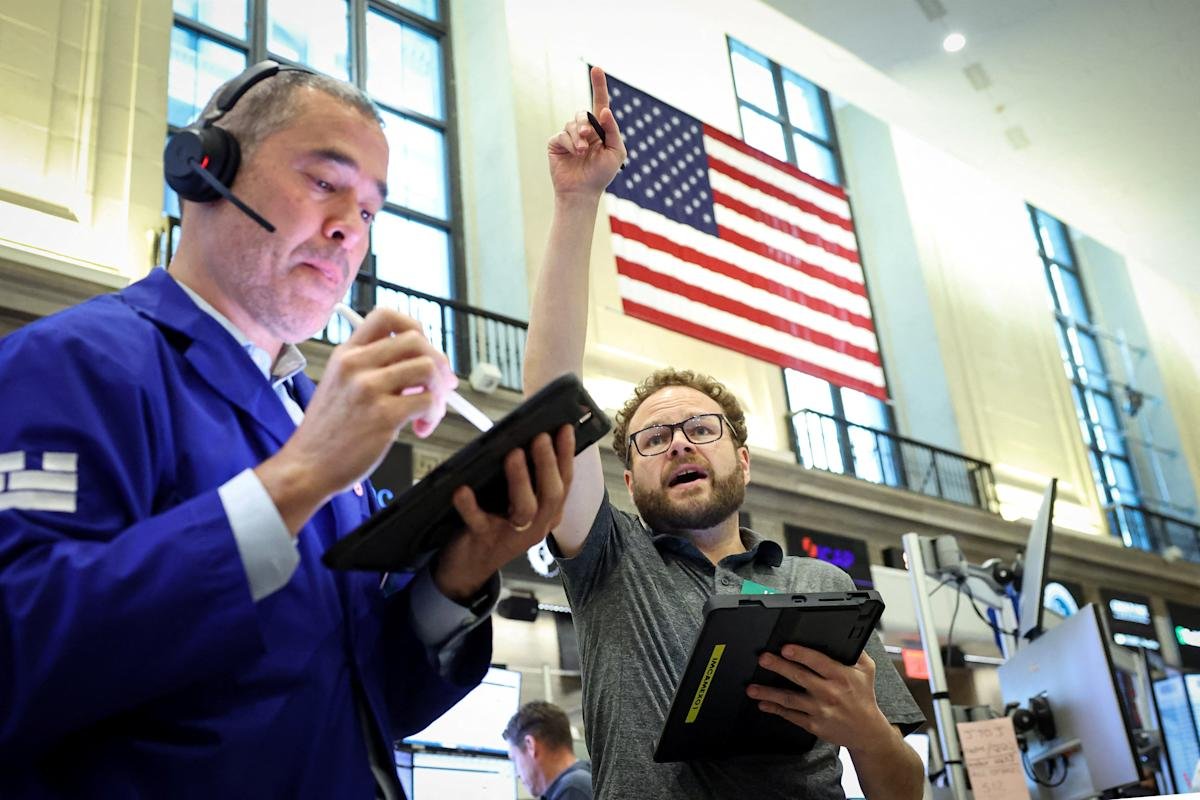
US stocks edged lower on Wednesday as Wall Street weighed the promise of the AI trade against fragile US-Iran negotiations.
The Dow Jones Industrial Average (^DJI) fell 0.8%, while the benchmark S&P 500 (^GSPC) slipped by about 0.5%. The tech-heavy Nasdaq Composite (^IXIC) declined by 0.6% after stocks hit record highs on Tuesday amid AI fervor.
Wall Street continued to eye the US talks with Iran that have no clear end in sight. Earlier this week, as doubts were circulating that US-Iran negotiations were on ice, President Trump took to social media to reassure that they were continuing “at a rapid pace.” Now, however, Israel’s military campaign against Hezbollah in Lebanon has become a new hurdle to reaching a lasting deal to end the war and open the Strait of Hormuz.
The growing strains on the ceasefire sent oil prices upward on Wednesday, especially after reports of Iranian strikes against Kuwait and Bahrain and US strikes on Iran’s Qeshm Island. US WTI crude (CL=F) traded above $95 a barrel, and Brent crude (BZ=F) was hovering around $97 at the opening bell.
On Wednesday, earnings season continues to wrap up, with Broadcom (AVGO) and CrowdStrike Holdings (CRWD) set to report their results.
Data released by the payrolls provider ADP showed that the US added 122,000 private sector jobs in May, in another bullish sign ahead of Friday’s marquee nonfarm payrolls report.
LIVE 7 updates
-
Macy’s reports best sales growth in 4 years as CEO says ‘not all customers are equal’
Yahoo Finance’s Brooke DiPalma reports:
Macy’s (M) reported its best growth in four years in the first quarter and raised its 2026 outlook despite pressure on US consumers. The company benefited from its higher-income shoppers as economists point to a K-shaped economy that continues to divide US consumers.
Macy’s CEO Tony Spring told Yahoo Finance that the department store struck a balance in its portfolio between affluent Bloomingdale’s customers and middle-income Macy’s customers. The Macy’s customer tends to earn over $75,000 a year, while a majority of Bloomingdale’s customers earn over $100,000.
“Whether you like the K- or the E- [shaped economy], we still live within that economic environment where not all customers are equal,” Spring said. “Our teams are just really focused on making sure that we get our fair share of the business by executing on the categories that are most important, that are trending well, by making sure that we’re flowing a level of newness to both our physical and digital businesses.”
Macy’s overall same-store sales grew 3% in the first quarter. Bloomingdale’s was the standout with 10.2% same-store growth, while Macy’s posted its fourth consecutive quarter of same-store sales growth, up 1.6%.

-
Meta begins selling businesses access to AI agent
Meta (META) will soon begin selling access to an AI agent in a new monetization path for the tech giant increasingly pushing into AI.
As of Wednesday, companies will now be charged for access to the “Meta Business Agent,” Bloomberg reported, citing a company spokesperson. The agent’s primary role focuses on communication with a business’s customers on Meta’s communications platforms WhatsApp, Messenger, and Instagram.
Meta shares rose 3% on the news.
In the future, the agent will be able to complete tasks such as managing users’ calendars and putting together market research, Bloomberg reported.
Smaller businesses will have to pay for a subscription to use the agent, while larger businesses will pay Meta for the token costs powering the service.
A similar service has been offered before, but it was free of charge, Bloomberg reported.
-
US stocks open in the red on Wednesday
US stocks fell on Wednesday as investors digested new action in the Middle East, weighed against continued strength in the AI trade.
The Dow Jones Industrial Average (^DJI) fell 0.4%, while the benchmark S&P 500 (^GSPC) and tech-heavy Nasdaq Composite (^IXIC) both lost 0.3%.
Stocks fell as oil prices moved up on Wednesday after reports that Iran had struck major infrastructure in Bahrain and Kuwait, while the US struck targets inside Iran. International Brent (BZ=F) ticked up 1.3%, while US WTI crude (CL=F) rose a slightly stronger 1.4%.
On the economic data front, numbers from payrolls provider ADP reported that the US added 122,000 private sector jobs in May.
-
US private employers add 122,000 jobs in May, outperforming expectations
US private employers added 122,000 jobs in May, payroll processor ADP said Wednesday, exceeding expectations and growing over April’s gain.
Economists surveyed by Bloomberg had expected an increase of 120,000 roles after April’s revised count of 105,000 positions added. The report, one of several major labor market datasets due this week, is likely to support the sentiment that the labor market is stabilizing and moving in a positive direction.
The education and health services sector, and the trade, transportation, and utilities sector saw the largest gains, adding 57,000 positions and 36,000 positions, respectively. Out of the industries ADP tracks, only information, natural resources, and mining lost jobs.
“Hiring was more broad-based in May than we’ve seen in the last few years,” ADP chief economist Nela Richardson said in a statement. “The labor market continues to show sustained momentum going into the summer hiring season.
-
Marvell stock gains another 12%, extending wild year-to-date rally
Marvell (MRVL) stock is trying to make Nvidia CEO Jensen Huang’s words a reality.
On Tuesday, Huang and Marvell CEO Matt Murphy were on stage together at the Computex annual chip conference in Taiwan, where Huang called Marvell “the next trillion-dollar company.”
Shares of the custom chipmaker soared 32% on Tuesday on the comment, highlighting Huang’s influence in a market chasing the artificial intelligence boom. In March, Nvidia invested $2 billion in Marvell — another strong endorsement by the AI kingmaker.
The run isn’t over. On Wednesday, Marvell stock added another 12% in premarket trading.
While Marvell’s market cap of $254 billion remains a long way from $1 trillion, it’s grown significantly from a roughly $76 billion market cap in January. The stock is up 242% year to date.
-
SpaceX aiming for $135 a share in $75 billion IPO
Bloomberg reports:
SpaceX aims to sell 555.6 million shares at $135 apiece for its record-breaking $75 billion initial public offering, Reuters reported, citing an unidentified person familiar with the matter.
The report indicates SpaceX is breaking from the traditional IPO process, whereby companies typically announce a price range before marketing the shares during investor roadshows, and set the price before trading begins. SpaceX didn’t immediately respond to a request for comment.
SpaceX’s Starship rocket lifts off during a test flight from Starbase, Texas, Friday, May 22, 2026. (AP Photo/Eric Gay) · AP Photo/Eric Gay AI rivals OpenAI and Anthropic PBC look to forge ahead with listings of their own, while Alphabet Inc. (GOOG) — which has its own large language models and AI infrastructure businesses — revealed plans for a record $80 billion equity offering on Monday.
The SpaceX deal would be the largest IPO on record, more than doubling the $29.4 billion raised by Saudi Aramco in 2019.
-
Oil holds gains as Israeli attacks on Lebanon upset US-Iran peace talks
Bloomberg reports:
Oil rose a third day, as contradictory headlines on the prospects of a US-Iran peace deal boosted price swings.
West Texas Intermediate (CL=F) climbed above $95 a barrel, after adding more than 7% in the prior two sessions, while Brent (BZ=F) closed at $96 on Tuesday. President Donald Trump said he’s still optimistic the US can reach an interim peace deal soon — disputing reports in Iranian state media that talks with Washington had been suspended over the fighting in Lebanon — adding that the two sides have been “continuously” having conversations.
Trump wants Iran to put specific nuclear concessions in writing as part of a preliminary agreement to end the war, ABC News reported, citing people familiar with the matter. Tehran had earlier given verbal assurances that it would agree to certain terms related to their nuclear program, according to the report.
Another key sticking point in the peace talks is Israel’s determination to continue military strikes against Hezbollah that could derail US objectives. Tehran insisted that Lebanon must be part of any peace agreement amid days of deepening Israeli military escalation in the country and a threat to bomb Beirut, the capital.