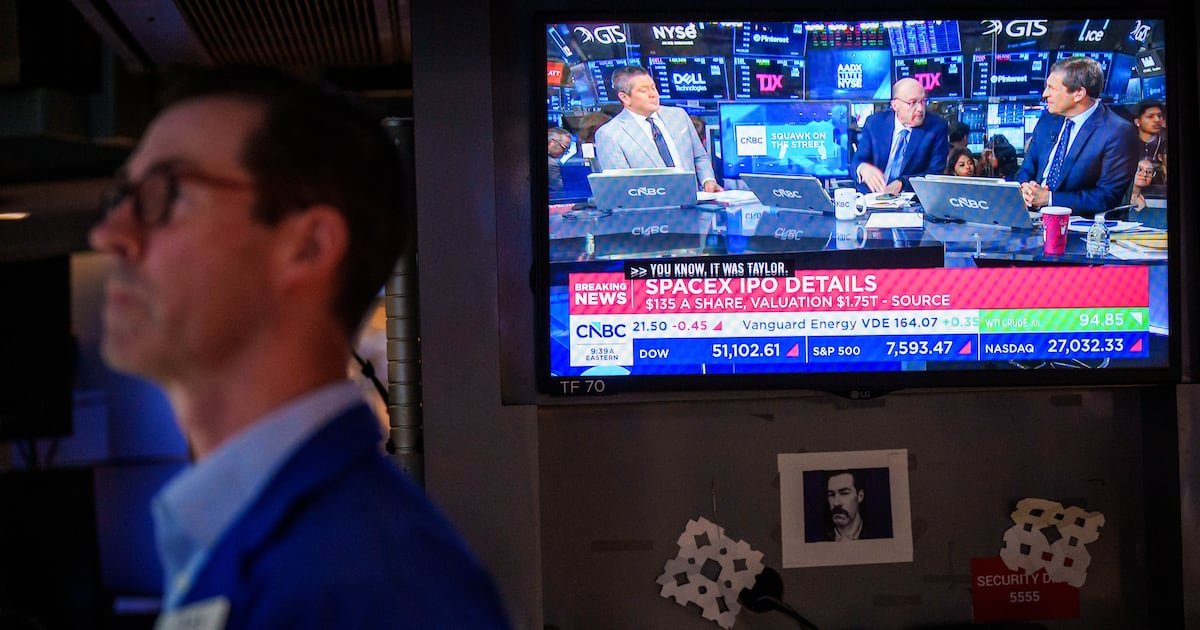
As the long-awaited initial public offering of Elon Musk’s SpaceX finally lands, fear and greed are gripping investors in equal measure.
SpaceX aims to raise $75 billion from the listing, giving it an estimated valuation of about $1.77 trillion. It is shaping up as the biggest flotation in history and could also put Mr Musk on track to become planet Earth’s first dollar trillionaire. Even bearish investors are struggling to resist the buzz surrounding this blockbuster market event.
But as the frenzy builds, even bullish investors can’t help wondering where all this will end, as the artificial intelligence revolution excites and horrifies in equal measure.
Incredibly, SpaceX’s Nasdaq listing is only the start. Every week seems to bring another story about eye-watering valuations, billion-dollar funding rounds or AI firms promising to reshape humanity itself.

Claude-maker Anthropic could float as early as October, possibly raising $900 billion. ChatGPT creator OpenAI could beat that at $1 trillion. Databricks, Stripe, Shein and Revolut could join what’s becoming a crowded field.
To some, this looks like an extension of the long bull market that began in March 2009 after the financial crisis. But it’s also reviving memories of the late 1990s dotcom boom, and investors know how that ended. Late-stage bull markets often produce a rush of flotations.

Trump’s Iran war rhetoric sends markets swinging
Up, up and away?
Rockets go down as well as up. As SpaceX and Jeff Bezos’s Blue Origin can testify, they can simply explode. So should investors jump on board or brace for a serious crash landing?
There are good reasons for the hype. James Budden, head of global marketing at Baillie Gifford, which runs several funds that invested in SpaceX privately at an early stage, says: “For the first time in history, living beyond our planet feels within reach.”
There are also reasons to be fearful. Sanjiv Tumkur, head of equities at Rathbones, noted that both SpaceX and OpenAI are currently unprofitable, while Anthropic only recently moved into profit.
“This makes establishing the fair value of these businesses a difficult task. In a risk-on market this could lead to a very high valuation being attributed to them.”
Mr Tumkur says the IPO rush has uncomfortable historical precedents. “A sharp acceleration in IPO activity often marks the peak of investor bullishness and of market levels.”
Garry White, chief investment commentator at Charles Stanley, is staggered by the sheer scale of the flotations, which he says could fundamentally reshape global markets. Together, SpaceX, OpenAI and Anthropic could bring more than $3 trillion in equity value to the US stock market within a short period, “making this one of the most concentrated IPO cycles in financial history”, he says.
SpaceX is breaking new ground in another way, as “a new class of late-stage IPO candidate”, he says, referring to giant private companies waiting until they have generated billions of dollars in revenues before turning to public investors.
The wave of mega-floats has forced Nasdaq to introduce a fast-entry system allowing newly listed companies to enter the Nasdaq 100 within days rather than months, accelerating access to passive investment flows.
Mr White says this risks distorting markets by forcing passive funds to buy stocks at elevated valuations before proper price discovery has taken place. “It prioritises liquidity and momentum, potentially at the expense of valuation discipline.”
A sharp acceleration in IPO activity often marks the peak of investor bullishness and of market levels
Sanjiv Tumkur
,
head of equities at Rathbones
These IPOs could hit demand for other corners of the market and even rival asset classes like Bitcoin. Analysts estimate the flotations could absorb hundreds of billions of dollars from investors, potentially sucking money out of existing shares as traders rotate into the glamorous new listings.
Markets already look dangerously concentrated around a handful of major AI-linked companies. The so-called Magnificent Seven technology stocks now account for roughly one-third of the S&P 500’s total market value and have driven a disproportionate share of recent gains.
Mr White notes that valuations are elevated, with price-to-earnings ratios approaching levels last seen during the dot-com bubble.
Valuation bubble
Tom Stevenson, investment director at Fidelity International, says the mega-cap IPOs follow nine consecutive weekly rises in global stock markets. “That’s the strongest run in three years, but it’s also fuelling fears of a valuation bubble.”
Mr Stevenson remains upbeat, citing the strong first-quarter earnings season in the US. “The rally is supported by higher earnings and rising margins, and that’s enough to keep the bull market on track for now.”
But he also points out that the current bull market is getting long in the tooth having started in March 2009, after the financial crisis. “On that basis, it’s been running for 17 years. That’s pushing close to the duration of the previous two big bull markets, from the end of the Second World War to the late 1960s and from 1982 to the top of the dotcom bubble in 2000.”
Mr Stevenson says bull runs typically end for two reasons. First, valuations rise to unsustainable levels where they’re no longer justified by earnings. That happened in 2000 and during the Wall Street crash in 1929.
Second, inflation. That sank markets in 1968. “The valuation threat looks less worrying this time around thanks to strong earnings growth. But the inflation fears are real.”
Ashok Bhatia, global head of fixed income at Neuberger, also worries about inflation as oil prices spike and government bond yields climb.
Rising bond yields can hurt equities because bonds offer investors a higher return without taking on the same level of risk.
He fears investors have overlooked the threat while getting distracted by IPOs and AI excitement. “Rates have been overshadowed recently. Don’t lose sight of them.”
There has been talk of a potential bond market rout, as the yield on 30-year US treasuries has hit 5.2 per cent, the highest since just before the financial crisis in 2007. In Japan they have climbed to levels last seen in the 1990s, Mr Bhatia says.
That could drive borrowing costs higher and increase the pressure on cash-strapped governments, who have borrowed heavily and are struggling to generate economic growth.
The AI splurge may be playing a part in this. While some argue AI will eventually reduce inflation, for now it’s consuming extraordinary amounts of capital and helping push up interest rates. “The situation is not yet critical, but the direction of travel is worrying,” Mr Bhatia says.
As stock markets continue to climb, the wall of worry keeps getting steeper.
The combined IPO surge and AI revolution are raising the stakes still higher. They could transform the global economy, and many investors will feel they simply cannot ignore them. Betting against big tech has been a losing play for years.
Bull runs can continue far longer than sceptics expect. Yet today’s combination of extreme valuations, concentrated market leadership, soaring AI spending and blockbuster flotations is enough to rattle even the boldest bull. But it would take an even braver investor to turn their back on it.