Updated 1 min read
US stocks mostly fell early Friday, with tech leading the way down after the release of May’s jobs report showed 172,000 jobs added in the month.
The Dow Jones Industrial Average (^DJI) fell slightly. The benchmark S&P 500 (^GSPC) slid 0.7%, while the Nasdaq Composite (^IXIC) sank 1.2%.
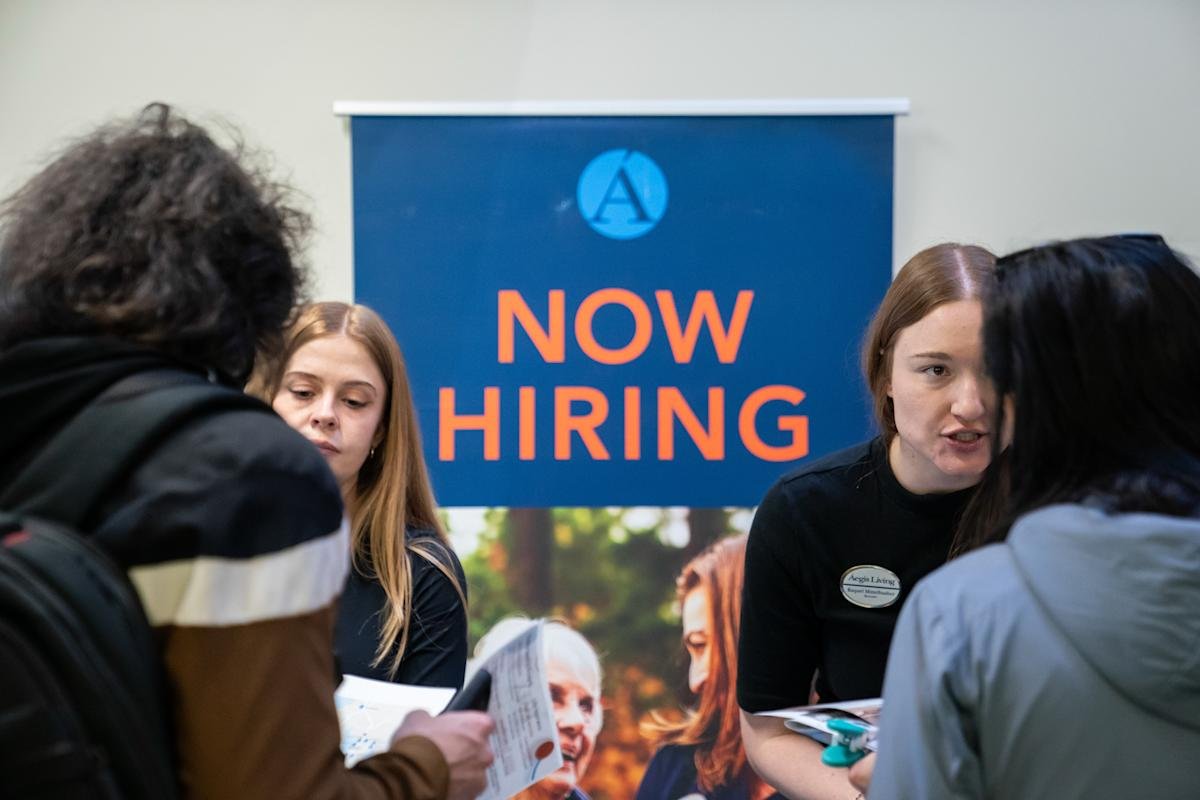
The May jobs report blew past expectations for job growth, with US employers adding 172,000 jobs last month, compared with economist expectations for around 88,000. The unemployment rate held steady at 4.3%.
But the strong report also fueled bets on a rate hike from the Federal Reserve at some point this year, with the labor market stabilizing as inflation runs high. Traders are now fully pricing in a rate hike from the central bank by the end of the year, even as President Trump continues to call for cuts as Kevin Warsh, his appointee to chair the Fed, takes the helm.
The S&P 500 (^GSPC) is at risk of snapping a historic weekly winning streak. The benchmark index is looking for a 10th straight week of gains, which would be the longest such run since 1985. Broadcom (AVGO) earnings sent shockwaves through the AI trade, and shares were poised to continue their sell-off Friday, while chipmakers broadly saw sharp declines.
Meanwhile, the fragile ceasefire between the US and Iran and reports of stalled negotiations continue to fuel uncertainty on Wall Street, even as President Trump assures that talks are in their “final” stages.
LIVE 9 updates
-
US stock market opens mostly into the red on Friday
The US stock market saw mostly losses at the opening bell on Friday after the May jobs report far outperformed expectations, while the tech sector continued a slide into the red, weighing on the rest of the market.
The benchmark S&P 500 (^GSPC) and tech-heavy Nasdaq Composite (^IXIC) fell by 0.6% and 1%, respectively, while the Dow Jones Industrial Average (^DJI) held roughly steady at the flat line.
May nonfarm payrolls figures from the Bureau of Labor Statistics showed the US economy added 172,000 jobs on the month, far exceeding expectations of 88,000 jobs added. The unemployment rate remained at 4.3% for the third month in a row.
The report, which also showed a slight tick down in average hourly earnings to a growth of 3.4% on an annualized basis from last month’s 3.6% growth, sent yields on 10-year and 30-year Treasurys both spiking. Traders are now fully pricing in a quarter-point hike by the end of the year.
Broadcom (AVGO) continued to lead a sell-off in chipmakers after earnings disappointed investors. Oil prices ticked down as progress appeared to stall in US-Iran negotiations.
-
Traders fully price in quarter-point hike by year-end
Traders are now fully pricing in a one-quarter-point hike by the December meeting of the Federal Reserve, according to Bloomberg data.
The hawkish shift for Fed bets comes after today’s nonfarm payrolls report showed 172,000 jobs added in May, but the unemployment rate remained steady at 4.3% for the third month in a row.

Traders are now fully pricing in a quarter-point rate hike by year-end, per Bloomberg data. · Bloomberg Data At the same time, inflation has remained sticky above target as shifts in energy prices led by the war in Iran appear to have begun slowly bleeding into the so-called “core” readings.
The Personal Consumption Expenditures index — the Fed’s preferred measure of inflation — showed that inflation rose at the fastest rate seen on the index in three years. On an annualized basis, headline PCE rose by 3.8%, while core PCE prices rose a slightly slimmer 3.3%.
Traders are still betting the Fed will remain on hold in the near term, but consensus has shifted to a near-certainty of at least one 25 basis point hike by year-end. Odds of a rate hike at the October Fed meeting stand at nearly 70%, which would come only weeks before the midterm elections.
The European Central Bank and Bank of England will meet in the next two weeks, and both central banks are expected to hike rates. In the US, the upcoming June meeting of the Federal Reserve will be the first for Kevin Wash as chairman.
-
Treasury yields rise after jobs report shows 172,000 jobs added in May
Yields on 10-year Treasurys (^TNX) jumped by 5.5 basis points in the minutes after the nonfarm payrolls report showed 172,000 jobs in May, far outperforming economists’ estimates of 88,000 jobs added.
Yields on 30-year Treasurys (^TYX) rose by 4 basis points, while those on the shorter-duration five-year note (^FVX) rose by 7.6 basis points.
While job growth is strong on paper — April’s tally was revised up to 214,000 jobs added — the unemployment rate held steady month-on-month at 4.3% for the third month in a row.
As inflation has remained sticky with prices rising, US average hourly wages ticked down year-on-year to 3.4% from 3.6%, putting increased pressure on Americans’ wallets.
-
US economy added 172,000 jobs in May, far outperforming estimates in third month of gains in a row
The US economy gained 172,000 jobs in May, according to data released by the Bureau of Labor Statistics on Friday, massively outperforming consensus expectations of 88,000 jobs added.
The unemployment rate held steady month-on-month at 4.3%, in line with economists’ expectations.
The payrolls gain marks the third month in a row of positive movement for the nonfarm payrolls count, coming off April’s revised tally of 179,000 jobs added. March’s tally was revised up to 214,000 jobs.
Leisure and hospitality led jobs gains with 70,000 jobs added, followed by gains of 55,000 in the local government sector. Health care, which has been a consistent strong spot for the labor market over the past few months, added 35,000 jobs. The financial activities sector lost 22,000 jobs in May, in a rare dark spot on this month’s payrolls report.
In the private sector, US private employers added 122,000 roles in May, according to the private payroll processor ADP, beating expectations of 120,000. Eight out of the 10 super-sectors ADP tracks saw hiring.
-
Here’s where major banks’ payrolls estimates stand ahead of the May jobs report
Fifteen minutes ahead of the May jobs report, economists’ estimates average out to 85,000 jobs added in May. Last month saw 115,000 jobs added.
Here’s where economists at some of Wall Street’s most prominent banks and wealth management firms have placed their bets for the May nonfarm payrolls report, ranked by estimate:
-
Jefferies, led by chief US economist Thomas Simons: 125,000 jobs added
-
Bank of America, led by chief US economist Aditya Bhave: 95,000 jobs added
-
BNP Paribas, led by chief US economist James Egelhof: 85,000 jobs added
-
JPMorgan Chase Bank, led by chief US economist Michael Feroli: 75,000 jobs added
-
Morgan Stanley, led by chief US economist Michael Gapen: 65,000 jobs added
-
Goldman Sachs, led by chief US economist David Mericle: 60,000 jobs added
-
Citigroup, led by chief US economist David Hollenhorst: 60,000 jobs added
-
TD Securities, led by chief US macro strategist Oscar Munoz: 60,000 jobs added
-
-
Lululemon stock tanks after company trims full-year financial outlook, citing ‘headwinds’
Lululemon stock (LULU) tumbled more than 10% in premarket trading on Friday after reporting quarterly results after the bell Thursday. The apparel company cut its second quarter and full-year financial outlooks, disappointing Wall Street.
Yahoo Finance’s Brooke DiPalma reports:
Lululemon’s incoming CEO Heidi O’Neill has her work cut out for her after the company slashed its full-year revenue outlook and reported weaker-than-expected second quarter earnings guidance.
For the second quarter of 2026, Lululemon expects net revenue to be in the range of $2.45 billion to $2.48 billion, while Wall Street was looking for $2.6 billion. Adjusted earnings are expected to be in the range of $1.76 to $1.81, lower than the Street’s forecast of $2.69.
“More recently, we have been navigating headwinds that have led us to adjust our outlook for the full year,” interim co-CEO and CFO Meghan Frank told investors in the earnings release. Frank added that the company is taking “additional actions to reposition where needed and further strengthen our product engine.”
For the full year, the company cut its revenue outlook to $11 billion to $11.15 billion, down from the previously expected range of $11.35 billion to $11.5 billion. The guidance for adjusted earnings also came in lower and is now seen in the range of $10.95 to $11.15, compared with previous expectations of $12.10 to $12.30.
-
Payrolls expected to show further growth in May, with unemployment holding steady
The government’s closely watched jobs report will be out at 8:30 a.m. ET, and investors will be watching the numbers for additional signs of stability in the labor market.
Yahoo Finance’s Emma Ockerman previews what to expect when the May jobs report lands:
Payrolls are expected to have grown by 85,000 in May, while the unemployment rate is seen remaining flat at 4.3%, according to estimates from economists surveyed by Bloomberg. If their prediction holds, the US will have added positions for three consecutive months, a feat the job market hasn’t managed since it began whipsawing last summer.
Data on private payroll growth from ADP already showed some strength for May: Private employers added 122,000 jobs for the month, with hiring taking place across eight of the 10 supersectors ADP tracks. A month earlier, job openings soared to 7.62 million, a sharp increase from March.
Still, hiring declined in April, federal government data showed, and the increase in openings was concentrated in the professional and business services sector. The Federal Reserve’s Beige Book for May, released Wednesday, also noted that “employment showed little to no change” in 11 of the Fed’s 12 districts.
-
S&P denies SpaceX, other mega-cap IPOs from rapid index entry
Bloomberg reports:
S&P Dow Jones Indices will keep its existing eligibility requirements for main benchmarks like the S&P 500 Index, rejecting proposals that would have made it faster for mega-cap companies such as Elon Musk’s SpaceX to gain rapid entry into the benchmark after going public.
The index provider in a press release Thursday said it will not shorten the 12-month seasoning period for newly public companies it currently has or waive existing profitability and public-float requirements based on a company’s size, diverging from a broader industry shift embraced by rivals Nasdaq Inc. and FTSE Russell.
SpaceX logo is seen in this illustration taken June 3, 2026. REUTERS/Dado Ruvic/Illustration · REUTERS / REUTERS The decision arrives as Wall Street grapples with a new reality: some companies are reaching unprecedented sizes before they ever enter public markets. The consultation, launched earlier this year, effectively asked whether index rules written for a different era should bend to accommodate companies that now arrive at a scale once reserved for mature blue chips in what has become known as the “fast entry” in industry parlance.
The push for quicker inclusion has raised concerns among some investors who say rules around profitability, float and trading history exist precisely to prevent benchmarks from chasing hype. Furthermore, adding IPOs too quickly, they say, could expose passive funds to greater volatility and force them to buy shares before reliable market pricing is fully established.
-
Oil holds after pullback from gains due to Israeli attacks in Lebanon
Bloomberg reports:
Oil steadied after its first decline this week, as optimism over US-Iran peace talks weighed against uncertainty surrounding a ceasefire deal between Israel and Lebanon.
Brent (BZ=F) traded around $95 a barrel after falling 2.8% on Thursday, while West Texas Intermediate (CL=F) was near $93. President Donald Trump said that talks with Iran were going well, despite Tehran-backed Hezbollah rejecting a US-brokered ceasefire deal between Israel and Lebanon.
WTI has gained more than 6% this week after uncertainty over the progress of the negotiations eroded some of the earlier optimism for a deal that would lead to a resumption of oil flows through the strait — which carries about a fifth of the world’s crude and liquefied natural gas in peacetime. Futures are still down about a fifth since early April — when the US and Tehran agreed to a ceasefire that ended more than five weeks of fighting.
There was no sign of progress in talks between Tehran and Washington, with Israel’s continued military strikes in Lebanon becoming a major sticking point.