MADRID (AP) — Pope Leo XIV challenged Europe to acknowledge Christianity’s contributions to its cultural identity Sunday, as he presided over a Mass in Madrid attended by more than a million people and honored Spain’s centuries-old traditions of religious devotion and culture.
Leo celebrated Spain’s Christian roots and culture with the huge morning Mass in downtown Madrid and an evening spectacle that featured flamenco dancers, classical guitar and a moving meditation by Spanish actor Antonio Banderas on art, faith and beauty.
In his remarks, Leo challenged Europe to consider what the continent’s identity would be without the influence of Christianity. He cited its art, culture and the role played by Christians — “motivated by their faith” — to build its schools, hospitals and other institutions.
“Is it seriously possible to believe that Europe — which we deeply love — would be the same without the influence of faith?” Leo asked, in demanding that religious expression be allowed to keep its place in the public sphere.
A morning Mass and procession on floral carpets
Leo, who arrived in Spain on Saturday at the start of his weeklong visit, has been keen to highlight the long tradition of Christian culture and devotion here to encourage especially young generations to find their faith. It’s a tall order in a once-staunchly Catholic country where religious observance has largely been on the wane.
Sunday fell on the Catholic Corpus Domini feast day, which often features processions of faithful through towns and cities led by a priest carrying the Eucharist. In Spain, as in other predominantly Catholic countries, the processions often feature elaborate floral carpets arranged along the route.
During Sunday’s Mass, Leo said that the floral carpets express the “spiritual sentiments of this country” through “altars erected in the streets.”
“This is not an exhibition, a remnant of folklore or a simple display of beauty,” he said. “It is a profession of faith in the presence of the risen Lord, who is alive and continues to walk among us.”
He said that the continued observance of such devotional practices points to what Spain can and should be for the world.
“Herein lies the task of Spain today and in the future: to ensure that the religiosity which has shaped and defined this country for centuries is not a museum of the past to be visited, but a school of faith from which to draw even today,” he said.
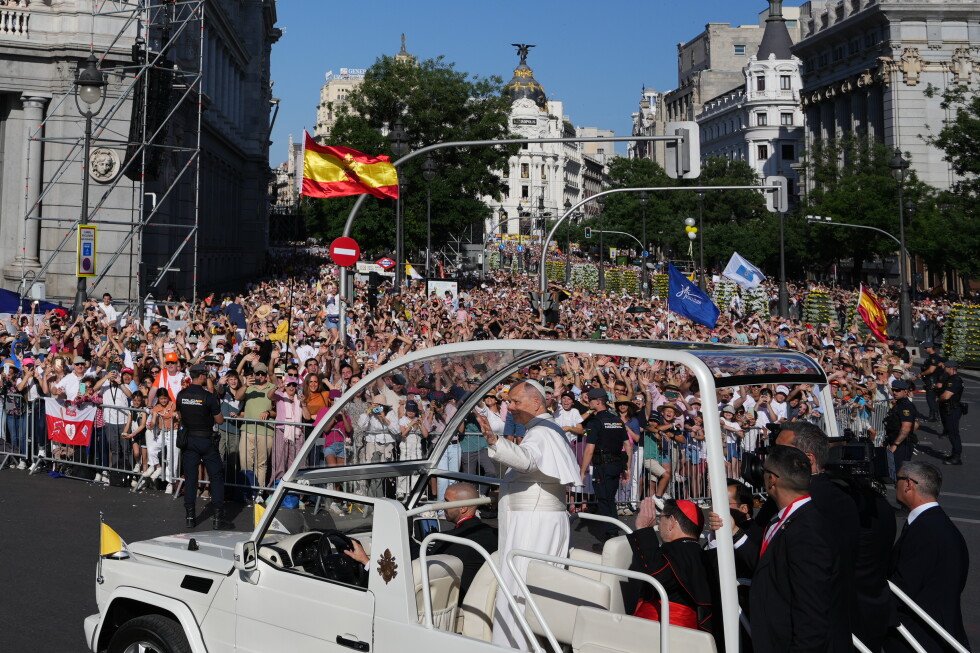
Pope Leo XIV arrives in the popemobile at Plaza de Cibeles for a Holy Mass and Corpus Christi procession in Madrid, Spain, Sunday, June 7, 2026, on the second day of his seven-day apostolic visit to mainland Spain and the Canary Islands. (AP Photo/Bernat Armangue)
Pope Leo XIV arrives in the popemobile at Plaza de Cibeles for a Holy Mass and Corpus Christi procession in Madrid, Spain, Sunday, June 7, 2026, on the second day of his seven-day apostolic visit to mainland Spain and the Canary Islands. (AP Photo/Bernat Armangue)
At the end of the Mass, Leo carried a gilded monstrance, or container, holding a Eucharistic host and walked over some of the 16 floral carpets that decorated the half-kilometer (less than half-mile) procession route, as children dropped additional petals before him and the crowd tossed petals from behind the barricades.
Huge crowds greet the American pope
Leo’s visit to the country of 50 million has drawn huge crowds, with a vigil service Saturday night. drawing an estimated 600,000 young Spaniards. They knelt for several minutes in silent prayer alongside Leo, suggesting that there is indeed interest in the faith among young people, despite Spain’s heavily secularized society.
On Sunday, their numbers doubled: Organizers said that 1.2 million people had turned out on a brilliant spring morning for Leo’s Mass at Madrid’s iconic Plaza de Cibeles and surrounding streets, with more trying to get in.
“It’s spectacular,” said Julián Tapiador, a consultant who came to the Mass. “I’m so proud that the pope is in Spain after 15 years. Hopefully he comes again and we can all see him again.”
Octavio Puche, a retiree, thanked Leo for making the trip.
“Apparently society is not as secularized as it seems, because there are a million people here in Madrid, and I think he has shown a very human face of Christ, very close to the people, to their suffering,” he said.
Sex abuse scandal hangs over visit
Pope Leo XIV presides over a Mass marking the Catholic feast of Corpus Christi at Plaza de Cibeles in Madrid, Spain, Sunday, June 7, 2026, on the second day of his seven-day apostolic visit to mainland Spain and the Canary Islands. (AP Photo/Manu Fernandez)
Pope Leo XIV presides over a Mass marking the Catholic feast of Corpus Christi at Plaza de Cibeles in Madrid, Spain, Sunday, June 7, 2026, on the second day of his seven-day apostolic visit to mainland Spain and the Canary Islands. (AP Photo/Manu Fernandez)
Despite the warm welcome, the clergy sexual abuse scandal, which has erupted belatedly in Spain in recent years, has loomed over Leo’s trip. The Catholic hierarchy has begun to reckon with its legacy after reporting in the local media.
Leo is expected to meet survivors while in Spain, but several victims groups have complained that they have been left in the dark about when the meeting is taking place and whether they are invited.
Miguel Hurtado, a prominent survivor who accused a monk at Montserrat Abbey outside Barcelona of sexually assaulting him more than two decades ago, protested outside the Vatican’s embassy in Madrid on Sunday. He said that he wrote to the Vatican requesting a meeting with Leo and for the pope to cancel his planned Wednesday visit to the 1,000-year old Benedictine monastery.
“I understand you can’t meet with all of us victims, because we are more than 400,000,” Hurtado said, speaking to a cardboard photo of Leo.
As he spoke, a crowd of nuns and others lined the street outside the Vatican embassy, waving Spanish flags and chanting slogans in favor of former dictator Gen. Francisco Franco, who ruled Spain with an iron grip for nearly four decades after the 1936-39 civil war.
The Catholic Church was a pillar of Franco’s dictatorship, and at least until the 1960s, the church enjoyed broad control and influence over Spanish society that waned after democracy took root.
“Spain is Christian and not Muslim!” the crowd yelled.
Pope Leo XIV presides over a Mass marking the Catholic feast of Corpus Christi at Plaza de Cibeles in Madrid, Spain, Sunday, June 7, 2026, on the second day of his seven-day apostolic visit to mainland Spain and the Canary Islands. (AP Photo/Manu Fernandez)
Pope Leo XIV presides over a Mass marking the Catholic feast of Corpus Christi at Plaza de Cibeles in Madrid, Spain, Sunday, June 7, 2026, on the second day of his seven-day apostolic visit to mainland Spain and the Canary Islands. (AP Photo/Manu Fernandez)
A form of popular piety dating back centuries
The tradition of laying flower carpets — and destroying them when the procession tramples them — dates back two centuries and is popular also in Latin America, where elaborate sand designs are also made. The painstaking displays are considered an offering to the Eucharist.
According to Spanish organizers, the 16 flower carpets decorating Sunday’s procession route off Plaza de Cibeles were prepared by a Spanish florists association from the northern region of Galicia. Florists used more than 30,000 flowers, most the yellow and white colors of the Holy See flag, for the carpets that feature decorations such as the Holy See keys.
People wait for the arrival of Pope Leo XIV ahead of a Holy Mass and Corpus Christi procession at Plaza de Cibeles in Madrid, Spain, Sunday, June 7, 2026, on the second day of his seven-day apostolic visit to mainland Spain and the Canary Islands. (AP Photo/Manu Fernandez)
People wait for Pope Leo XIV to preside over Mass marking the Catholic feast of Corpus Christi in Plaza de Cibeles in Madrid, Sunday, June 7, 2026, on the second day of a seven-day apostolic journey to mainland Spain and the Canary Islands. (AP Photo/Alessandra Tarantino)
Poland has already had its tradition of Corpus Domini flower carpets recognized by UNESCO, and Galicia is trying to have its tradition listed along with other countries as part of the world’s intangible cultural heritage.
Wildly popular religious processions, pilgrimages and feasts continue to be held in most Spanish regions. The most recognizable are Semana Santa, or Holy Week, processions during the final week of Lent where brotherhoods and robed penitents parade ornate statues of Christ and the Virgin Mary through cities, towns and villages alongside marching bands. Such processions draw the faithful as well as droves of nonbelievers and tourists.
___
Alicia León and Srdjan Nedeljkovic contributed to this report.
___
Associated Press religion coverage receives support through the AP’s collaboration with The Conversation US, with funding from Lilly Endowment Inc. The AP is solely responsible for this content.