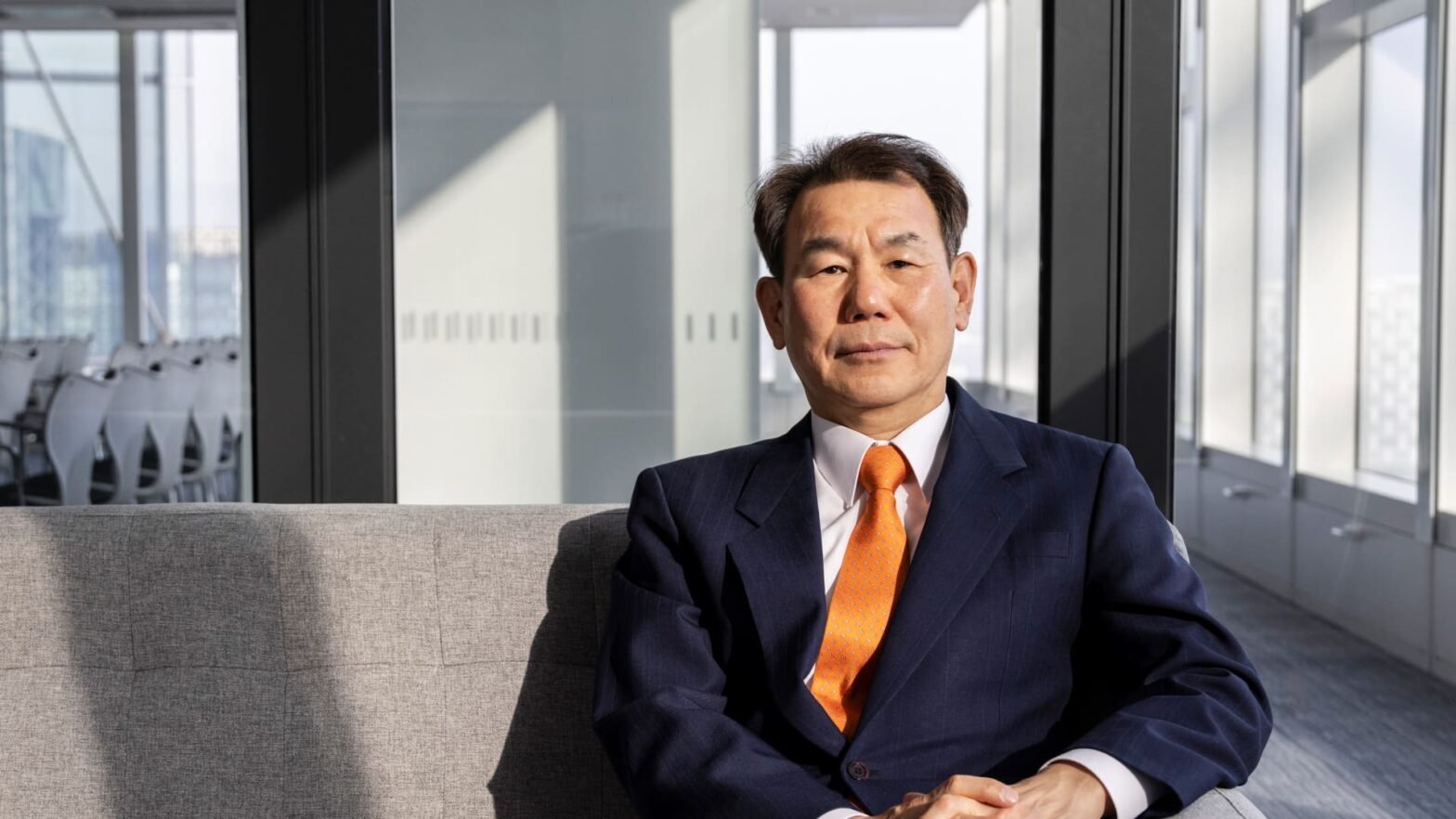
Jeong Eun Bo, chief executive officer of the Korea Exchange (KRX), in Seoul, South Korea, on Friday, Jan. 16, 2026.
Bloomberg | Bloomberg | Getty Images
The selloff in South Korean stocks is not because foreign investors have lost confidence in the country, its stock market chief told CNBC.
Korea Exchange CEO Jeong Eun-bo told CNBC’s Lisa Kim that as the South Korean market had posted massive gains in 2025 and earlier this year, rebalancing in foreign portfolios was inevitable.
South Korea’s Kospi grew 76% in 2025 and was up 108.85% year to date before the selloff began on June 3, Jeong said, adding this meant that the country’s weight in many global portfolios has likely nearly doubled or even tripled.
“As a general rule, foreign institutional investors maintain set portfolio allocation targets… As a result, rebalancing is inevitable, and in that process, foreign investors have been selling Korean stocks,” he added.
The benchmark Kospi fell more than 13% in just six sessions after touching its record high on June 2.

Jeong said that, when he meets with major foreign institutional investors, “the message is consistent across the board — this is a rebalancing exercise, and has nothing to do with any loss of conviction in the Korean market.”
He added he believed that this portfolio rebalancing among major foreign institutional investors is now coming to an end.
On Monday, overseas investors had unloaded a net 1.24 trillion won (about $801 million) worth of Kospi-listed shares as of 11 a.m. Singapore time (11 p.m. ET Sunday), according to Korea Exchange data.
Circuit breakers were activated on the Kospi as it tumbled beyond 8% on that day.
Goldman Sachs analysts had also estimated that net foreign outflows from the Kospi this year had reached roughly $62 billion as of late May, they wrote in a June 5 note.
The overseas selloff has affected the South Korean won, with the currency weakening to a 17 year-low of 1,561.5 against the dollar on June 5.
Jeong said that as the won is a “local currency” rather than a global reserve currency, it is more susceptible to capital outflows. But authorities have been “actively conducting smoothing operations,” he added.
“Once that process runs its course, I expect the rebalancing-driven pressure on the FX market to ease, and conditions to largely normalize,” he said.
South Korean market volatility
The KRX CEO said that volatility has risen due to the conflict in the Middle East, South Korea’s heavy economic dependence on external factors, and the inherent volatility of the semiconductor industry, which has powered Seoul’s market.
The huge Kospi rally has been concentrated around two companies, Samsung and SK Hynix, which have been an integral part of the semiconductor space and make up 45% of the Kospi.
Jeong said the sector has “cyclical characteristics that then amplify volatility.”
The semiconductor sector is vulnerable to the recurring pattern of boom-and-bust periods in the global chip industry, driven by the lag between supply and demand, as the building of supply capacity may take years, as compared to demand for semiconductors, which can spike or fall quickly depending on technological developments.
Jeong also aimed to reassure investors, saying that “given that we are seeing heightened volatility internationally as well, we will take the time to carefully review whether the trigger thresholds for sidecars and circuit breakers may need to be adjusted.”
He said that major banks have revised their forecasts for the Kospi upward. Goldman Sachs raised its 12-month Kospi target to 12,000 on June 5, up from the previous forecast of 9,000.
“The fact that Korea’s significant upside potential is being recognized internationally gives me confidence that there is plenty of room for further gains.” Jeong said.
— CNBC’s Lisa Kim and Blair Baek contributed to this report.