DAMASCUS, Syria (AP) — Ghaith Alsayed is based in Damascus, Syria, where he covers events and developments across the country. He has worked with The Associated Press since 2019.
Here’s what he had to say about this extraordinary photo.
Why this photo?
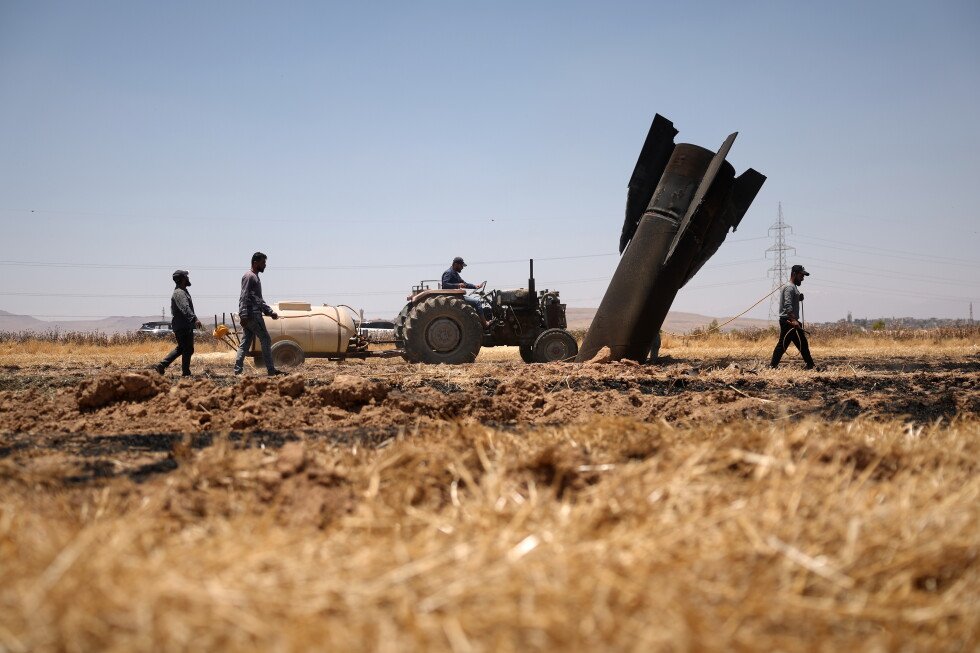
When I learned that debris from an Iranian missile had fallen near the town of Najha in rural Damascus, I headed to the area to document what had happened and how this regional conflict was affecting Syria and Syrians.
Upon arriving at the impact site in an agricultural field, what caught my attention was not the missile debris itself, but the farmers trying to extinguish flames that kept reigniting because of the wind after a fire had broken out overnight.
For me, the scene reflected these people’s efforts to protect what remained of their crops and livelihoods, and how wars can reach people far from the battlefield.
How I made this photo
When I arrived, farmers were spraying water on piles of hay that had been damaged by the fire caused by the missile debris, while the missile itself remained lodged in the ground some distance away.
I did not want to photograph the missile alone as some photographers did when they arrived, because I knew the debris by itself would not tell the whole story. The missile was not going anywhere, but the human moment was changing every second.
From the first moment, I started looking for an angle that could bring all the elements of the story into a single frame: the farmers, the burned field and the missile debris. I chose my position, lowered my camera angle and waited about 15 minutes until the farmers moved closer to the missile while trying to reach a hay pile that was still burning.
At that moment, the frame I had imagined came together. The cause and the consequence of the event existed in a single image.
For me, it was the most powerful moment because it showed not only the missile debris, but also its direct impact on people’s lives and what they were trying to protect using simple tools: a tractor, a small water tank and a hose stretched across the field.
Why this photo works
As a photojournalist who grew up in the field from a young age, I have learned that strong images often begin before the shutter is pressed.
I try to imagine the frame in advance and build the scene in my mind before it fully develops in front of me.
I always try to focus on the impact of an event on people rather than the event itself.
When I arrived, my attention was not focused on the missile, but on the farmers, what they were doing, how this event had affected them and how they were trying to protect their land and livelihood.
I believe the image works because it shows more than a missile that landed in a field.
It shows how ordinary civilian life intersects with political and military events far larger than the people affected by them.
There is a visual and human contrast between farmers trying to save their crops and the remains of a missile from a wider regional conflict.
That contrast gives the image its strength and reminds us that wars do not end at the front lines; they continue into fields, homes and the lives of ordinary people.
—
For more extraordinary AP photography, click here.