Headline inflation has eased to an annual rate of 4 per cent in May, down from 4.2 per cent in April, according to the latest ABS data.
The better-than-predicted figure comes after sharp falls in petrol and diesel prices.
The Australian share market has started its day higher despite a major sell-off across US tech, AI and semiconductor stocks, which resulted in steep losses on Wall Street.
See how the trading day unfolds on our blog.
Disclaimer: This blog is not intended as investment advice.
Wed 24 Jun 2026 at 11:51am
Market snapshot
- ASX 200: +0.4% to 8,819 points
- Australian dollar: -0.1% to 69.12 US cents
- Wall Street: Dow Jones (-0.1%), S&P 500 (-1.4%), Nasdaq (-2.2%)
- Europe: Stoxx 600 (-0.7%), DAX (-1%), FTSE (-0.1%)
- Asia: Nikkei (-0.5%), KOSPI (+2.3%)
- Spot gold: -0.5% to $US4,083/ounce
- Brent crude: -0.4% to $US76.74/barrel
- Iron ore: +0.1% at $US99.90/tonne
- Bitcoin: +0.9% to $US62,930
Prices current around 11:50am AEST
Live updates on the major ASX indices:
Wed 24 Jun 2026 at 12:16pm
‘Inflation problem is not yet solved’: Deloitte
So, were today’s inflation numbers good news or bad news?
It depends on how you look at them.
On the surface, a headline inflation figure of 4% — lower than the forecast 4.3%, and under the 4.2% the previous month — seems like a positive development.
But Stephen Smith, partner at Deloitte Access Economics, said the latest data means there could be another rate hike from the Reserve Bank of Australia (RBA) this year.
“Today’s CPI data is an unwelcome reminder that Australia’s inflation problem is not yet solved, with another rate hike in 2026 still likely,” he said in an emailed statement.
“The government’s temporary fuel excise cut has masked the extent to which inflation pressures remain a problem for the Australian economy and is delaying some of the price growth pass-through to other sectors. These pressures will become more visible as the policy is unwound through July.”
He added that the RBA was dealing with “a difficult mix of softening growth and elevated inflation” with the economy slowing in the March quarter, as the labour market cools.
“That may normally suggest the central bank needs to be patient. But with underlying inflation now above the 2.5% target for almost five years, today’s result means the Reserve Bank must remain vigilant,” Mr Smith wrote.
“For households, the message is familiar but uncomfortable. Inflation is no longer surging, but it is still eroding purchasing power. Until price growth slows more convincingly, cost-of-living pressure will remain real, and the risk of another rate hike will remain firmly on the table.”
Wed 24 Jun 2026 at 11:58am
Inflation trending lower but underlying stickiness: RSM
RSM Australia economists say the May inflation report keeps the RBA’s August rates decision “finely balanced”, as inflation trends lower but “underlying stickiness” remains.
RSM economist Devika Shivadekar has retained her forecast of a prolonged pause on rates by the central bank.
“Looking beneath the headline, the composition of inflation remains skewed towards persistent, domestically driven components, which is keeping underlying (trimmed mean) inflation elevated,” she wrote.
“The direction of travel on inflation is encouraging, but a 4% annual pace is still too high to justify an early pivot to rate cuts, especially with core pressures likely lingering above target…
“The next CPI release, due on 29 July 2026, will be pivotal for the August meeting, as it will include the full June quarter data alongside the monthly update giving the RBA its most comprehensive read on inflation momentum.”
Wed 24 Jun 2026 at 11:57am
Markets react positively to inflation data
The better-than-expected inflation numbers have had a positive effect on the Australian share market.
We’ve just heard that headline inflation for May was 4%, when many pundits were predicting 4.3%. It was 4.2% in April and an eye-watering 4.6% in March.
Having traded almost flat before the 11:30am AEST announcement, the ASX 200 is now up by around 32 points, or 0.36%.
And the All Ordinaries has risen by about 31 points, or 0.35%.
Wed 24 Jun 2026 at 11:53am
Inflation pressures increase chance of a rate hike: BDO
Anders Magnusson, chief economist at advisory firm BDO, has given his take on the inflation data.
He sees it as increasing the possibility of another rate hike, due to the shift from headline to underlying inflation pressures.
“Today’s CPI data confirms inflation is becoming more entrenched, with underlying inflation moving higher and increasing the likelihood that the Reserve Bank will tighten policy further in August,” he wrote in a note.
“This increase in underlying inflation, while headline inflation decreases, reflects a shift from an initial energy-driven shock to broader and more troubling price pressures across the economy.”
He said the data showed that rising energy costs were no longer confined to fuel and utilities.
“Higher transport, production and distribution costs are now flowing through to a wider range of goods and services, lifting trimmed mean inflation and signalling that underlying price pressure is building.
“This is consistent with the pattern seen in previous supply-driven shocks, where headline inflation rises first, followed by a more persistent increase in underlying inflation as businesses pass on higher costs.
“That dynamic is now clearly playing out, and it marks a more concerning phase of the inflation cycle.”
He said, as a result, the RBA is likely to hike rates in August.
Wed 24 Jun 2026 at 11:43am
Mixed inflation outcome compared to forecasts
It was a mixed inflation report compared to forecasts.
Headline inflation eased more than expected.
It fell 0.7% in the month, seeing the annual rate ease back to 4% — that compares to forecasts of -0.4% and 4.3% according to a Reuters poll.
However, the trimmed mean was hotter than forecast.
It had been tipped to rise 0.3%, taking the annual rate up to 3.5%.
The ABS figures showed the trimmed mean up 0.4% in May, taking the annual pace of underlying inflation to 3.6%, well above where the RBA would want to see it.
Wed 24 Jun 2026 at 11:40am
Housing, food, transport biggest contributors to inflation: ABS
The ABS says the biggest contributor to annual inflation in the year to May was housing, followed by food and non-alcoholic beverages, and transport.
The annual housing inflation rate was 6.5%, which the ABS says reflected rising costs for electricity, new dwellings and rents.
“Electricity costs are 21.1% higher than 12 months ago as Commonwealth and state government rebates that reduced electricity costs for households are no longer in place,” ABS head of prices statistics Rachael McCririck said.
Wed 24 Jun 2026 at 11:36am
Prices lower in May than in April
Looking at the monthly movement, the consumer price index was down 0.7% in May compared to April.
That took the annual rate from 4.2% in April to 4% in the year to May.
That’s the second month of the annual pace of headline inflation decline, after it came in at 4.6% in March as the Middle East war caused a shock to energy prices.
Wed 24 Jun 2026 at 11:32am
Inflation eases more than expected in May
Headline inflation has eased more than expected in May.
Figures from the Australian Bureau of Statistics show the consumer price index rose 4% in the 12 months to May, down from 4.2% in April.
The trimmed mean, a measure of underlying inflation preferred by the Reserve Bank, rose to 3.6% in May, up from 3.4% in the year to April.
The Reserve Bank targets inflation between 2 and 3 per cent and will next meet in August.
Wed 24 Jun 2026 at 11:19am
YouTube settles case over alleged harm to children
This could be a groundbreaking settlement from the United States.
Google’s YouTube has settled a lawsuit brought by a young user who claimed the platform damaged his mental health, his lawyers have confirmed.
This comes ahead of a second California trial over social media’s role in the youth mental health crisis.
The terms of the settlement of the state court lawsuit were confidential, the lawyers said.
The suit named four defendants — the corporate owners of YouTube, Instagram, Snapchat and TikTok — and the remaining three companies are still set to face trial in July.
Google spokesperson Jose Castaneda said in a statement that the lawsuit had been amicably resolved.
“Our focus remains on building age-appropriate products and parental controls that deliver on that promise,” Mr Castaneda said.
John Morgan and Emily Jeffcott, lawyers for the plaintiff, known by his initials R.K.C., released a statement, vowing to continue the fight for “justice”.
“YouTube’s decision to resolve this case before having to face a jury speaks for itself.”
“We will continue fighting on behalf of all those affected by social media addiction to bring these companies to justice and compel them to prioritise the safety of their young users over their bottom lines.”
R.K.C., a 16-year-old boy from Florida, said he started using social media when he was about eight, according to court filings.
He became addicted to it, losing sleep and suffering from depression and anxiety, according to court records.
With reporting by Reuters
Wed 24 Jun 2026 at 11:07am
Market snapshot
- ASX 200: Flat at 8,879 points
- Australian dollar: -0.1% to 69.11 US cents
- Wall Street: Dow Jones (-0.1%), S&P 500 (-1.4%), Nasdaq (-2.2%)
- Europe: Stoxx 600 (-0.7%), DAX (-1%), FTSE (-0.1%)
- Asia: Nikkei (+0.4%), KOSPI (+4%)
- Spot gold: -0.9% to $US4,107/ounce
- Brent crude: -0.5% to $US76.70/barrel
- Iron ore: +0.1% at $US99.90/tonne
- Bitcoin: +0.7% to $US62,819
Prices current around 11:05am AEST
Live updates on the major ASX indices:
Wed 24 Jun 2026 at 11:05am
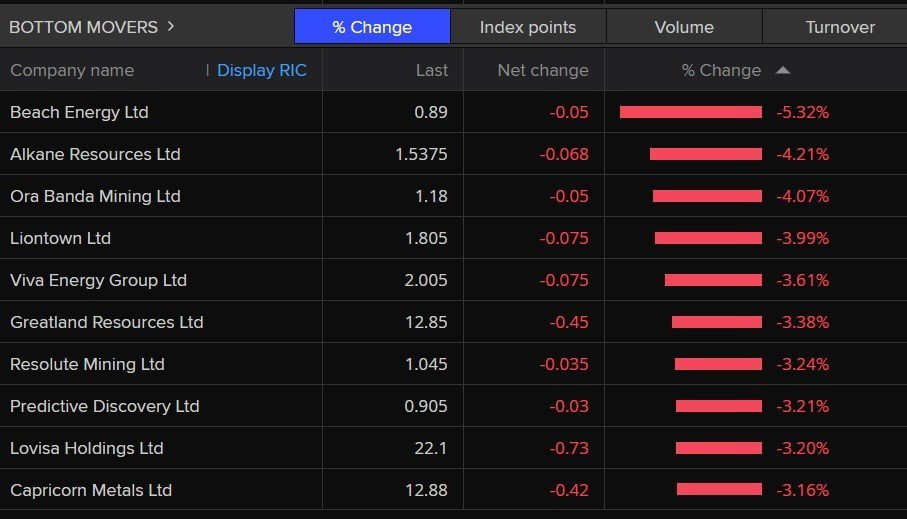
Energy and mining stocks fall sharply, along with gold and oil price
It’s also a good time to talk about the stocks that are doing terribly this morning.
Several of today’s worst performers are oil companies like Beach Energy and Viva Energy, along with gold miners like Ora Banding Mining, Capricorn Metals and Resolute Mining.
It comes after steep falls in the price of gold and oil overnight, with spot gold dropping more than 2%, while Brent crude futures lost more than 1% of their value.
Wed 24 Jun 2026 at 10:57am
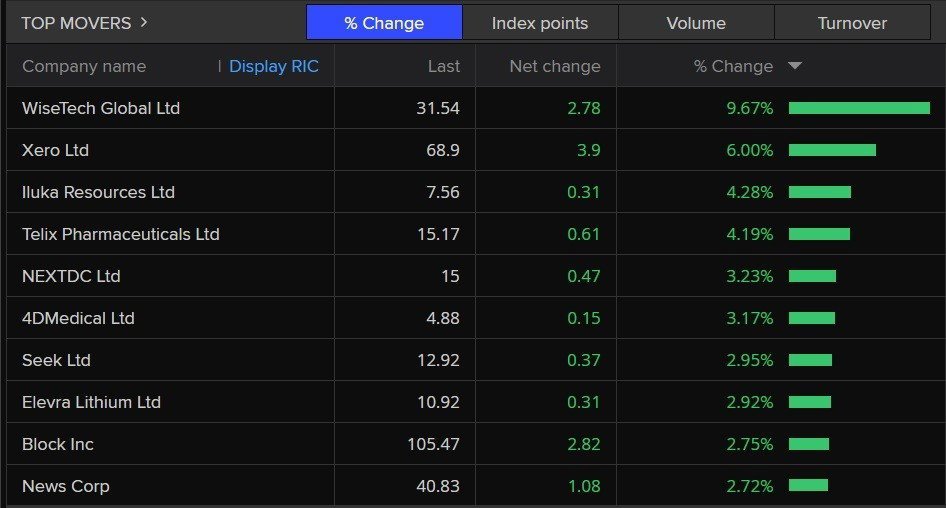
Australian tech sector surges, along with Xero, Block and NextDC shares
Apart from WiseTech Global, other tech stocks in Australia are also surging this morning.
Bookkeeping software firm Xero, data centre operator NextDC, and electronic payments company Block are also enjoying sharp increases in their share prices.
In fact, the ASX tech sector has jumped 1.4% in the first hour of trade, making it the best-performing local sector — so basically the complete opposite of the tech sell-off on Wall Street overnight.
Wed 24 Jun 2026 at 10:48am
WiseTech Global rebounds after founder Richard White denies human trafficking allegations
Australian technology stocks are actually some of today’s best performers.
That’s a surprise given how much US, Japanese and South Korean tech and AI stocks have fallen in recent days, on concerns about them being seriously overvalued.
WiseTech Global shares have risen the most on the ASX 200. They’ve jumped 9.2% to $31.40 in early trade as investors are ‘buying the dip’.
Though that’s after the business software firm’s share price had plunged 21% in two days — after the AFR, The Age and Sydney Morning Herald wrote, on Monday, that WiseTech’s billionaire founder Richard White was being investigated by the Australian Federal Police for alleged human trafficking.
Mr White has since “emphatically and unequivocally” denied those allegations.
Despite today’s rebound, WiseTech’s share price is still down by a massive 71% over the past year.
Partly it’s due to investor concerns about AI making many pieces of software obsolete — along with the companies that produce them.
But it’s also because of Mr White’s personal scandals in the past couple of years, which you can read more about here:
Wed 24 Jun 2026 at 10:18am
Market snapshot
- ASX 200: +0.2% to 8,807 points
- Australian dollar: -flat at 69.17 US cents
- Wall Street: Dow Jones (-0.1%), S&P 500 (-1.4%), Nasdaq (-2.2%)
- Europe: Stoxx 600 (-0.7%), DAX (-1%), FTSE (-0.1%)
- Asia: Nikkei (+0.1%), KOSPI (+4%)
- Spot gold: steady at $US4,107/ounce
- Brent crude: -0.5% to $US76.68/barrel
- Iron ore: +0.1% at $US99.90/tonne
- Bitcoin: +0.7% to $US62,843
Prices current around 10:15am AEST
Live updates on the major ASX indices:
Wed 24 Jun 2026 at 10:14am
ASX opens slightly higher, defying global tech sell-off
The Australian share market is off to a mildly positive start this morning.
The ASX 200 was up 0.2% to 8,802 points by around 10:15am AEST.
The broader All Ords index rose by a similar percentage to 9,008 points.
So local shares have decided to head in a different direction from Wall Street and Asian markets, which recorded massive losses due to a tech and AI sell-off in the past couple of days.
I’ll have more details for you shortly!
Wed 24 Jun 2026 at 10:03am
Is monthly inflation rising or falling? Demystifying headline and core inflation
The May inflation figures, which the ABS will publish later this morning, will be confusing for a lot of people. So I’ll try to demystify it for you:
- To quickly recap, economists are predicting annual headline inflation will rise 4.3% (slightly higher than April’s result of 4.2%).
- But monthly inflation is likely to fall by 0.4%, which would be a major drop compared to April’s result (an increase of 0.4%).
That’s right, you read correctly! Cost-of-living pressures are expected to have increased sharply over a 12-month period, but to have decreased between April and May.
The word for what happens when the pace of inflation declines is disinflation.
There’s no doubt those results will have been impacted by the Albanese government’s temporary cut to the fuel excise.
Core inflation looks very different
But when you ignore the most extreme price swings from the inflation data, the core (or trimmed mean) inflation figures tell a very different story:
- Annual core inflation is expected to have risen 3.5% (up from April’s result of 3.4%)
- Monthly core inflation is forecast to have lifted 0.3% (unchanged since April).
Basically, when last month’s significant fall in petrol prices is excluded from the inflation tally, the picture isn’t as rosy.
Cynical people might say government policies to bring down energy or fuel prices temporarily are simply a way to mask how bad the inflation problem is and reduce the political heat on themselves.
So that’s why economists like to focus on the trimmed mean figure instead because they see it as a more accurate and less volatile gauge of where the cost of living is headed.
Wed 24 Jun 2026 at 9:33am
Oil prices sink to lowest level since the start of US-Israeli war against Iran
While the Australian dollar and Wall Street’s tech and AI stocks were sold off after a bout of pessimism and profit-taking overnight, oil traders are not feeling quite the same gloom.
In fact, oil prices fell to a four-month low with Brent crude futures down 1.1% to $US77.08 per barrel.
US West Texas Intermediate crude futures dropped 0.9% to $US 73.21 a barrel.
A fall in oil prices — to their lowest level since the start of the US-Israeli war against Iran — indicates people are feeling hopeful that there will be a longer-term resolution that will eliminate the threat of a global fuel shortage.
There is some debate, however, about whether these expectations are realistic given Iran has shown it can easily block the Strait of Hormuz, a crucial oil and gas shipping route, at any time.
Plus, it will take at least several months, or years, for the neighbouring Gulf states to repair the damage that Iran’s missile and drone strikes have caused to their oil and gas infrastructure and for their energy exports to return to pre-war levels.
NAB senior economist Taylor Nugent has outlined some of the complications ahead in a note to the bank’s clients:
“Traffic in the strait remains far from normal, but some positive signals have come from more tankers transiting with satellite signals switched on.
“India, meanwhile, sent two ships back to the region for the first time since February. And the International Maritime Organization said it had received safety guarantees allowing hundreds of ships to exit the Persian Gulf.
“Iran and Oman said they’ll begin work on finding an agreement over the future administration of the Strait of Hormuz, including the cost of managing transit.
“US-Iran discussions have seen progress including agreement to form working groups on implementing the MoU [memorandum of understanding], but public comments from both sides have differed.
“[US President Donald] Trump said $US12 billion in unlocked financing will be controlled by the US and used to purchase American products, and Iran had agreed to ‘highest level nuclear inspections long into the future’.
“Both of which were rejected by Iran.”
Wed 24 Jun 2026 at 9:18am
Chris Bowen asks energy regulator to investigate power price hikes
Following on from our reporting of power bill increases, we can confirm Energy Minister Chris Bowen has asked the Australian Energy Regulator (AER) to investigate whether retailers have breached regulations with increases to supply charges that are catching consumers out.
The price rises are not confined to one or two retailers, but appear to be across most major power providers.
ABC News has seen price increase notices for customers from five of the largest electricity providers, plus a couple of popular smaller retailers.
You can read more from energy reporter Daniel Mercer:
Wed 24 Jun 2026 at 9:01am
Why your energy bill may rise, even though the regulator says prices are falling
As I mentioned earlier, electricity users across Australia have been receiving notices about their rates going up.
That’s despite the default offer falling in many markets across the nation.
Richard Foxworthy from comparison service Bill Hero says some retailers appear to be raising their cheapest electricity price plans to claw back some profit.
The Australian Energy Regulator says default offers are merely a safety net for consumers, and it’s up to retailers to set their own prices.
The regulator urged people to shop around and says they are free to change their energy plan at any time.
For more, you can watch this story by Daniel Mercer, which aired on The Business last night:
Loading…