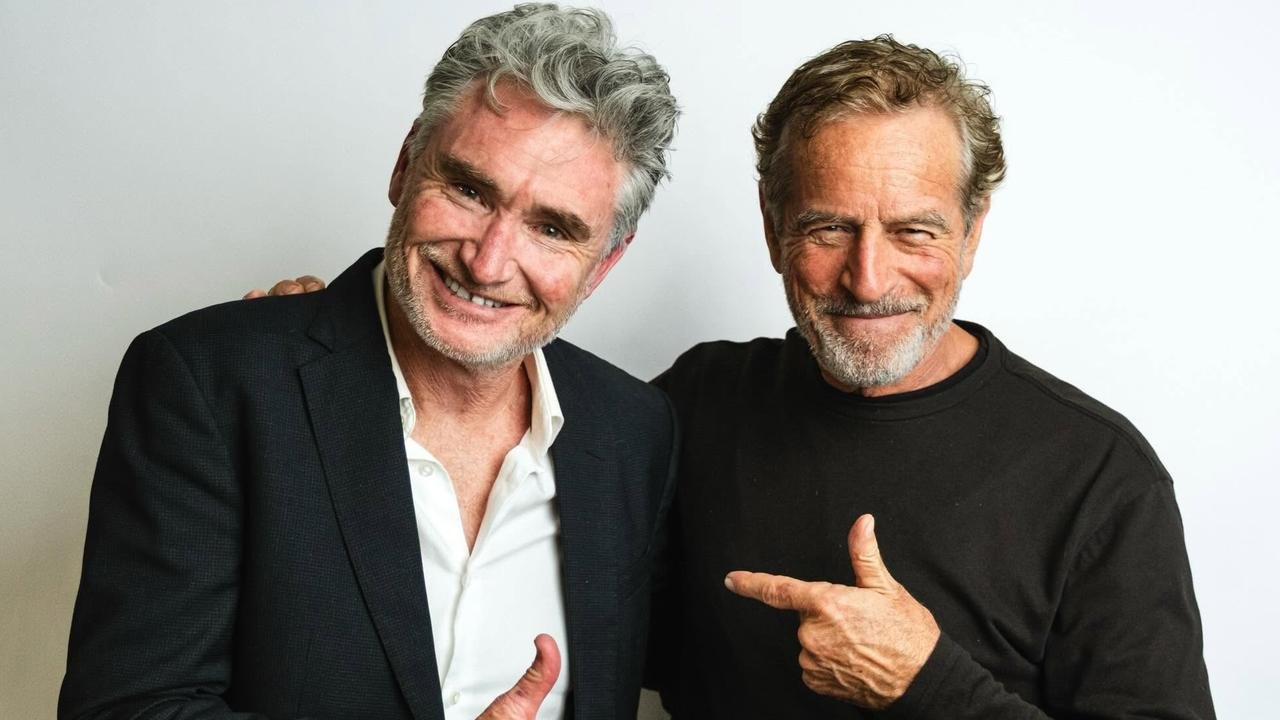
Comedian Dave Hughes has detailed his hair-raising experience buying shares with borrowed money in two companies that collapsed and how his bank called him to ask for its money back.
The 55-year-old has made headlines in recent weeks for posting daily videos on social media that have been highly critical of the Federal Government’s new tax changes.
Appearing on Mark Bouris’ Straight Talk podcast on Monday for a one-hour chat, Hughesy did not back down — describing the changes to the capital gains tax (CGT) as “insane” before revealing his own journey in buying shares.
He told Bouris he took a margin loan out from a bank to buy shares shortly before the Global Financial Crisis in 2008.
A margin loan is a type of loan that allows you to borrow money to invest in financial assets — most commonly shares or managed funds — using your existing portfolio or cash as security.
Essentially, it is a way to use leverage (borrowed money) to increase the size of your investment, magnifying both your potential gains and your potential losses.
“Just before the GFC, actually, I took a loan out from a bank,” Hughes said. “I thought, ‘What’s going on? I should get in the share market.’ And this bank I was with said, ‘Oh, you take a margin loan out… just pay the interest, you know, it’ll be fine and the share market goes up.’
“The GFC hit probably three months after I had spent a lot of money on shares. A lot of money. It hit big time. The bank was calling me wanting their money back. I’m like, ‘What the hell’s going on here?’”
Bouris explained how a margin loan works.
“You buy $100,000 worth of shares. The bank will lend you $50,000… But that’s based on the shares being a certain price,” he said. “Let’s say the shares are a dollar each. But if they go down to 50 cents, the bank says, ‘Well, we only want to lend you 50 per cent, so now you’ve got to pay us 50 per cent back straight away.’ Like in 20 days or whatever. So margin loans aren’t like a home loan. If the value of the asset goes down, you’ve gotta pay it back… You’ve always gotta keep the margin.”
Hughes said the bank kept calling him, demanding money.
“Luckily for me, I was able to do that because I was earning good money. So I was able to cover it,” he said. “But I was shell-shocked. Shell-shocked. And I decided never to leverage again — never to borrow where I could get in trouble again. I just decided that was the moment.”
He said the two shares he lost all his money on was ABC Learning, a major Australian child care provider that collapsed and went into voluntary administration in 2008.
The other stock he bought was Babcock & Brown Limited, a global investment and specialised fund management company that was tipped to be the ‘next Macquarie Bank’. It collapsed during the 2008 financial crisis and was delisted from the ASX in June 2009. The company’s shares are now considered worthless.
Hughes said he put money into the companies after reading about them in a magazine.
“I was able to pay off the margin loan, but I didn’t even look at my portfolio for, I reckon, four or five years. It just hurt me.”
However, when he checked his portfolio all those years later, he was in for a shock.
“I just went and had a look and it was above what it was. It had actually gone up,” he said. “I had bought realestate.com.au when it was like hardly anything, and oh my god, it had just gone up 100 times or something.
“That’s when I went back and looked at those shares — that’s when I fell in love with the share market. I said, ‘All right, there is money to be made. There is a way to build wealth here. I’m not ever going to do it through loans, but I’m going to do it through money I earn.’”
He has tried to pass on his experience to his kids, by encouraging them to invest from a young age. However, the upcoming changes to the CGT has made him reconsider his advice.
“I told my kids that. I said, ‘Guys, you go work a shift at Woolies, you might get $100. Buy, with 50 of that hundred, a BHP share. If you sit it there, it’ll grow in value and you will get to a point in your life where you don’t have to work because the money you’ve already earned will be working for you.’ That’s the lesson I wanted to teach my kids,” he said.
“My son now buys a $50 or $60 BHP share. If it doubles in value… he has to pay 30 per cent tax on the profits of that share. That is just discouraging any kid from building wealth. I just find that insane that this government would do that. It really offends me that they just think we all should be working for a wage and the most we could dream about is having a unit in Marrickville.”
He said he believed the country was run by people who have no idea how risk and reward is needed for people to become successful in the private sector.
“I feel like the government now is full of people who have never worked in the private sector and don’t understand the risk, or the reward, or the work,” he said.
“You need an incentive because you’re putting your balls on the line. The incentive is that if it works for you, you can get a gain out of it. To take half of it, to make it the biggest capital gains tax in the world… think that’s not something that strivers and people with ambition are going to be offended about?
“Albo doesn’t understand that’s the way to make money. He’s never done it. He’s made all his money off the government, just his income. He’s clearly never invested in shares. Clearly… And Chalmers, he’s just got a political science degree. He loves Paul Keating. He did his PhD on Paul Keating… He’s got no idea. No idea.”
He also teed off about the narrative that the government is shaking up the tax system to address intergenerational inequity.
“It’s ridiculous,” he said. “Every time they spend money, I think about my kids having to pay it off. The kids have to pay because the country has to pay interest. It’s a bit of a shame that we talk about intergenerational equity when we’re going to pass on to them a massive debt.”
He argued that there shouldn’t be any tax at all for anyone under $52,000 a year and the government should reign in spending.
“I think that is a way to boost the economy and to give people a chance to make their own way rather than the government taking like $12,000 of that $50,000 off them,” he said.
“Hardworking people are angry — no matter their ethnicity, or religion, or anything else. They’re angry because their life is really expensive for them now and they feel like the government aren’t taking it seriously. And there’s no clear pathway for them to get ahead.
“I’ve never had this in my life. Obviously, I’ve never been this political or this outspoken, but so many people every day are saying, ‘Thanks for speaking for us.’ Because they are under a lot of pressure.
“I want my children to have a great life in a great country, which is this country. Just stop spending. Stop wasting our money.”
He was also still furious about Labor not putting its tax changes to a vote.
“I voted for Albo and I like the guy. But then because he’d said he wasn’t going to change CGT… The CGT one, I think, was a real betrayal of the people,” he said. “You just shouldn’t lie to that degree. You can’t come out after a budget and say this is the biggest change to the tax system in 50 years… knowing that you have blatantly lied before the election, which was only 13 months ago.
“If you go to an election with this tax plan, you go to the election and say, ‘This is what we’re going to do,’ and then you get voted back in? I’m not whinging. I’m not saying anything. I’m disappointed, I’m shocked, but I’m not on this rant.
“It’s that it was a massive deception, and I can’t believe they think that’s okay. It’s not okay because you lose trust in the whole system. Yeah, you lose trust in democracy. Your vote’s worth nothing.”
He is also worried about the impact of the changes. He said a house came up for sale on his street and his neighbours asked if he was going to buy it. He said it wasn’t worth the hassle buying property any more.
“Anyone who knows anything about anything knows if you cut off 40 per cent of potential buyers — which they’ve done, maybe 50 per cent, because no one’s going to invest in property now, it’s just not worth it — you’ve cut half your market out,” he said. “So of course every property in Australia is worth less money, and you’ve lied about that repeatedly before the election. You’re going to cost people so much money and you’ve done it… and you see that so many of the government members have sold houses before it happened. Like, come on, guys, it’s not right.
“When you can’t trust the government, you don’t want to put money somewhere where they can affect it. And that’s what housing is now. We just can’t trust them. I think it’ll go down way lower than what they’re saying.”
You can listen to Mark Bouris Straight Talk on Spotify.