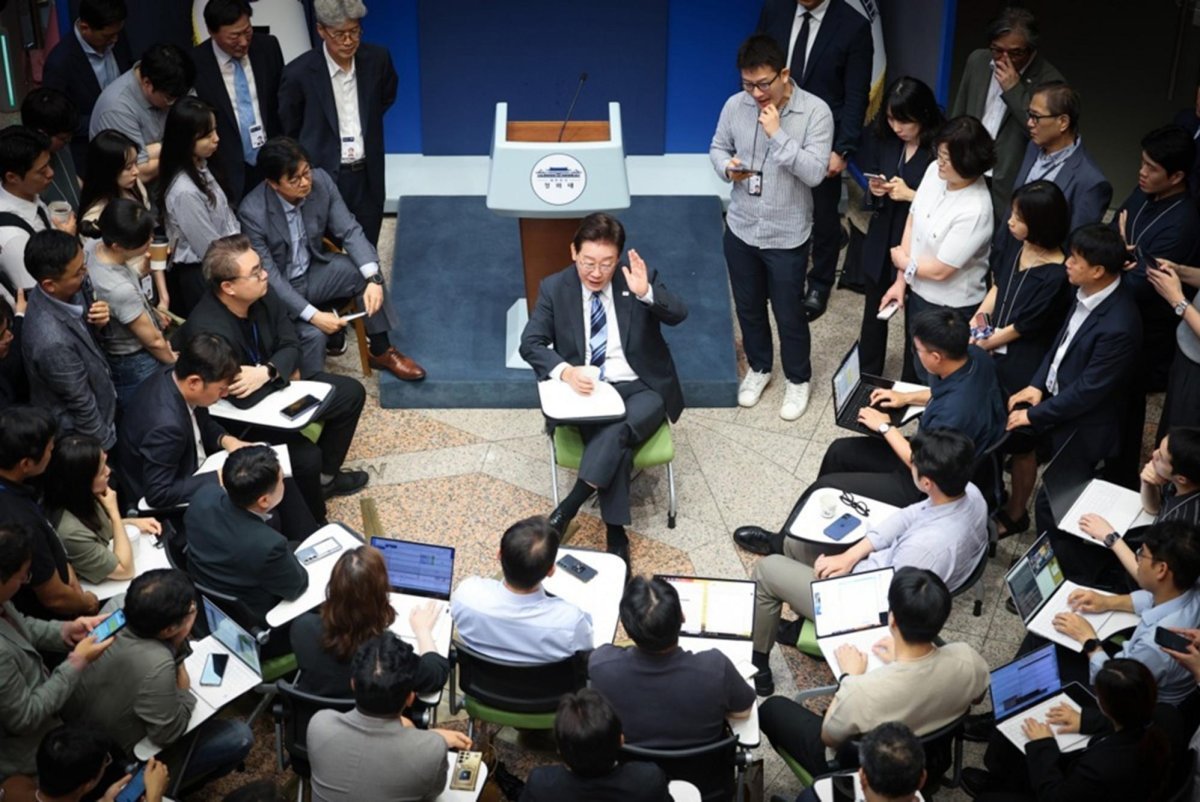
South Korean President Lee Jae Myung (C) attends a press conference with reporters covering him and the presidential office at Cheong Wa Dae in Seoul, South Korea, 15 July 2026. Photo by YONHAP / EPA
July 15 (Asia Today) — South Korean President Lee Jae Myung called Wednesday for faster passage of legislation intended to prevent controlling shareholders from deliberately depressing stock prices and questioned why the country had again failed to advance toward developed-market status at MSCI.
“Legislation, including the bill to prevent stock-price suppression, has not been passed and is being delayed,” Lee said. “Find a way to secure cooperation and move it forward quickly.”
Lee made the remarks during a government policy briefing at the Blue House guesthouse involving the Ministry of Finance and Economy, Financial Services Commission, Ministry of Planning and Budget, National Tax Service, Korea Customs Service, Public Procurement Service and National Data Agency.
“Normalizing the capital market is a very important national policy,” Lee said.
The proposed legislation is intended to address cases in which controlling shareholders allegedly keep a company’s share price artificially low to reduce inheritance taxes, lower the cost of transferring control or obtain other financial benefits.
Lee also asked why South Korea was not placed under consideration in June for inclusion in the MSCI World Index, a benchmark tracking developed equity markets.
“Our domestic stock market is quite unstable,” Lee said. “Because it rose by an extraordinarily large amount over such a short period, it needs time and some fluctuations before it can stabilize.”
“Inclusion in an index such as MSCI’s can help stabilize the stock market internationally, but it did not happen this time,” he said. “Why are we not making progress?”
Deputy Prime Minister and Finance and Economy Minister Koo Yun-cheol said the government was moving according to its own timetable.
“It is not that we are failing to make progress,” Koo said. “We have our own pace.”
“We are pursuing practical gains so that South Korea can join the MSCI developed-market index as soon as possible while considering both capital market stability and foreign exchange risks,” he said.
Asked to identify the biggest obstacle, Koo said international investors want the Korean won to be freely traded around the clock and want fewer restrictions on opening investment accounts.
“If we open the market all at once before we are prepared, it could have adverse effects on the foreign exchange market,” Koo said.
The government expects to complete a number of institutional improvements by early next year and pursue the matter more actively during 2027, he said.
Lee questioned whether the problem would be resolved merely by waiting.
“If that is the fundamental concern, is it an issue that will be resolved simply with the passage of time?” Lee asked.
Koo said the government expects to have safeguards and supporting systems in place by early next year.
South Korea remains classified by MSCI as an emerging market. MSCI has identified the limited offshore convertibility of the won as a major obstacle to a possible upgrade, along with other issues affecting the ability of international institutional investors to enter, trade in and exit the Korean market.
MSCI said in June it would continue monitoring the implementation of South Korean measures aimed at improving market accessibility for foreign institutional investors.
— Reported by Asia Today; translated by UPI
© Asia Today. Unauthorized reproduction or redistribution prohibited.
Original Korean report: https://www.asiatoday.co.kr/kn/view.php?key=20260715010005620